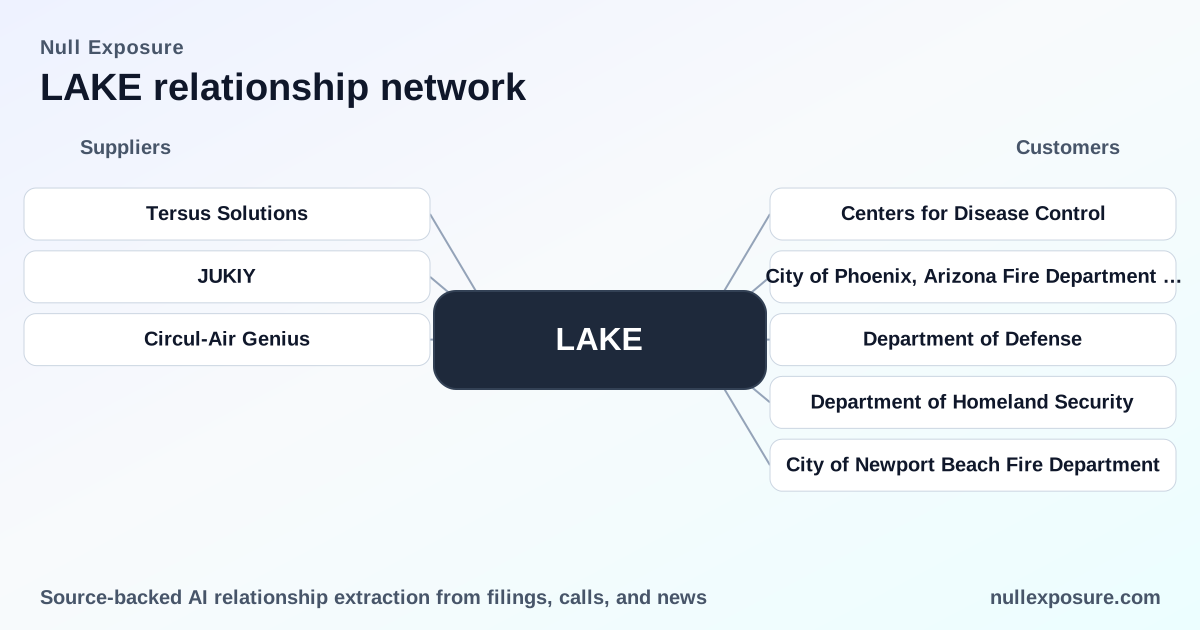
LAKE supplier relationships: where Lakeland sources critical PPE capacity and service
Lakeland (LAKE) operates as a global supplier and manufacturer of protective clothing and PPE, monetizing through direct product sales to institutional customers, recurring service and cleaning contracts, and facility-level technology partnerships that extend product lifecycle and service revenue. Recent supplier engagements underline a strategic shift toward on-site decontamination capability and in-house repair capacity, which supports higher-margin service contracts and reduces reliance on third-party laundries.
Learn more about relationship analytics and supplier exposure at https://nullexposure.com/.
Why these supplier ties matter for investors
Lakeland’s supplier network is not a back-office detail; it is a direct driver of product availability, margins, and customer retention. Equipment and technology partnerships—like long-term leases for cleaning systems and investments in sewing and extraction machinery—both lower operating risk and create recurring revenue opportunities through maintenance, consumables, and enhanced service offerings. Investors should value these ties not as peripheral procurement notes but as operational levers that affect gross margins and contract stickiness.
The supplier relationships in plain English
Below are the supplier relationships surfaced in the current review, each described in plain language with the primary source identified.
-
Tersus Solutions
Lakeland’s California PPE unit executed a long-term lease with Tersus Solutions to install a CO₂ advanced cleaning and decontamination machine at its Riverside, California facility, signaling a move toward in-house sophisticated decontamination capability. According to GlobeNewswire coverage in February 2026, the lease brings a new CO₂ system to the Riverside site and is positioned as a strategic upgrade to cleaning operations. (GlobeNewswire, Feb 19, 2026) -
Juki (JUKIY)
Lakeland’s facility equipment list includes commercial Juki sewing machines used for garment repairs, indicating on-site repair and refurbishment capacity that supports product lifecycle services and reduces turnaround time for institutional customers. This equipment detail was reported in a March 2026 business news piece referencing facility upgrades. (Bitget report, Mar 2026) -
Circul-Air Genius
The company has installed Circul-Air Genius extractors for advanced and specialized cleaning, reflecting investment in specialized cleaning infrastructure that complements the CO₂ decontamination lease and broadens the firm’s in-house processing capabilities. A March 2026 article highlighted Circul-Air Genius extractors among facility equipment additions. (Bitget report, Mar 2026)
What the relationships collectively signal about operating posture
Taken together, these supplier ties indicate a deliberate move to vertically integrate cleaning and repair operations at key U.S. facilities. That strategy generates several investor-relevant consequences:
- Higher service revenue potential. In-house decontamination and repair reduce outsourcing and create opportunities to package cleanup and maintenance with product contracts.
- Capital and lease commitments. Long-term equipment leases and capital-intensive systems increase fixed-cost leverage while improving operational control.
- Operational resilience. Reducing reliance on external laundries and repair shops lowers logistical risk and shortens lead times for high-priority institutional customers.
Company-level constraints and what they mean for risk and concentration
The supplier intelligence includes several company-level constraints that frame these relationships.
- Counterparty type: the firm uses more than 25 suppliers in the U.S. and internationally for key fabrics, which indicates a broad sourcing base rather than single-source dependency for textiles. This is a company-level signal of supplier diversification, from a March–FY2026 disclosure excerpt.
- Relationship role: Lakeland maintains manufacturing operations across Mexico, India, Argentina, New Zealand, and accesses independent contractors in China, Vietnam, Argentina, and Mexico, pointing to a hybrid in-house and outsourced manufacturing posture. This is a company-level indicator of geographically distributed production capacity.
- Segment: materials such as polypropylene and spun-laced polyester are available from 30 or more major mills, which reflects industrial maturity in the raw-material supply chain and reduces raw material scarcity risk for standard materials.
These constraints should be read as operational context rather than relationship-specific attributions: they support the view that Lakeland is a mature manufacturing operator with diversified supplier sourcing and growing in-house service capability.
Key investment implications and risks
- Upside: Increased capture of after-sales and cleaning revenue is a structural margin improvement. Owning in-house decontamination and repair lowers variable costs and improves service promise to large institutional accounts.
- Capital intensity: Long-term leases and specialized equipment introduce fixed-cost commitments that amplify earnings volatility if demand softens.
- Concentration watch: While material sourcing is diversified, critical equipment suppliers for in-house processing (e.g., CO₂ systems, extractors, sewing equipment) become higher-impact counterparties; disruptions to those specific technology providers could create short-term operational stress.
- Operational execution is critical. The strategic benefit depends on efficient deployment and robust maintenance regimes for the new equipment.
Mid-article action point
For a deeper read on how supplier contracts translate to balance-sheet risk and service revenue capture, visit https://nullexposure.com/.
Tactical observations for operators and procurement teams
Operators should prioritize integration of maintenance workflows and spare-parts inventories for the CO₂ system, extractors, and sewing machines to realize the intended uptime gains. Procurement teams need to track service-level agreements with these equipment providers because service-quality and after-sales support will determine whether capital investments convert into higher margins or into downtime costs.
Bottom line and recommended next steps for investors
Lakeland’s recent supplier moves are strategic and management-led: they emphasize operational control, higher-margin service offerings, and reduced reliance on external laundries. Monitor near-term capital expenditure disclosure and any comments on utilization of the Riverside facility; these will be the clearest signals that the company is converting equipment leases into sustainable revenue. For ongoing tracking of supplier exposure and relationship-level impact, reference the supplier profiling resources available at https://nullexposure.com/.
A practical investor checklist:
- Watch capex and lease disclosures tied to equipment installations.
- Confirm service revenue growth in subsequent quarters and margin trends.
- Evaluate spare-parts and maintenance commitments from equipment vendors.
Investors evaluating LAKE should treat these supplier relationships as material operational assets that affect both margin structure and operational risk.