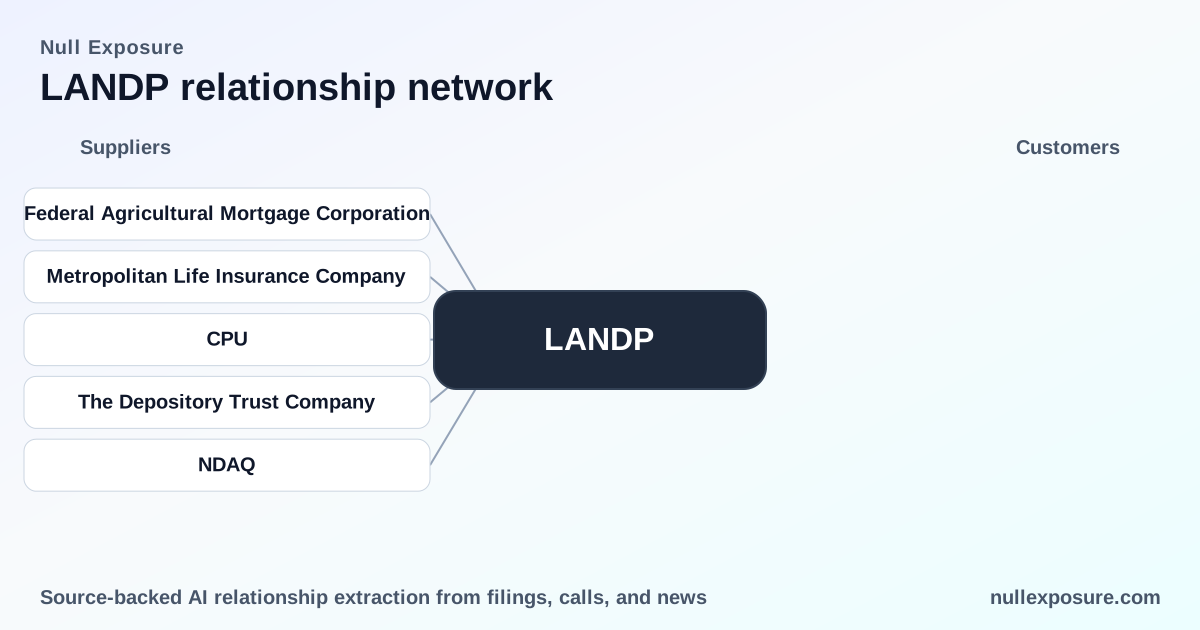
LANDP supplier relationships: the financing, custody and market plumbing that drive capital access
Gladstone Land Corporation (LANDP) operates as an owner and manager of farmland and related water assets, monetizing primarily through rental income, selective land sales and structured financing lines that support portfolio acquisition and liquidity. The company's operating model relies on a small number of credit counterparties for capital, third‑party service providers for corporate and securities administration, and exchange / custody systems for market access and liquidity events. For investors assessing counterparty risk and operational continuity, the balance between long‑term credit facilities and standard market plumbing is the defining profile.
If you want a concise counterparty map and risk lens for underwriting or vendor diligence, visit https://nullexposure.com/ for a structured supplier view.
How funding and market plumbing are arranged in practice
Gladstone Land layers its funding with both revolving equity lines and multi‑year term notes while outsourcing administration and securities handling to established providers. This structure keeps operating leverage predictable and concentrates credit exposure into a few named relationships, but retains market standard service nodes for custody and redemption activity. The net effect: capital availability is concentrated and operational execution depends on external administrators and market infrastructure.
What the public records show — relationship-by-relationship
MetLife: a formal, multi-piece credit facility
Gladstone Land’s FY2024 Form 10‑K documents a structured financing package with Metropolitan Life Insurance Company that includes $75.0 million of revolving equity lines of credit, a $75.0 million long‑term note (2020 MetLife Term Note) and a $100.0 million long‑term note (2022 MetLife Term Note), collectively the MetLife Facility. This is a long‑term, committed credit relationship that represents core capital capacity for the business. (Source: FY2024 Form 10‑K filing).
Federal Agricultural Mortgage Corporation (Farmer Mac): secured note purchase facility
The company discloses a secured note purchase facility arranged with Federal Agricultural Mortgage Corporation and Farmer Mac Mortgage Securities Corporation (the Bond Purchaser), referred to as the Farmer Mac Facility in the FY2024 10‑K. This provides an alternative secured funding line tied to agricultural finance markets and adds diversification to the company’s funding mix. (Source: FY2024 Form 10‑K filing).
Computershare: redemption agent for preferred stock
In a March 10, 2026 disclosure, Gladstone Land announced that Computershare acted as the redemption agent for the Company’s Series D Preferred Stock; Computershare was responsible for payment processing to DTC in the redemption transaction. Computershare’s role is operational and transactional — it executes corporate actions but does not carry credit exposure to the issuer. (Source: company redemption notice published via Yahoo Finance, March 10, 2026).
The Depository Trust Company (DTC): book‑entry custody for preferreds
The Series D Preferred Stock is held in book‑entry form at The Depository Trust Company and the March 2026 redemption was processed in accordance with DTC procedures. DTC provides the custody and movement backbone for securities; disruption or changes in DTC procedures would affect the mechanics of redemptions and transfers. (Source: company redemption notice published via Yahoo Finance, March 10, 2026).
The Nasdaq Global Market: listing and delisting mechanics
In connection with the Series D redemption the company stated the Series D Preferred Stock would be delisted from The Nasdaq Global Market. The exchange relationship defines market access and liquidity for the security; delisting actions alter secondary market availability and related investor liquidity. (Source: company redemption notice published via Yahoo Finance, March 10, 2026).
Operating constraints and what they imply about the business model
- Long‑term credit posture is baked into financing strategy. The MetLife Facility is explicitly structured with multiple long‑term notes and revolvers, indicating a preference for committed multi‑year debt that supports acquisition cadence and reduces refinancing frequency (constraint excerpt naming MetLife is contained in the FY2024 10‑K).
- Global IT and security monitoring is present as a company‑level operational posture. The company states it operates as an international service provider with continuous monitoring of IT risk and cybersecurity threats, so operational resilience and third‑party IT controls are enterprise priorities (company‑level signal).
- The company is structured to outsource management and administration. Filings indicate use of an external Adviser and Administrator to manage the real estate portfolio and provide administrative services, which positions the business as asset‑owner rather than integrated operator and creates vendor concentration in advisory/admin services (company‑level signal).
- Spend profile shows both mid‑sized liquidity moves and smaller tactical asset purchases. From FY2024 disclosures the company repaid roughly $53.0 million of loans (indicative of $10M–$100M scale cash flows) while also spending roughly $2.1 million to secure water assets — demonstrating both large debt management events and selective small‑ticket asset purchases within the same fiscal window (company‑level signals).
Risk and opportunity: what investors should weigh
- Concentration risk in credit counterparties is material but manageable. With large committed facilities from MetLife and an additional secured facility via Farmer Mac, funding is concentrated into a few counterparties; however, the existence of multiple facility types provides structural diversity across credit markets.
- Operational criticality sits with administrators and market infrastructure. Computershare and DTC are standard industry providers; their roles are operationally critical but not credit‑bearing. Operational failure or process friction (e.g., custody or redemption processing) would be the primary source of non‑credit risk.
- Liquidity events are discrete and visible. The March 2026 Series D redemption and Nasdaq delisting provide a clear example of lifecycle management of listed securities — the company executes structured buybacks/redemptions through recognized agents and de‑listing when appropriate, which reduces open market complexity for holders.
- Maturity profile is intentional and supports strategic acquisitions. The long‑term nature of MetLife notes aligns with an asset class that is capital intensive and slow to rotate; this supports steady rental income capture and measured land purchases.
If your due diligence requires a mapped supplier profile and counterparty scorecard, a consolidated view is available at https://nullexposure.com/.
Conclusion: a concentrated financing backbone with market‑standard operational partners
Gladstone Land’s supplier ecosystem is characterized by concentrated, long‑term credit relationships that provide funding predictability, paired with industry‑standard operational providers for securities processing and corporate actions. For investors, the primary credit exposure warrants focused counterparty monitoring of MetLife and Farmer Mac facilities, while operational diligence should focus on administrative arrangements and custody mechanics. The company’s structure favors predictable capital access over operational vertical integration.
For a vendor‑level map and to compare these counterparties across peers, visit https://nullexposure.com/ today.