Landmark Bancorp (LARK): Funding Partnerships and What Investors Should Price In
Landmark Bancorp operates as a regional financial holding company that monetizes through traditional community-banking activities—net interest margin on loans funded by deposits and wholesale borrowings, fee income from mortgage and payment services, and occasional mortgage sales. The company offsets deposit volatility with Federal Home Loan Bank (FHLB) advances to sustain loan growth and preserve margin, creating a funding profile that is as much about liquidity management as it is about credit selection. For a direct review of supplier exposure and related counterparty links, consult https://nullexposure.com/.
Small bank, high funding sensitivity — a quick financial snapshot
Landmark is a compact, low-beta regional bank with market capitalization around $156 million and a trailing P/E of 8.7. The bank delivers solid profitability metrics for its size — profit margin ~27% and return on equity ~11.7% — while trading below book at a price-to-book near 0.94, which signals investor caution on either earnings sustainability or funding/asset risk. These valuation cues matter for supplier diligence because smaller regional banks are more likely to lean on committed credit lines and central liquidity facilities when deposits ebb. If you are modeling downside scenarios or counterparty concentration, start with the bank’s funding mix and borrowing behavior. Learn more on supplier relationships at https://nullexposure.com/.
How Landmark uses the Federal Home Loan Bank — the operational reality
Landmark increased FHLB borrowings by $105.9 million to offset deposit outflows and fund loan growth, according to a company press release reported by The Globe and Mail on March 10, 2026. This is a straightforward commercial funding decision: the bank presses an established liquidity facility to bridge shortfalls and support earning asset expansion. The Globe and Mail coverage reported the borrowing increase as a deliberate funding action tied to loan growth in FY2025.
The company’s own disclosures also identify deposits and FHLB borrowings as primary ongoing sources of funds, signaling that FHLB advances are a recurring, not ad hoc, component of Landmark’s funding architecture. That disclosure elevates FHLB from a contingency backstop to an integrated funding partner for the bank.
What that relationship implies for contracting posture, concentration, criticality and maturity
- Contracting posture: Landmark behaves as a borrower that accesses short- to medium-term advances; the posture is tactical and liquidity-driven rather than equity-like capital. FHLB advances are standard bank facilities with defined terms and collateral requirements.
- Concentration: With public evidence of a $105.9 million increase in FHLB borrowings, counterparty concentration risk is real for funding lines. For a bank of Landmark’s size, sizeable draws on a single wholesale source can alter liquidity risk profiles materially.
- Criticality: The FHLB relationship is highly critical to operational continuity during deposit stress, per the company’s disclosure that lists FHLB borrowings among primary funding sources.
- Maturity: The relationship has the character of a mature, conventional bank-to-FHLB counterparty link — established, contractually governed, and collateralized — rather than a nascent or contingent facility.
Funding and margin consequences you should model now
Using wholesale advances to fund loan growth preserves earning asset momentum and supports near-term net interest income, but it also compresses liquidity buffers and creates rollover and collateral-management exposures. Investors should value the trade-off: higher loan-driven earnings versus increased wholesale funding dependency and potential margin sensitivity if wholesale spreads widen. Stress scenarios should consider deposit run rates, FHLB collateral eligibility, and the potential requirement to substitute higher-cost funding.
Counterparty and operational risk — sharper points for due diligence
- FHLB advances are low credit-risk in isolation, but operational and covenant execution matters: mismanaged collateral, margin requirements, or covenant breaches can force rapid balance-sheet adjustments.
- As a small regional bank, Landmark’s ability to substitute funding sources quickly is limited, increasing execution risk if access to FHLB advances tightens.
- The company also references the use of third-party technology and service providers to maximize deposit growth, indicating reliance on external vendors for customer acquisition and deposit stability — a company-level signal that complements the FHLB funding story.
Every supplier relationship in the public record
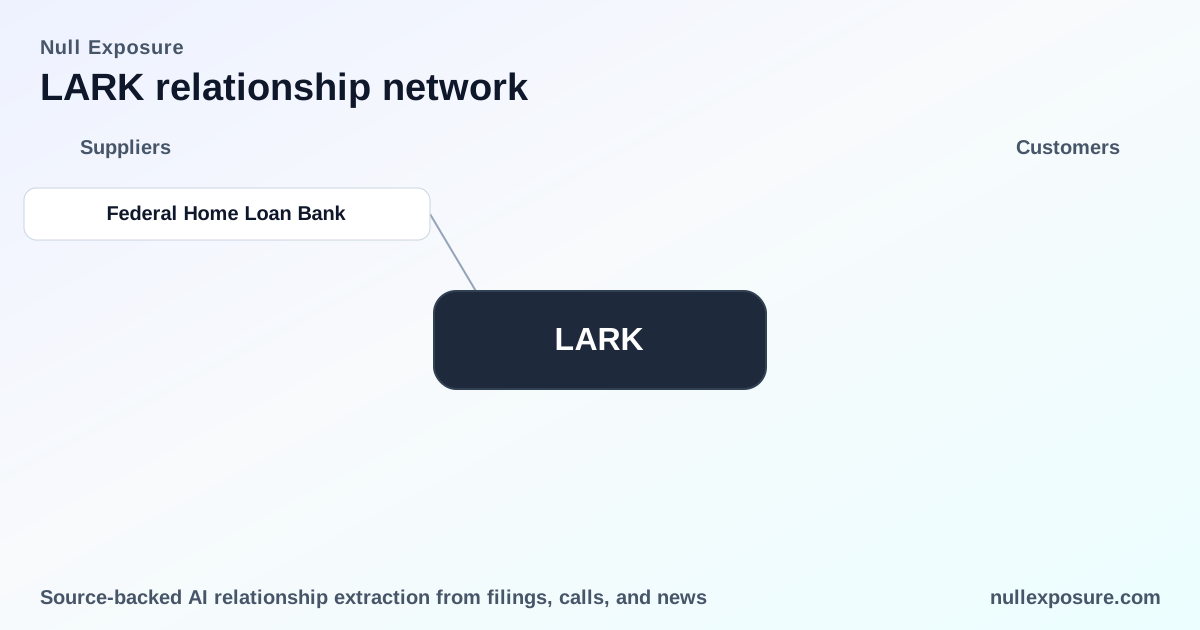
Federal Home Loan Bank — Landmark increased FHLB borrowings by $105.9 million to offset deposit outflows and fund loan growth, illustrating a material and active funding relationship; The Globe and Mail reported this action on March 10, 2026. According to the bank’s own disclosures, FHLB borrowings are listed among the company’s primary ongoing sources of funds, confirming the facility’s centrality to Landmark’s funding mix (press coverage and company disclosures, FY2025 / March 2026).
Practical due-diligence questions for investors and operators
- What is the current size and structure of Landmark’s FHLB lines, and what collateral is pledged against them?
- How frequently does the bank use these advances during normal cycles versus stress events?
- What covenants, margin calls, or eligibility rules could force deleveraging if deposit runs accelerate?
- How quickly can Landmark replace FHLB funding with alternate sources — unsecured lines, broker deposits, or equity — and at what cost?
- What vendor- or technology-linked dependencies support deposit retention, and how do outages or vendor failures propagate into funding stress?
Final read for investors
Landmark’s use of the Federal Home Loan Bank is a deliberate funding strategy that materially influences liquidity, margin, and balance-sheet flexibility. For investors and operators evaluating counterparty or supplier risk, the FHLB relationship is not peripheral — it is central to how the bank funds growth and manages deposit volatility. For an organized review of supplier connections, risk indicators, and related signals, visit https://nullexposure.com/ for a concise vendor and funding map.
Bold action point: incorporate FHLB borrowing scenarios into your funding-stress models and monitor collateral eligibility and covenant language closely; these elements determine whether funding lines are a stable backstop or a potential source of forced asset sales.