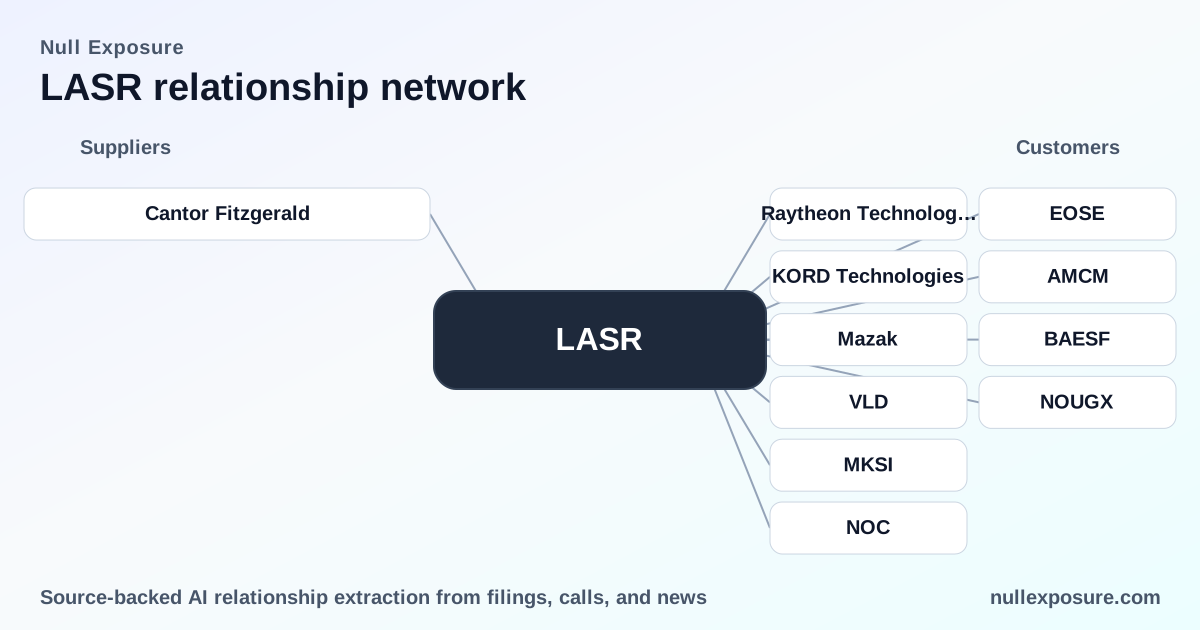
nLIGHT (LASR): Supplier relationships and operating signals for investors
nLIGHT designs, develops and sells fiber and semiconductor lasers across industrial, microfabrication, aerospace and defense end markets and monetizes through direct product sales and OEM/contract-manufacturing relationships. The company funds growth through periodic equity and capital-market transactions and services defense and commercial customers with both in-house and third‑party manufacturing. For investors evaluating supplier exposure, the critical facts are nLIGHT’s short-term procurement posture, explicit APAC contract-manufacturing footprint, and active capital-market access evidenced by underwriter relationships.
Explore more supplier insights at https://nullexposure.com/.
What the business model looks like in practice
nLIGHT’s revenue base is product-driven: Revenue TTM of $261.3m with gross profit of $77.96m reflects a manufacturer that still carries negative net profitability on an EPS basis (-$0.47 diluted EPS). The business is capital-intensive and cycle-sensitive—investors should expect episodic working capital and financing events as the company scales defense and commercial laser programs. Institutional ownership is high at ~83%, signaling professional investor interest and scrutiny.
Valuation and market signals are aggressive: Price-to-Sales ~14.6 and EV/Revenue ~14.25, with a wide trading range over 52 weeks ($6.20–$71.35) and a Beta of 2.34, indicating equity volatility consistent with growth-oriented industrials and semiconductor suppliers. Analysts collectively skew positive (consensus target $73.50 and multiple buy/strong-buy recommendations), which aligns with recent capital raises and strategic expansion into defense lasers.
The underwriting relationship you need to know
- Cantor Fitzgerald — nLIGHT added Cantor Fitzgerald as a co‑lead underwriter on an equity raise in FY2026, underscoring strong access to capital markets and active financing capability to fund growth and defense expansion. According to industry reporting in March 2026, the deal used an existing shelf registration and these underwriting terms point to ready financing channels for execution and R&D push (Simply Wall St, March 10, 2026; Sahm Capital, Feb 6, 2026).
Source: https://simplywall.st/stocks/us/tech/nasdaq-lasr/nlight/news/nlight-equity-raise-fuels-defense-laser-expansion-and-execut and https://www.sahmcapital.com/news/content/nlight-equity-raise-fuels-defense-laser-expansion-and-execution-focus-2026-02-06
What the supplier/contract constraints tell you about operational risk
nLIGHT’s disclosures and the extracted constraints indicate three company-level signals that materially shape supplier risk and operating leverage:
-
Short-term contracting posture. The company procures materials primarily via purchase orders and agreed-upon terms rather than long-term guaranteed supply contracts; nLIGHT does not maintain guaranteed supply arrangements with many suppliers. This procurement style reduces fixed supplier commitments and increases flexibility, but it also elevates exposure to market tightness, lead-time volatility, and price risk during demand spikes. (Company disclosures.)
-
APAC manufacturing footprint. nLIGHT uses a third‑party contract manufacturer located in Thailand to package certain semiconductor lasers for commercial applications. This creates concentrated geographic exposure in APAC for a critical packaging step and introduces geopolitical, logistics, and regional labor-cost considerations into supplier risk. (Company disclosures referencing Thailand contract manufacturer.)
-
Manufacturer / contract-manufacturing reliance. Outsourcing packaging and select manufacturing functions to third parties signals a hybrid operating model—nLIGHT maintains core design and higher-value manufacturing while leveraging external partners for scale and cost efficiency. That reduces capital intensity of expansion but increases dependency on partner performance and quality control.
Taken together, these constraints point to an operating model that is asset-light at scale for some product lines, but dependent on short-term procurement and a critical APAC contract-manufacturing node. Investors should treat supply-chain continuity and contract-manufacturer performance as operational risk drivers for revenue realization and margin stability.
How those characteristics affect investor decisioning
- Concentration risk: The Thailand packaging partner is a single geographic node for semiconductor packaging; disruptions there would have outsized effects on certain product deliveries and revenue timing.
- Contracting leverage: Short-term supplier contracts give nLIGHT flexibility but reduce downside protection against input shortages; in tight markets this translates directly to delayed shipments and margin pressure.
- Capital access mitigates near-term liquidity risk: The Cantor Fitzgerald-backed equity raise in FY2026 demonstrates active capital-market access, which reduces immediate liquidity concern when the company needs to fund capacity expansion or buffer working capital.
If you are evaluating supplier counterparty risk for operations or investment, these are the actionable dimensions: supply concentration in APAC, short-term purchase posture, and demonstrated ability to refresh capital through underwriters.
Relationship roll call — what the data shows, relationship by relationship
- Cantor Fitzgerald — nLIGHT engaged Cantor Fitzgerald as co‑lead underwriter on an FY2026 equity raise, signaling ready market access to fund defense-laser expansion and execution initiatives. Reporting notes the use of an existing shelf registration and the addition of Cantor as co‑lead underwriter (industry press, Feb–Mar 2026).
Source: https://simplywall.st/stocks/us/tech/nasdaq-lasr/nlight/news/nlight-equity-raise-fuels-defense-laser-expansion-and-execut and https://www.sahmcapital.com/news/content/nlight-equity-raise-fuels-defense-laser-expansion-and-execution-focus-2026-02-06
(These are the relationships identified in the supplier-scope results; other partner names are not disclosed in the supplied extraction.)
Practical signals for portfolio managers and operators
- For portfolio allocation, treat nLIGHT as a growth industrial with high operational leverage and elevated execution risk tied to supply-chain continuity; valuation multiples reflect growth expectations rather than near-term profitability.
- For ops and sourcing teams evaluating supplier contracts, prioritize dual-sourcing strategies for APAC packaging functions and consider negotiating longer-term supply agreements for critical input categories to reduce shipment risk.
- For corporate development or M&A counterparties, the underwriter relationships and access to capital imply nLIGHT can pursue inorganic moves or capex-funded scaling without immediate refinancing distress.
Learn how to integrate supplier intelligence into credit and counterparty models at https://nullexposure.com/.
Bottom line and next steps
nLIGHT’s business is a classic technology-manufacturing hybrid: engineered product sales levered to a mix of in-house and third-party manufacturing, with short-term procurement and concentrated APAC packaging risk. The FY2026 equity raise with Cantor Fitzgerald demonstrates capital-market support, which materially affects near-term execution risk and strategic optionality. Investors should weight growth prospects against supply-chain concentration and short-term contracting exposure when sizing positions.
For a deeper supplier-profile and to map counterparty exposure across your portfolio, start with the NullExposure platform: https://nullexposure.com/.