LBDAV Supplier Relationships: Charter, Advisory, and Legal Counsel — What Investors Need to Know
Liberty Broadband (LBDAV) operates as a strategic investment vehicle that monetizes through sizable equity stakes in communications and media companies, most prominently Charter Communications, and through structuring acquisitions and share purchases that concentrate economic exposure to broadband growth. Its revenue and value drivers flow from ownership economics in underlying operating companies rather than operating revenues generated by Liberty itself. For detailed supplier and counterparty profiles, visit the NullExposure homepage.
High-level view: who LBDAV contracts with and why it matters
Liberty Broadband’s supplier and counterparty map is dominated by strategic equity partners and professional advisers rather than operating vendors. That profile signals a corporate posture focused on negotiated equity transactions, advisory relationships for deal execution, and external legal counsel for transaction governance. This structure produces concentrated counterparty risk tied to a small number of large counterparties and elevated reliance on financial and legal advisers during transactional windows.
The explicit relationships surfaced in public coverage
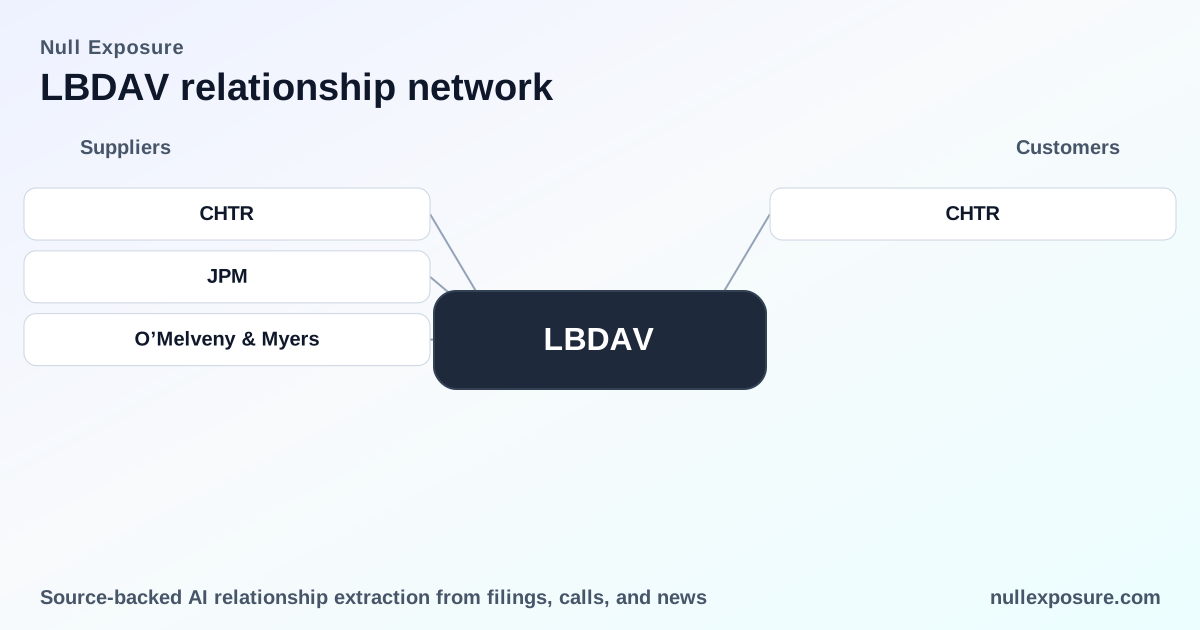
Below are the relationships found in the public record for the supplier scope and what each implies for a sophisticated investor.
Charter — large strategic equity counterparty
Liberty Broadband agreed to purchase newly issued Charter shares tied to the Charter–Time Warner Cable transaction, including a $700 million tranche at a price equivalent to $173 per share as part of the broader deal activity in FY2015. This is a direct equity commitment that increases Liberty’s exposure to Charter’s operating performance and strategic decisions. According to reporting on the 2015 transaction, Liberty Broadband committed this capital in connection with the Charter–Advance/Newhouse transaction (Patch, FY2015).
New Charter — committed post-transaction equity purchaser
In connection with the Time Warner Cable deal, Liberty Broadband also agreed to purchase $4.3 billion of newly issued shares of New Charter at a price equivalent to $176.95 per share, reflecting an explicit, large-scale recapitalization position established contemporaneously with the transaction close. That commitment demonstrates Liberty’s strategy of capturing scale exposure through primary share issuances tied to major industry consolidations (Patch, FY2015).
J.P. Morgan — exclusive financial adviser for deal execution
J.P. Morgan served as Liberty Broadband’s exclusive financial adviser in the referenced transaction, indicating Liberty’s reliance on top-tier investment banking capabilities to structure and execute complex equity commitments and mergers. This advisory relationship concentrates execution risk and value capture in a single lead banker during deal negotiations (TVTechnology, FY2024).
O’Melveny & Myers — legal counsel for transaction governance
O’Melveny & Myers provided legal counsel to Liberty Broadband, supplying the legal structuring and documentation capacity necessary to close equity purchases and manage regulatory and contractual risk. For investors, this underscores Liberty’s practice of deploying external, experienced law firms for governance and compliance in high-stakes transactions (TVTechnology, FY2024).
What these relationships tell you about Liberty Broadband’s operating model
These supplier ties collectively reveal several company-level signals about Liberty Broadband’s business model and contracting posture:
- Contracting posture: transaction-driven and negotiated. Liberty negotiates large, bespoke equity purchases and relies on contractual commitments rather than recurring vendor engagements. That implies concentrated negotiation cycles and elevated importance of deal timing and terms.
- Counterparty concentration is high. The business model concentrates exposure in a small number of material counterparties — most notably Charter/New Charter — which makes Liberty’s value sensitive to the commercial and operational outcomes of those entities.
- Criticality of advisers during execution. The exclusive use of a lead financial adviser and established legal counsel for material transactions makes those advisory relationships operationally critical during deal windows.
- Maturity profile: strategic investor rather than operating company. Liberty’s maturity is reflected in repeatable capital commitment patterns and use of professional advisers, indicating a stable, institutional approach to equity ownership as the core value driver.
No supplier-specific operational constraints were disclosed in the reviewed materials; the absence of explicit constraints is itself a signal that Liberty relies on contractual commitments and external professional services rather than in-house transactional execution.
Investor implications: risks and upside to weigh
Liberty Broadband’s relationship posture creates a compact risk–reward profile:
- Upside: Direct, large-scale equity positions in Charter/New Charter deliver leveraged exposure to broadband market growth and consolidation-driven value creation. These are strategic, value-accretive moves when the underlying operator executes.
- Risks: High counterparty concentration increases sensitivity to Charter’s operational performance, capital allocation, and regulatory environment. Reliance on a single lead financial adviser during deals concentrates execution risk.
- Governance/Execution: Use of established external legal counsel reduces documentation and regulatory risk in transactions, but does not eliminate commercial exposure once equity is committed.
Key checklist for underwriters and operators evaluating supplier relationships:
- Confirm the legal and financial adviser appointments and their exclusivity terms for any upcoming deals.
- Stress-test the counterparty exposures under downside scenarios for Charter’s revenue and cash flow.
- Assess liquidity and funding mechanisms that support large primary share purchases in concentrated capital calls.
For a deeper review of counterparties and supplier exposures, consult the NullExposure homepage.
Tactical recommendations for investors and operators
- Maintain active monitoring of Charter’s operating KPIs and regulatory developments; Liberty’s equity returns are driven by that operator’s performance.
- Pressure-test advisory arrangements in future transactions; evaluate whether single-adviser exclusivity is optimal for price discovery and execution.
- Codify contingency plans for counterparty concentration risk, including hedges, staggered commitments, or co-investor frameworks where feasible.
Bottom line and next steps
Liberty Broadband monetizes through concentrated equity ownership and transaction-driven capital commitments. Its supplier footprint is small, strategic, and centered on Charter as the principal operating exposure, with J.P. Morgan and O’Melveny & Myers serving as execution partners in material deals. Investors should treat Liberty as a financial holding with concentrated counterparty risk and high dependence on successful integration and performance of its underlying holdings.
For more granular supplier intelligence and to track changes in Liberty’s counterparty map, visit the NullExposure homepage.