Liberty Broadband (LBRDK): Supplier Relationships, Contract Posture, and Operational Risk for Investors
Liberty Broadband operates and monetizes primarily as a cable operator and investment holding company, deriving revenue from subscription services for video, Internet and voice to residential and small-to-medium business customers, alongside returns from strategic equity holdings. The company’s cash flow profile is subscription-driven, augmented by asset-level financing and intercompany service arrangements, which together determine supplier commitments and operational dependencies. For investors assessing counterparty risk and supplier concentration, this note dissects the supplier footprint disclosed in public filings and extracts the contract characteristics that matter for valuation and operational continuity.
Explore supplier relationships and risk profiles at https://nullexposure.com/.
Quick investor thesis: how Liberty Broadband makes money and where suppliers matter
Liberty Broadband generates recurring revenue from customer subscriptions and holds material investments that influence consolidated leverage and liquidity. Suppliers and service providers influence content licensing costs, network access arrangements, and core IT/cybersecurity operations — each of which can be a lever on margins or a point of operational concentration. The company’s financial statements show approximately $1.016 billion in trailing revenue and $171 million in EBITDA, underscoring that supplier costs and debt/financing posture are relevant to near-term cash flow and strategic optionality.
What the filings show about supplier relationships
Liberty Broadband’s disclosures emphasize two classes of supplier interactions: carrier/network partners referenced in operating-company disclosures, and third‑party service providers used for operations and cybersecurity. The public record lists one identified third‑party carrier relationship in the FY2025 filing and several company-level contract and financing characteristics that shape supplier risk.
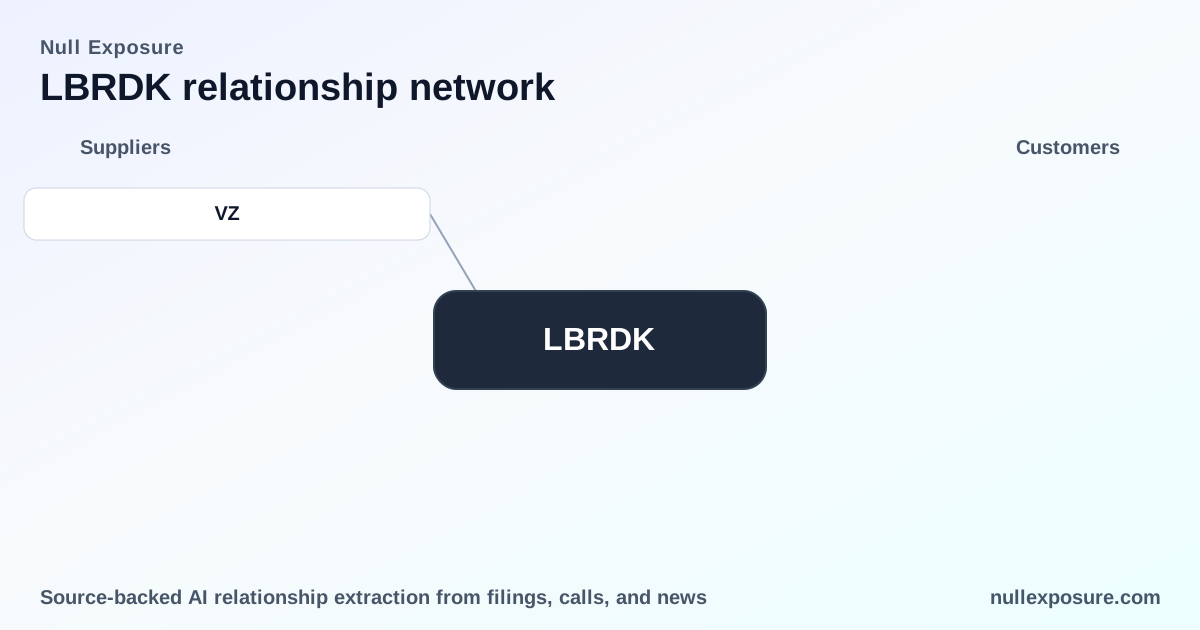
The carrier relationship investors should note: Verizon
- Liberty Broadband’s FY2025 filing references Verizon as the underlying wireless network used by a related cable operator’s MVNO offering. Specifically, the 2025 Form 10‑K states that “Charter provides this service as a mobile virtual network operator (MVNO) using Verizon’s network and its network through Spectrum WiFi and CBRS.” This ties Verizon to mobile access used by the operating cable business referenced in Liberty’s filing and is the sole explicit supplier entity disclosed in the supplier results. (FY2025 10‑K)
Takeaway: Verizon functions as the underlying network provider for MVNO services described in Liberty’s filing, representing a network-access dependency for related cable operations.
Company-level constraints that shape supplier and counterparty risk
The filings contain several explicit contract and financing snippets that are best read as company-level signals — they describe the nature and maturity of obligations that affect supplier negotiating posture, concentration, and time horizon.
-
Licensing-based commercial posture. The filing documents that programming is typically made available to Charter for a license fee calculated by the number of customers receiving that programming. This signals a variable, volume‑based licensing model that links content supplier payments directly to subscriber counts and therefore to churn and growth dynamics. (Licensing excerpt in FY2025 filings)
-
Mixture of long-term financing with fixed maturities. The company discloses outstanding borrowings under a Margin Loan Agreement ($790 million as of December 31, 2025) with a stated maturity (June 30, 2027) and available capacity. This demonstrates longer-dated financing commitments that constrain optionality but provide runway, and it explains why some supplier contracts may be structured with multi-year terms to match financing timelines. (FY2025 financial notes)
-
Near-term debt classification and put/exchange features. Certain debentures (3.125% due 2053) are classified as current because holders can exchange or put them in a specified near window, flagging short-term liquidity and covenant sensitivity that can increase pressure on vendor payment terms or require renegotiation of supplier agreements. (FY2025 financial notes)
-
Reliance on third‑party service providers for operational functions and cybersecurity. The company states that it utilizes third‑party vendors for a variety of operational functions and has a third‑party risk management program to evaluate cybersecurity practices for higher‑risk vendors; additionally, some corporate IT and cybersecurity functions are delivered via a services agreement described at the corporate level. This points to operational criticality concentrated in a small group of vendors and internal service agreements and signals the need for continuous vendor oversight. (FY2025 Business section)
Operational implications: contracting posture, concentration, criticality, maturity
Combine the above signals into investor-relevant constraints on the business model:
-
Contracting posture: Liberty’s supplier economics include licensing and volume-based fees, which align supplier incentives with subscriber growth but also transmit downside when churn increases. Licensing deals typically push variable cost exposure onto Liberty’s P&L as subscriber counts move.
-
Concentration: The explicit identification of Verizon in the filing — framed as the network underlying MVNO services — plus stated reliance on a limited set of third-party providers for IT and security suggests concentration risk in both network and service tiers. For operators, a small number of critical vendors increases operational leverage and transition costs.
-
Criticality: Core functions (network access for MVNO services; IT and cybersecurity) are critical to customer-facing operations and regulatory compliance, implying that supplier disruptions would have immediate revenue and reputational consequences.
-
Maturity and timing sensitivity: The mix of longer-dated margin loans and near-term debenture features shows collisions between medium-term financing covenants and short-term liquidity events, which can compress negotiating flexibility with suppliers — especially if short-term debt reclassification tightens liquidity metrics.
Relationship summary (complete coverage)
- Verizon (VZ): The FY2025 10‑K references Verizon as the network used by a related operator’s MVNO offering — Verizon is the underlying wireless carrier for MVNO services noted in the filing. This establishes a supplier role for network access in Liberty’s operating disclosures. (FY2025 10‑K)
What investors should watch next
-
Contract renewals and licensing terms: Monitor filing disclosures and press releases around programming license renewals and MVNO or carrier agreements for any change to pricing structures, minimum guarantees, or term lengths. These items directly affect margins because programming is billed on a per-customer basis.
-
Debt maturities and covenant language: Watch the timeline for the Margin Loan Agreement and the put/exchange window for debentures in early 2026; any refinancing or covenant revisions will affect supplier negotiation leverage and working capital flexibility.
-
Vendor concentration and cyber posture: Given the reliance on third‑party providers for operational IT and cybersecurity, investors should prioritize management commentary on vendor risk management, incident readiness, and replacement costs.
Explore deeper supplier risk analytics and ongoing monitoring at https://nullexposure.com/ to align counterparty exposure with portfolio thresholds.
Conclusion: framing supplier risk in valuation and operations
Investors should treat Liberty Broadband’s supplier profile as a mixture of variable-content licensing exposure, concentrated network-access dependencies, and structured financing timelines that together influence margin volatility and operational resilience. The Verizon network relationship is explicit in the FY2025 filing and represents a meaningful operational dependency for MVNO services referenced in the company disclosure; broader supplier risk is concentrated in programming licensing and third‑party IT/cyber providers. For active investors and operators, the next actionable items are to track contract renewals, near-term debt events, and vendor risk disclosures. For continuing coverage and supplier-focused monitoring, visit https://nullexposure.com/.