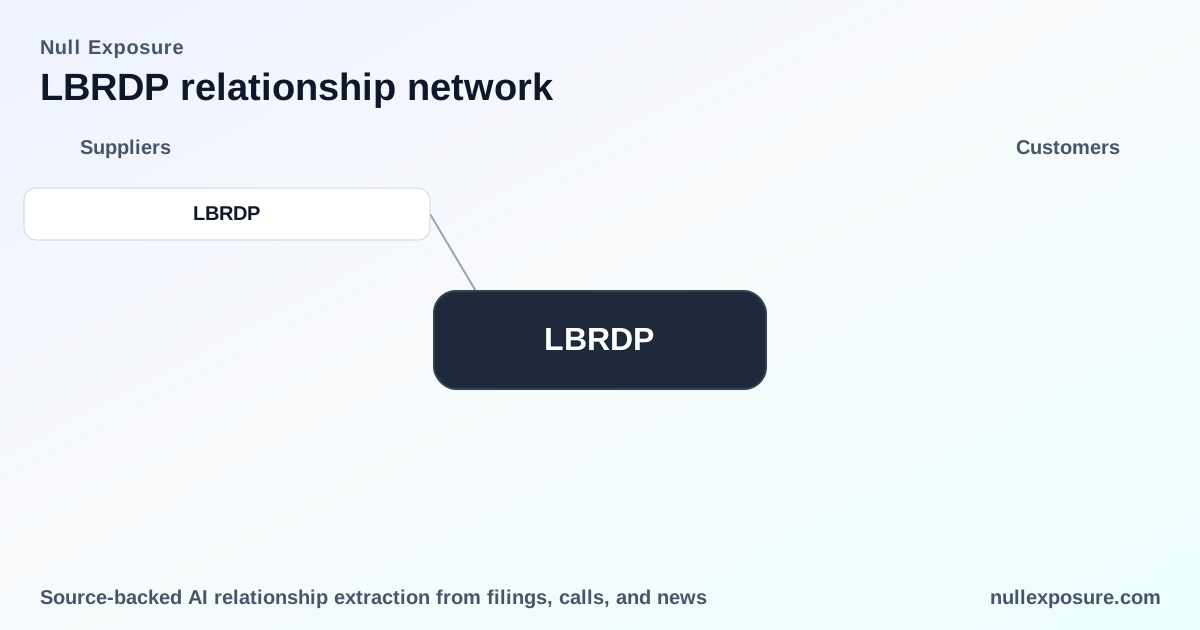
Liberty Broadband (LBRDP) — supplier relationships and what they mean for investors
Liberty Broadband operates as a U.S. cable operator that delivers video, Internet and voice services to residential and small‑to‑medium business customers and monetizes through recurring subscription revenue and related service fees; it also runs a corporate structure that purchases management services from affiliated Liberty entities for a fixed fee. For investors evaluating supplier risk, the critical dynamic is the close operational integration with Liberty corporate employees combined with a capital structure anchored by long‑dated financing.
Explore more supplier intelligence at https://nullexposure.com/.
The headline relationship you must understand
Liberty provides core management services to Liberty Broadband
Liberty Broadband is party to a services agreement under which 74 Liberty corporate employees provide management services to Liberty Broadband for a determined fee, making Liberty a primary operational counterparty. According to Liberty Broadband’s FY2025 Form 10‑K, this services agreement is explicitly documented in the company’s disclosures (FY2025 10‑K).
Why this single relationship matters to investors and operators
The services agreement is not a peripheral vendor contract — it transfers core management functions to an affiliated provider and therefore shapes governance, operational continuity, and the supplier risk profile. Because the service is provided by a related party (Liberty) rather than a market third party, counterparty concentration and control dynamics become central valuation and governance considerations.
How Liberty Broadband’s broader operating signals influence supplier risk
Treat the following constraints as company‑level operating signals that shape the supplier posture:
- Long‑term contracting and capital maturity: Liberty Broadband’s filings document material long‑dated obligations — including margin loans and an exchangeable debenture issuance — that imply a funding profile managed over multiple years. For example, the company disclosed outstanding borrowings under its Margin Loan Agreement of $790 million as of December 31, 2025, and the company completed a $1,265 million private offering of 3.125% exchangeable senior debentures in 2023. These items indicate a capital structure with substantial long‑term commitments that creditors and suppliers should account for in pricing and covenant design.
- Service‑provider posture in operations: Liberty Broadband states it “utilize[s] certain third‑party service providers to perform a variety of operational functions,” signaling a mixed model of affiliated and third‑party outsourcing for operations. This is a company‑level operational choice that shapes supplier selection and expected SLAs.
- Active relationship stage and material spend scale: Filings classify relevant relationships as active, and the scale of borrowings signals a company that operates at $100m+ spend/commitment bands for financing and related contracts, which translates into meaningful negotiation leverage and systemic exposure if a counterparty fails.
These signals collectively imply that Liberty Broadband runs a hybrid operating model — core management is delegated to an affiliated provider while other operational functions are outsourced — with significant long‑dated financial obligations that affect supplier credit and contract terms.
Every listed relationship (concise, investor‑ready)
- Liberty — management services: Liberty Broadband has a services agreement under which 74 Liberty corporate employees provide management services to Liberty Broadband for a determined fee, creating a direct operational dependence on the Liberty organization. This is documented in Liberty Broadband’s FY2025 Form 10‑K (FY2025 10‑K).
Operational and counterparty risk implications
- Concentration risk: The affiliation with Liberty concentrates management knowledge and decision‑making in a related party. That reduces onboarding friction but increases vendor dependency and governance complexity.
- Continuity and control: Because management is provided by employees of Liberty, transitions or disputes could have immediate operational impact; contract terms around termination, transition assistance, and service continuity matter more than standard vendor SLAs.
- Financial offset: Long‑term funding commitments (margin loans and exchangeable debentures) mean the company has fixed financial obligations that can constrain flexibility during supplier negotiations, but also create a predictable cash‑flow profile for suppliers who price credit risk accordingly.
- Negotiation posture: Large scale borrowings and an active outsourcing model suggest Liberty Broadband negotiates at scale; suppliers should expect sophisticated contracting terms and limited tolerance for delivery failures.
Practical implications for suppliers and procurement teams
- Insist on robust transition and governance clauses: Given the affiliated‑provider arrangement, suppliers contracting with Liberty Broadband should require explicit termination assistance, access to key systems, and data‑transfer rights to mitigate concentration risk.
- Tie commercial terms to the capital profile: Service pricing and credit terms should reflect the company’s long‑dated financing obligations; require periodic credit protections or step‑in rights as appropriate.
- Assess control and independence: For third‑party suppliers, clarify decision rights and escalation paths: who at Liberty Broadband, versus Liberty, signs off on operational changes?
If you need a deeper supplier risk map or benchmarking versus peers, visit https://nullexposure.com/ for tailored intelligence.
Bottom line and recommended next steps for investors
- Key takeaway: Liberty Broadband runs a highly integrated relationship with Liberty for management services — 74 corporate employees — which is operationally critical and raises counterparty concentration risk.
- Financial backdrop matters: The company’s long‑term debt and margin loan profile reshapes bargaining power and operational continuity expectations.
- Action items: For investors, validate related‑party governance disclosures, request copies of the services agreement or summary terms when possible, and stress‑test cash flows under alternative management continuity scenarios.
For a deeper supplier mapping or to request contract‑level intelligence, visit https://nullexposure.com/ — the resource for targeted supplier analysis and investor due diligence.