Liberty Oilfield Services (LBRT): supplier relationships that determine uptime and margin
Liberty Oilfield Services operates and monetizes by providing hydraulic fracturing, cabling, power generation equipment and related onshore services to North American oil and gas producers; revenue is earned through per-job fracturing contracts, equipment and power blocks, and related service agreements. The company's cash flow and margins are tightly coupled to its supplier and manufacturing relationships for proppant, chemicals, engines and power-generation modules, and investors should evaluate those counterparty linkages when modeling volatility in utilization and operating leverage. For a structured view of Liberty’s supplier posture and public partner mentions, read on — or visit the research hub at https://nullexposure.com/ for deeper context.
How supplier posture shapes Liberty’s operating model
Liberty’s business model is capital- and logistics-intensive: fleets of custom hydraulic fracturing equipment, on-site power generation, and continuous supplies of proppant and chemicals. That combination produces four practical characteristics investors must price into forecasts:
- Contracting posture: Liberty operates as a buyer of critical inputs (proppant, chemicals, engines) and as a systems integrator/assembler for its fracturing fleets and power solutions. Public disclosures show ongoing purchases from third‑party sellers and long-term arrangements with manufacturers and assemblers.
- Concentration and criticality: Access to proppant and power-generation hardware is material to uptime; interruptions would create immediate margin pressure because fracturing jobs are time-sensitive and equipment-intensive.
- Maturity of relationships: Liberty emphasizes long-term supplier and manufacturer relationships in filings and calls, which supports equipment lead-time predictability but also creates exposure when firm purchase commitments change.
- Operational flexibility: The company’s partnerships with engine and power providers enable modular power blocks and alternative fuel options, which are strategic levers for lowering per-job energy costs.
According to company disclosures, Liberty purchased chemicals, proppant and maintenance parts from named sellers and has established relationships with manufacturers and assemblers of custom fleets (company filings through FY2025). These are company-level signals that supply chains are an active management focus; monitor the firm’s published commitments and vendor concentrations when projecting margins.
Visit https://nullexposure.com/ to compare Liberty’s supplier signals across peers and historical filings.
What the transcripts and reports name: direct partner mentions
Below are every partner mentioned in the sourced results, with concise, sourced descriptions.
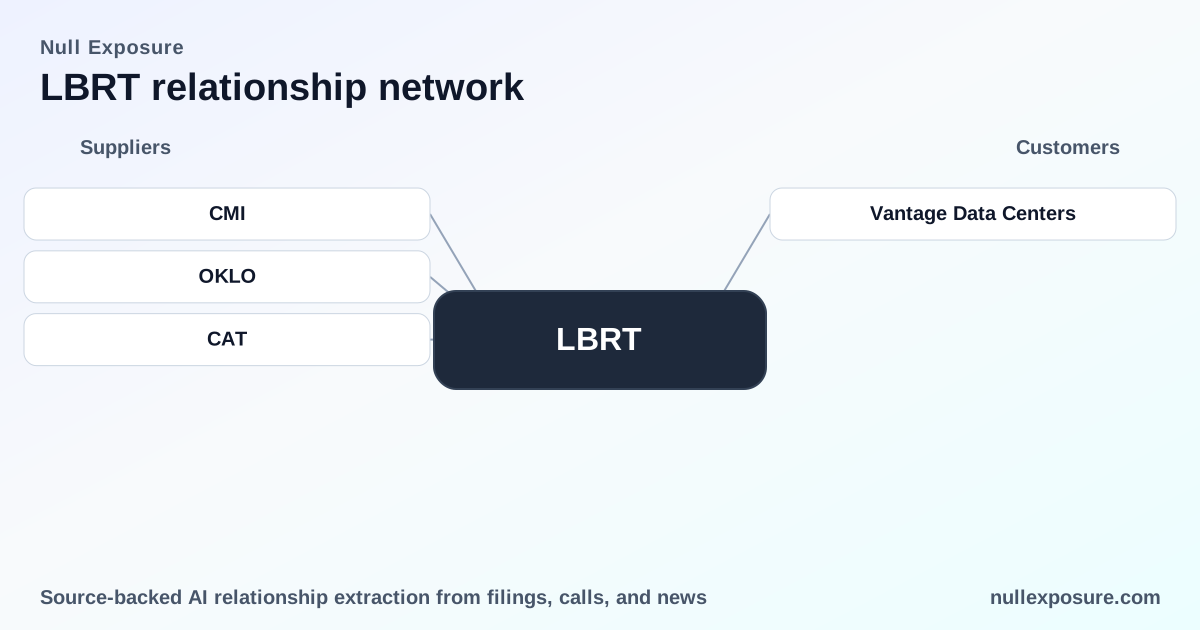
Cummins — engine and digiPrime collaboration
Liberty cited Cummins as a longstanding partner and announced collaboration on a natural‑gas, variable‑speed large‑displacement engine integrated into Liberty’s digiPrime platform in the Q4 2024 earnings call. This partnership signals Liberty is pursuing fuel‑flexible, higher-efficiency power solutions to lower fleet energy cost and emissions intensity. (Q4 2024 earnings call transcript.)
Oklo — a targeted power partnership
Liberty referenced a “very specific” partnership with Oklo in the FY2025 call transcript, indicating a focused relationship around Liberty’s power or energy solutions. The Oklo mention reflects Liberty’s strategy to broaden its power partner set beyond traditional engine OEMs. (InsiderMonkey transcript of FY2025 earnings call.)
Caterpillar — standardized power block architecture
Liberty discussed working with Caterpillar to deploy modular power blocks—described in the transcript as roughly 2.5 MW building blocks and up to 25 MW configurations—illustrating the firm’s use of established OEM power modules for scaleable onsite generation. Caterpillar aligns with a modular power strategy that supports larger, repeatable job footprints. (InsiderMonkey transcript of FY2025 earnings call.)
What these relationships imply commercially
Cummins and Caterpillar are complementary: one focuses on advanced gas engines and the other on industrialized power blocks, giving Liberty options across fuel types and scales. Oklo’s mention suggests Liberty is selecting specialized partners for particular power solutions, expanding choices for energy sourcing and possibly resilience. For investors, the takeaway is simple: equipment and engine partnerships directly reduce operating expense variability and are strategic levers for margin expansion.
Company-level constraints and supply signals to monitor
Public excerpts in Liberty’s filings and disclosures provide concrete supply-side signals investors should fold into risk models:
- Liberty disclosed purchases from Schlumberger of approximately $1.7 million during January 1–31, 2023, demonstrating recurring purchases from large oilfield service vendors. This is a named-seller signal of where some chemicals and parts originate (company disclosures).
- Proppant purchases from Nomad were recorded at $5.5 million in 2024 and $0.6 million in 2025, showing material year-to-year variability in proppant sourcing and spend (company disclosures for years ended December 31, 2025 and 2024).
- Liberty entered a Tax Credit Transfer Agreement in the year ended December 31, 2024 to acquire up to $33.5 million of transferable tax credits under the Inflation Reduction Act, indicating financial structuring activity tied to regulatory credits (company disclosures).
- As of December 31, 2024 the company had commitments to purchase 360,000 tons of sand; by December 31, 2025 no outstanding commitments remained, signaling a shift away from forward sand commitments and increased exposure to spot-price procurement or short-term contracts (company disclosures).
These points collectively indicate material supplier reliance and active contract re‑shaping. Investors should treat the loss of forward proppant commitments and the reliance on multiple engine/power partners as both a flexibility tool and a source of short-term price exposure.
Metrics and monitoring checklist for investors
Track the following items quarterly to translate supplier relationships into forecast adjustments:
- Changes in disclosed purchase commitments (proppant, sand, chemicals) and remaining tonnage.
- Public statements on equipment lead times and fleet build schedules tied to manufacturer partners.
- Power-cost and fuel-mix commentary tied to Cummins, Caterpillar, or alternative power partners.
- Backlog and utilization rates for fracturing fleets; any comments on modular 2.5 MW/25 MW rollouts.
- Any new tax-credit transfer agreements or other structuring deals that alter cash taxes or effective cost of capital.
Bottom line: where the risk and optionality sit
Liberty’s supplier ecosystem is a central operational asset: strong manufacturer and engine partnerships reduce capital lead-time risk and help control per-job energy costs, while termination or reduction of forward commodity commitments (notably sand/proppant) increases spot exposure. Financials reflect scale — revenue of roughly $4.0 billion and EBITDA around $600.8 million — but margins are sensitive to supply-side moves and power costs (company financials through FY2025).
For investors evaluating Liberty, focus your diligence on quarterly disclosures about supplier commitments, power partnerships development, and any changes in purchase concentration. For additional, comparative supplier intelligence and transcripts that support this analysis, visit https://nullexposure.com/.
To review Liberty’s supplier network across filings and calls and to get structured intelligence for modeling, go to https://nullexposure.com/.