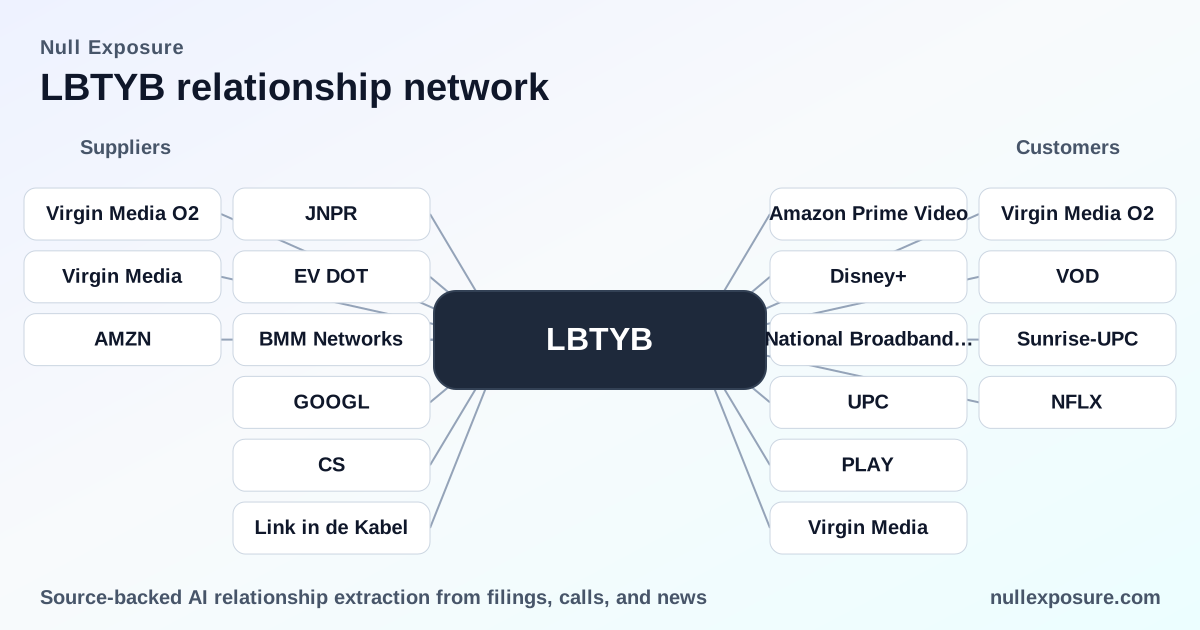
Liberty Global (LBTYB): supplier map and implications for investors
Investor thesis: Liberty Global operates as a multinational telecom and media operator that monetizes through consumer subscriptions (broadband, video, voice, mobile), wholesale and anchor wholesale contracts, and infrastructure-led services. The company leverages a mix of long-term contractual infrastructure commitments and third-party programming/licensing spend to deliver recurring cash flows while outsourcing significant portions of hardware, software and cloud connectivity to suppliers.
If you want a consolidated view of Liberty Global's supplier relationships and counterparty risk for underwriting or portfolio decisions, review the supplier intelligence at https://nullexposure.com/.
How Liberty Global runs its business and where suppliers fit in
Liberty Global’s operating model depends on combining owned distribution (cable and fiber) with outsourced capabilities: content licensing, network equipment leases, cloud interconnects and managed services. Programming and rights fees are a material, recurring operating cost, while network equipment and customer premises equipment (CPE) are bought or leased from third parties. Liberty Global uses a mix of long-term leases and short-term vendor financing, which creates both durable asset exposure and near-term payables that can stress working capital in cyclical environments.
This model produces a supplier posture that is:
- Contractually hybrid — both long-term (multi-year leases) and short-dated vendor-finance obligations exist.
- Concentration-sensitive — programming and cloud/network interconnects drive commercial criticality and cost volatility.
- Operationally integrated — suppliers deliver hardware, software, and services that are embedded in customer-facing systems, increasing switching complexity.
Explore supplier-level credit signals and relationship depth at https://nullexposure.com/.
What Liberty Global’s disclosed relationships look like (plain-English summaries)
Below I cover every supplier/partner referenced in the latest relationship extraction.
Juniper Networks
Liberty Global collaborated with Juniper to demonstrate cloud interconnect use cases, deploying Juniper Cloud Interlink Gateways in an AWS Outpost on Liberty Global premises in Reading, UK and in regional cloud environments. This is a strategic networking and cloud-connect play rather than a one-off product sale (source: Liberty Global press release, FY2025 — https://www.libertyglobal.com/liberty-global-and-juniper-networks-collaborate-to-demonstrate-seamless-cloud-connections/).
AWS (Amazon Web Services)
Liberty Global used an AWS Outpost as part of the Juniper deployment, indicating direct on-prem cloud infrastructure integration for low-latency services and hybrid cloud operations (source: Liberty Global press release, FY2025 — https://www.libertyglobal.com/liberty-global-and-juniper-networks-collaborate-to-demonstrate-seamless-cloud-connections/).
Regional cloud capacity from Google was part of the multi-cloud connectivity demonstration, showing Liberty Global’s approach of using multiple hyperscalers for regional services and redundancy (source: Liberty Global press release, FY2025 — https://www.libertyglobal.com/liberty-global-and-juniper-networks-collaborate-to-demonstrate-seamless-cloud-connections/).
EV DOT
Liberty Charge’s UK electric-vehicle rollout will use charging points operated by EV DOT, a publicly accessible charging network, indicating Liberty Global is leveraging third-party operators for EV infrastructure operations rather than building a wholly owned charging business (source: Liberty Global announcement on Liberty Charge, FY2021 — https://www.libertyglobal.com/liberty-charge-launches-national-electric-vehicle-infrastructure-rollout-in-uk/).
BMM Networks
BMM Networks is the owner/operator of EV DOT and thus the operational counterparty running charging infrastructure for Liberty Charge; this is a vendor/operator relationship tied to a UK rollout initiative (source: Liberty Global Liberty Charge release, FY2021 — https://www.libertyglobal.com/liberty-charge-launches-national-electric-vehicle-infrastructure-rollout-in-uk/).
Credit Suisse
Credit Suisse acted as Liberty Global’s financial advisor on the sale of UPC Poland to Iliad’s Polish mobile unit, indicating reliance on external investment banking partners for disposal and M&A execution (source: Liberty Global transaction disclosure, FY2021 — https://www.libertyglobal.com/liberty-global-to-sell-upc-poland-to-iliads-polish-mobile-subsidiary-play/).
Link in de Kabel
Link in de Kabel delivered digital skills training as part of Telenet’s community/essential internet initiatives, reflecting Liberty Global’s engagement with local NGOs and training partners to support social programs (source: Telenet program announcement, FY2021 — https://www.libertyglobal.com/telenet-expands-essential-internet-project-for-vulnerable-families-in-belgium/).
Virgin Media / Virgin Media O2
Virgin Media (Liberty Global’s UK subsidiary) supplies the underlying network infrastructure and deployment capabilities for Liberty Charge’s UK EV rollout; Virgin Media O2 is identified as the anchor wholesale client for a JV to build new fiber in the UK, demonstrating wholesale revenue and anchor-client strategies in Liberty’s capital allocation and infrastructure plans (sources: Liberty Charge release, FY2021 — https://www.libertyglobal.com/liberty-charge-launches-national-electric-vehicle-infrastructure-rollout-in-uk/; joint-venture press release, FY2022 — https://www.telefonica.com/en/communication-room/press-room/liberty-global-telefonica-and-infravia-form-joint-venture-to-build-a-new-fibre-network-in-the-uk/).
Operational constraints and what they signal for counterparties
The company-level constraints extracted from Liberty Global’s filings and public disclosures paint a clear picture of supply-side risk.
-
Long-term leases coexist with short-term vendor finance. Liberty reports weighted-average remaining lease terms exceeding 7–11 years for finance and operating leases, while vendor-financed payables are frequently due within one year. This combination means suppliers and lessors have both durable contractual exposure and cyclic working-capital claims that affect liquidity timing (company filing excerpts, 2024–2025).
-
Programming costs are material and recurring. Programming and copyright costs exceeded $400 million annually in recent years, making content suppliers economically consequential and commercially critical to operations (company annual disclosures, 2022–2024).
-
Multi-role dependence. Liberty acts both as a licensee and licensor and is heavily dependent on third-party service providers, manufacturers and software vendors for network operations and customer equipment. These roles increase counterparty complexity and require robust third-party risk governance (company governance excerpts, 2024).
-
Segment-level exposure: commitments span hardware (CPE, network equipment), infrastructure (leased mobile sites, real estate), software and services (IT, call centers, programming commitments). This breadth means suppliers range from capex-centric manufacturers to variable-cost content licensors, and each has different negotiation leverage and recovery profiles in stress.
One constraint excerpt explicitly names an MVNO arrangement with Three (Hutchison) for VM Ireland, confirming Liberty’s use of third-party wireless networks to provide mobile services rather than owning all radio infrastructure (company disclosure).
Learn more about how these supplier signals affect credit and contracting strategies at https://nullexposure.com/.
Takeaways for investors and operators
- Supplier concentration on programming and cloud/network partners is the primary commercial risk; programming costs are material and volatile, while hyperscaler/cloud interconnects are operationally critical.
- Contract mix raises both resilience and exposure: long-term leases lock in infrastructure availability but vendor financing and purchase commitments create short-term liquidity claims.
- Opportunistic asset monetization and JV wholesale strategies (e.g., fiber JV with Telefonica/Infravia, sale of UPC Poland) are central to capital allocation and de-leveraging options, often executed with external financial advisors.
If you are underwriting Liberty Global counterparty exposure, model both the long-duration lease obligations and near-term vendor-finance maturities, stress programming spend, and treat cloud/hyperscaler interconnects as essential operational dependencies.
For a detailed supplier risk profile and counterparty scoring for investment committees, start here: https://nullexposure.com/.
Final action: compile these relationship summaries into due diligence materials and prioritize counterparties that represent operational criticality (programming vendors, hyperscalers, core network equipment lessors) for deeper contract review. For full supplier coverage and contract-level signals, visit https://nullexposure.com/.