Liberty Global (LBTYK) — supplier map and what it means for investors
Liberty Global operates as a pan‑European and U.K. cable & broadband operator that monetizes through recurring consumer subscriptions (broadband, video, telephony and mobile), hardware provisioning and carriage/licensing arrangements with content owners and technology vendors. The company's P&L and capital structure are materially shaped by large, recurring programming payments, multi‑year equipment leases and platform development contracts that support its entertainment and connectivity stack. For investors evaluating supplier risk, the relevant facts are straightforward: high recurring spend on programming, material long‑dated lease commitments, and dependence on a mix of hardware and software suppliers to deliver customer services. For a consolidated supplier view, visit https://nullexposure.com/.
How Liberty Global’s supplier posture drives cash flow and risk
Liberty Global’s operating model is a blend of subscription economics and capital‑intensive network delivery. The company pays large, recurring fees to programming rights holders and invests in customer premises equipment (CPE) and network hardware while also licensing software platforms and outsourcing services. That structure creates two linked dynamics: predictable recurring revenue but also fixed, often long‑dated supplier obligations that compress operating leverage.
Key operating characteristics implied by public disclosures:
- Contract mix is mixed-term — Liberty Global records both near‑term obligations (including VAT- and working‑capital‑type payables) and multi‑year operating and finance leases (weighted average remaining lease terms of ~11.4 years for operating leases and ~7.8 years for finance leases). This signals a capital‑heavy supplier relationship profile with meaningful fixed costs over multiple years.
- Multi‑segment vendor reliance — the company buys hardware (CPE and network equipment), licenses software, and procures services from third parties to run mobile and entertainment platforms, indicating a diversified vendor set spanning hardware, software and managed services.
- Spend concentration on programming — Liberty Global reports programming and copyright costs in the high hundreds of millions annually (programming costs totaled roughly $406.3 million in 2024), which positions content counterparties as strategically important suppliers.
These attributes make supplier resilience, contract terms and rights renewal economics a core lever for both margin recovery and downside protection for investors.
Contracting posture and maturity
The coexistence of short‑term payables and long‑term leases implies operational flexibility in some areas (procurement and payables) and lock‑in in others (infrastructure and real estate). For investors, the consequence is that cost reductions are possible through procurement optimization, but balance‑sheet leverage and lease liabilities are less fungible and will underpin near‑term cash conversion dynamics.
Public supplier relationships on record
Below are the supplier relationships surfaced in public documents and filings, each summarized in plain English with the reporting source.
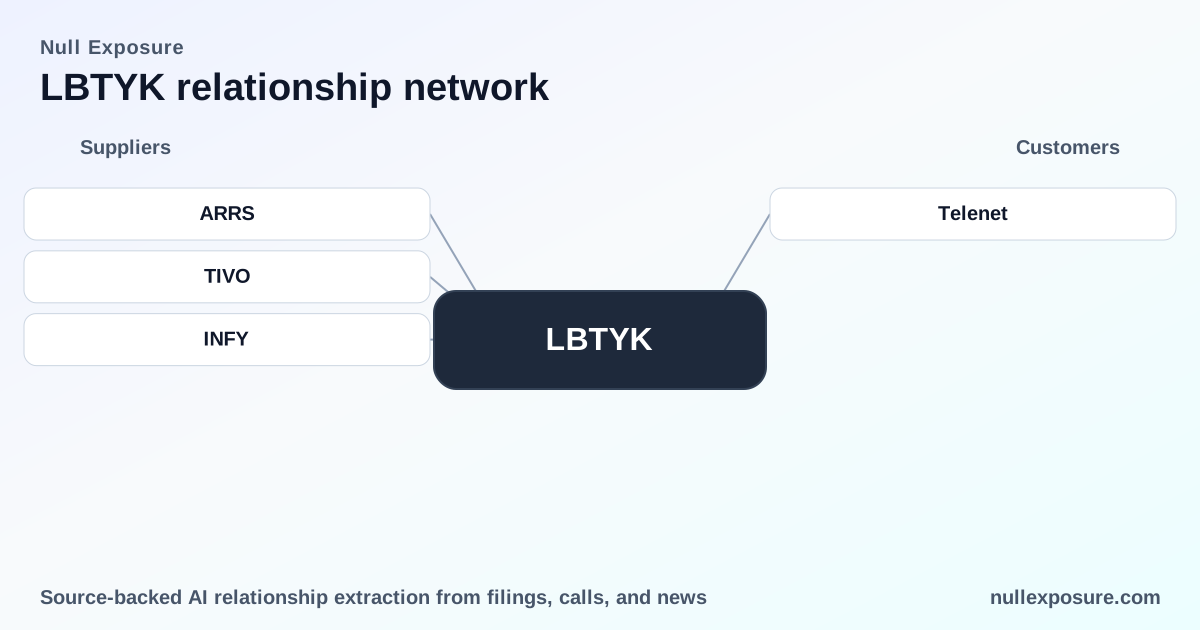
Arris (ARRS) — Arris built the V6 set‑top box for Virgin Media’s flagship rollout; the device was identified as the hardware manufacturer for the TiVo‑powered V6 offering. This is documented in a NextTV article covering Virgin Media’s V6 rollout (FY2018 reference). Source: a NextTV blog post on Virgin Media accelerating rollout of the TiVo‑powered V6 box.
TiVo (TIVO) — TiVo provided the software and services platform that powers Virgin Media’s V6 set‑top device, positioning TiVo as the entertainment software licensor in that product stack. The arrangement is cited in the same NextTV article discussing the V6 release and deployment (FY2018 reference). Source: NextTV coverage of the V6/TiVo/Arris implementation for Virgin Media.
Infosys (INFY) — Liberty Global expanded a collaboration with Infosys in 2023 to evolve and scale its entertainment and connectivity platforms, indicating a strategic technology partnership for platform engineering and managed services. This expansion is disclosed in Liberty Global’s Form 10‑K for the year ended December 31, 2024. Source: Liberty Global 2024 Form 10‑K (company filing).
What these supplier ties mean in practice
The Arris/TiVo mentions illustrate a vendor stack split between hardware OEMs and software licensors for consumer entertainment products, while the Infosys disclosure demonstrates Liberty Global’s use of large systems integrators to scale platforms. Collectively these public relationships highlight three investment implications:
- Technology and delivery are multi‑vendor — hardware, middleware and managed engineering all come from different suppliers, which reduces single‑vendor lock but increases integration and ops risk.
- Content and platform costs are recurring and material — programming spend is large and steady, pressuring gross margins when ARPU growth lags.
- Strategic partners for platform evolution are critical — expanded deals with companies like Infosys indicate Liberty Global is outsourcing significant engineering and scaling work rather than doing it organically, which affects operating leverage and vendor concentration in services.
If you need a consolidated supplier-risk snapshot for portfolio diligence, see the Liberty Global supplier overview at https://nullexposure.com/.
Risk and concentration profile investors should watch
- Cash exposure to content suppliers is large and recurring; failure to re‑negotiate unfavorable terms or higher copyright fees would pressure margins and free cash flow.
- Lease and equipment commitments are long‑dated, creating limited near‑term flexibility to reduce fixed costs if demand softens.
- Platform outsourcing increases operational dependency on systems integrators and software licensors for customer experience, which elevates execution risk during major upgrades or migrations.
Against these risks, Liberty Global’s recurring revenue base and diversified geographic footprint provide some offset, but the balance between contractual rigidity and procurement flexibility defines short‑to‑medium‑term downside.
You can review this supplier intelligence and more company supplier maps at https://nullexposure.com/ for comparative diligence and portfolio monitoring.
Bottom line and recommended next steps for investors
Liberty Global’s supplier footprint is strategically mixed: large recurring content spend and long leases anchor costs, while a multi‑vendor technology stack distributes execution risk. For investors and operators, focus on three actionable items:
- Monitor programming cost trends and renewal schedules — they are a primary margin driver.
- Track platform outsourcing agreements and SLAs (for example, expanded collaborations like the one with Infosys) because service delivery and upgrade cycles will affect churn and ARPU.
- Quantify lease liabilities and procurement pipelines to model fixed‑cost flexibility under different demand scenarios.
For an updated supplier risk assessment and tailored reports that integrate these relationship signals into investment metrics, visit https://nullexposure.com/ and request a supplier diligence brief.