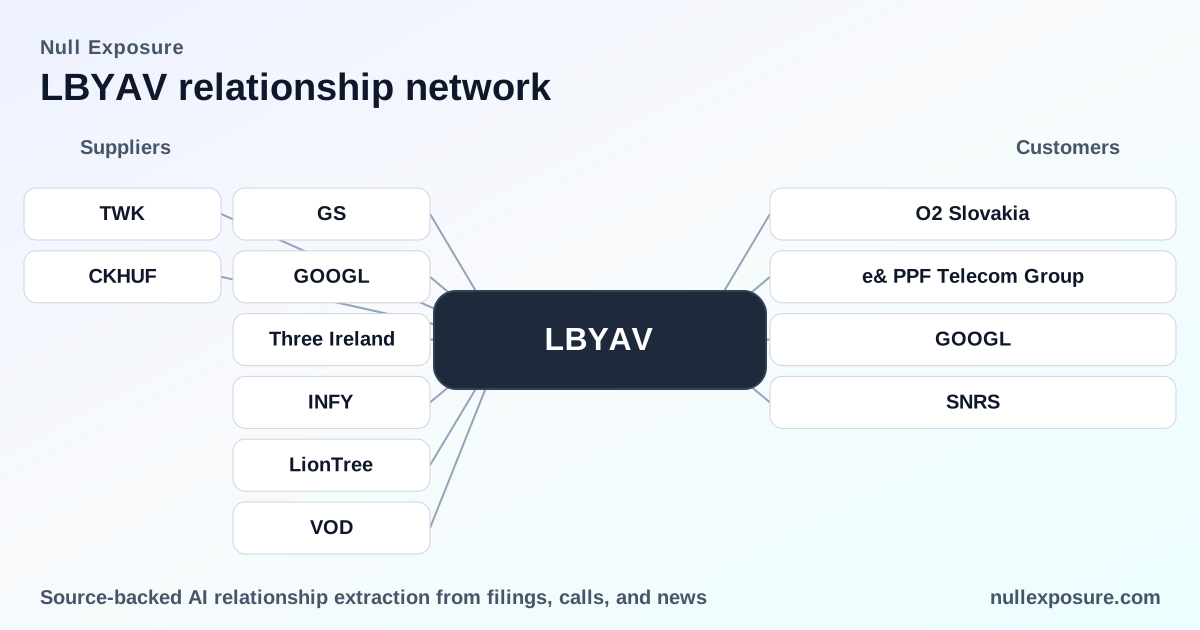
Liberty Global (LBYAV) — supplier relationships and strategic priorities investors need to track
Liberty Global operates as a pan‑European and Caribbean telecommunications and media operator, monetizing a subscription base through fixed broadband, video services, mobile offerings and device/adjacent product sales. The company drives growth by pairing scale — millions of fixed and mobile connections — with strategic outsourcing and technology partnerships that reduce capital intensity and accelerate product rollout; monetization is therefore a mix of recurring subscriber revenue, B2B services and distribution margins on device and platform bundles. For investors evaluating supplier risk and opportunity, the current supplier map underscores a concerted digital transformation strategy built around long‑term technology partners and financial advisers supporting deal activity. Learn more at https://nullexposure.com/.
How Liberty Global contracts and why it matters for revenue quality
Liberty Global’s supplier posture reflects a hybrid model: multi‑year, strategic engagements for core technology and one‑off advisory relationships for M&A and capital strategy. These characteristics produce several company‑level signals for investors:
- Contracting posture: The firm is entering multi‑year strategic alliances (not ad‑hoc procurement), indicating long lead times to realize benefits but also higher vendor switching costs.
- Concentration: Large commitments to a small number of strategic partners increase operational leverage to those partners’ roadmaps and pricing.
- Criticality: Partnerships that embed AI, cloud, and customer‑facing services are critical to customer experience and margin improvement.
- Maturity: The mix of strategic cloud deals and investment banker engagements signals an organization in mid‑transformation — operational scale now leveraged by third‑party technology and capital advisors.
These are company‑level signals (the supplier dataset shows no explicit contractual constraints), and they should drive diligence around counterparty concentration, contract terms, and transition risk. If you want a deeper supplier risk profile, start here: https://nullexposure.com/.
The relationship map every investor should know
Google Cloud — five‑year strategic AI and cloud partnership (FY2026)
Liberty Global signed a five‑year strategic partnership with Google Cloud to deploy Gemini models and Google Cloud infrastructure across its European operations, aimed at embedding AI into customer care, Horizon TV and network operations across roughly 80 million fixed and mobile connections. The deal is explicitly positioned to accelerate product rollout, improve network scalability and drive cost efficiencies, representing a high‑impact, multi‑year technology commitment (Liberty Global press release and Google Cloud materials, February 3, 2026).
Infosys — strategic collaborator on platform scaling (FY2026)
Liberty Global has named Infosys among its strategic technology collaborators to scale digital entertainment and connectivity platforms while integrating AI services, signaling a complementary systems‑integration relationship supporting cloud and AI rollouts (reported in Liberty Global materials summarized via TradingView, FY2026).
Goldman Sachs — financial adviser on transactions (FY2026)
Goldman Sachs is acting as a financial adviser to Liberty Global on recent transaction activity, providing M&A and capital markets advisory services that support the company’s strategic consolidation ambitions. This adviser relationship reflects active deal execution and external capital strategy support (Yahoo Finance coverage, March 10, 2026).
LionTree — financial adviser alongside Goldman Sachs (FY2026)
LionTree is serving with Goldman Sachs as a financial adviser to Liberty Global, reinforcing the company’s use of specialized boutique and bulge‑bracket advisers in transaction planning and negotiation. The dual‑adviser posture is consistent with an aggressive M&A playbook (Yahoo Finance, March 10, 2026).
Three Ireland — MVNO radio access partner (FY2026)
Liberty Global operates Virgin Media Ireland’s mobile service as an MVNO using Three Ireland’s radio access network; Virgin Media Ireland has roughly 380,000 fixed broadband customers and about 144,000 mobile customers on that arrangement, giving Liberty an operational footprint in the Irish mobile market through a network sharing construct (SiliconRepublic reporting and TelecomTV context, FY2026).
CK Hutchison — potential acquisition counterparty for Three Ireland (FY2026)
CK Hutchison, owner of Three Ireland, has been reported as engaged in talks that could involve selling the mobile operator to Liberty Global, indicating potential consolidation and asset integration risk/opportunity should negotiations progress (SiliconRepublic, FY2026).
Vodafone — strategic stake discussions referenced (FY2026)
Market reports have referenced Liberty Global’s interest in buying out Vodafone’s stake in a joint venture, highlighting longer‑term consolidation possibilities in partner stakes and infrastructure ownership that could alter competitive dynamics and capital requirements (SiliconRepublic reporting, FY2026).
TWK — provider referenced on corporate operations page (FY2025)
TWK is credited as the website provider on Liberty Global’s operations pages, a minor but visible supplier relationship documented on the company site; it reflects standard third‑party service procurement for corporate digital presence rather than an operationally critical tie (Liberty Global operations page, FY2025).
What these relationships mean for investors: risks and opportunity
Collectively, these supplier ties point to two dominant strategic axes: (1) deep technology dependency on cloud and AI partners to drive customer experience and cost efficiency; and (2) active M&A and market consolidation plays supported by premier financial advisers.
- Upside: The Google Cloud and Infosys relationships accelerate product differentiation and scalability, which could improve ARPU and reduce operating cost per subscriber if integration succeeds. Multi‑year contracts create revenue and margin optionality.
- Downside: Concentration risk is material — outsized reliance on a few strategic suppliers adds vendor concentration exposure and transition risk. M&A activity increases execution risk and capital intensity; adviser relationships indicate the board is prepared to pursue transformation via transactions.
- Operational impact: Embedding cloud AI into customer care and TV platforms is strategically critical; failures or delays would more than cosmetic and could affect churn and customer satisfaction.
Note: the supplier dataset contains no explicit contractual constraints; however, the absence of recorded constraints is itself a signal that diligence should prioritize contract term review, SLAs, and data governance provisions with strategic partners.
If you want a vendor risk scorecard tailored to Liberty Global’s partner map, start your assessment at https://nullexposure.com/.
Practical next steps for investors and operators
- For investors: request copies of the Google Cloud and Infosys master services agreements and any termination/change‑of‑control clauses to quantify counterparty and integration risk. Demand disclosure on expected timeline to capture cost savings from the AI program.
- For operators and operators’ counterparties: prioritize playbooks for vendor management and contingency plans for critical services embedded in customer‑facing systems.
For a deeper supplier‑level due diligence framework and ongoing monitoring, visit https://nullexposure.com/.
Final takeaway: Liberty Global’s supplier relationships reflect a deliberate pivot to partner‑led digital transformation while simultaneously pursuing consolidation through adviser‑backed M&A activity. That combination creates a powerful growth vector — and concentrated vendor and execution risk — that should frame underwriting, board oversight, and operational contingency planning.