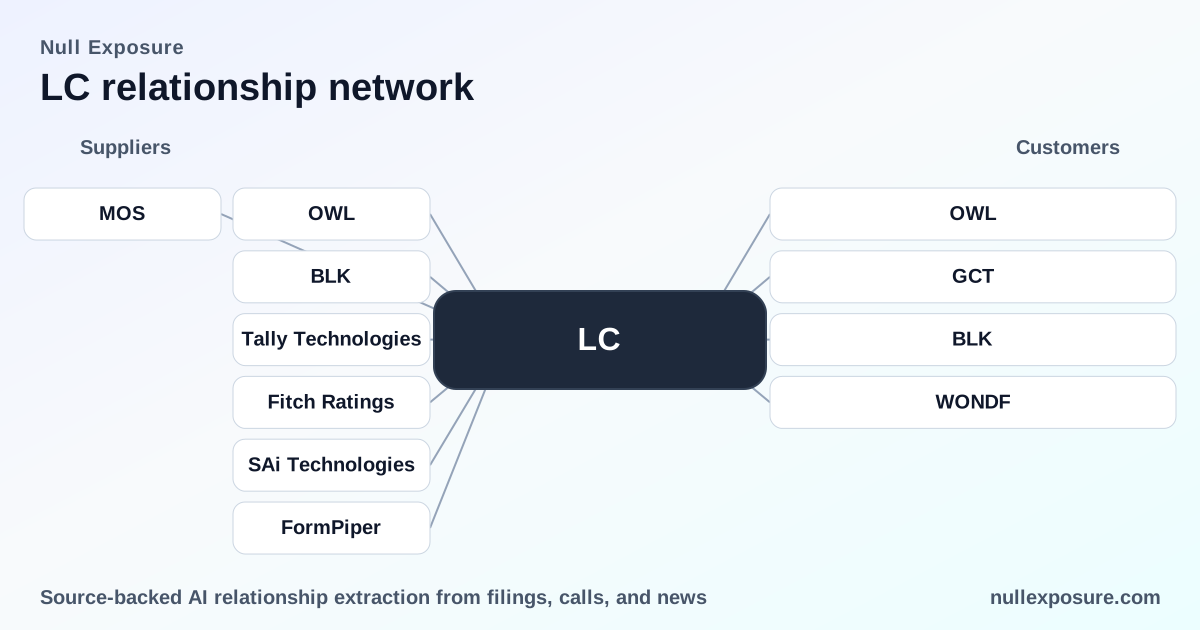
LendingClub (LC): A supplier map that explains how the platform funds growth and controls risk
LendingClub operates as a bank holding company built around a technology-enabled lending platform; it monetizes through net interest margin on originated loans, fee income from servicing and loan sales, and structured funding programs that transfer credit risk while freeing capital for new originations. Funding partnerships and structured certificates are core to the capital strategy: they reduce the dependence on deposit funding alone and allow LendingClub to scale originations without proportionate balance-sheet growth. For a consolidated view of counterparties and operational suppliers, see NullExposure for supplier intelligence: https://nullexposure.com/
Why supplier relationships matter to investors
LendingClub is not a monolithic bank — it is a hybrid: a loan originator, servicer, and bank that relies on external capital, technology integrations, and ratings/structuring partners. Supplier relationships therefore influence funding cost, operational resilience, and the speed of product expansion.
Key operating-model characteristics to watch:
- Contracting posture: LendingClub uses structured certificates and rated notes to transfer or tranche credit exposure while retaining servicing, which implies recurring contractual work with asset managers and rating agencies.
- Concentration: The firm intentionally diversifies funding across institutional partners, but some large commitments can create bilateral concentration risk if renegotiated or withdrawn.
- Criticality: Third-party vendors support critical functions (loan origination, collections, cloud, data verification). Vendor failure would be immediately operationally material.
- Maturity and predictability: Funding programs such as rated notes and structured certificates are repeatable and rated, offering predictability in capital access; newer tech acquisitions and partnerships are less proven operationally.
Who LendingClub is doing business with — concise relationship notes
Below are the supplier and partner mentions found in public reporting; each relationship is summarized in plain English with the cited source.
-
Blue Owl. LendingClub has developed a diversified funding runway that includes large commitments from Blue Owl, used to support loan originations and reduce single-counterparty concentration risk. (FinViz news, March 10, 2026)
-
BlackRock. The company uses structured certificates involving BlackRock as part of its securitization and funding toolkit to support lending capacity without expanding the bank balance sheet unduly. (FinViz news, March 10, 2026)
-
Tally Technologies. In 2024 LendingClub participated with PGY to acquire the intellectual property of Tally Technologies, integrating a credit-card management tool to expand member debt-management features and drive engagement. (FinViz news, March 10, 2026)
-
Fitch Ratings. LendingClub issues the LendingClub Rated Notes (LENDR) program and other structured certificates that include multiple tranches rated by Fitch, enabling access to investors who require third-party credit opinions. (FinViz news commentary on FY2025)
-
SAi Technologies. During a recent earnings call LendingClub referenced questions submitted via the SAi Technologies platform, indicating the company uses third-party investor/analyst engagement tools to manage market communications and investor interactions. (InsiderMonkey earnings call transcript, Q4 2025)
-
FormPiper. LendingClub uses integration infrastructure from vendors like FormPiper to connect multiple lending partners into a unified workflow, preserving user experience while expanding conversion opportunities. (FurnInfo industry report, FY2026)
-
Mosaic. LendingClub entered home-improvement financing through partnerships and a technology acquisition from Mosaic, a move that broadens product penetration into point-of-sale home-improvement finance. (SimplyWall commentary referencing FY2025 activity)
Contracting and constraint signals that shape the supplier story
LendingClub’s public statements and filings contain two company-level constraint signals that directly inform supplier risk analysis:
-
Government-backed securities concentration in investment portfolio. Management states that the majority of unrealized losses in recent periods were concentrated in U.S. agency-backed and mortgage-backed securities, which management classifies as high credit quality because of government guarantees. This is a company-level signal about asset-liability composition and the balance-sheet buffer strategy, not a vendor named in the relationships above.
-
Heavy reliance on third-party service providers for critical operations. LendingClub explicitly discloses reliance on third parties for customer support, collections, loan origination, data verification, record keeping and cloud computing, which creates operational dependency on a broad vendor base and raises outsourcing governance as a live risk.
These constraints combine to produce a profile where capital access is engineered externally (structured funding, institutional commitments) while operational continuity depends on a diversified, but critical, vendor ecosystem.
What investors should read into the mix
-
Funding diversity is a strategic strength. The presence of Blue Owl and BlackRock in funding constructs supports scale and reduces reliance on deposits; rated LENDR issuances underpin access to investor segments that demand external credit opinions. (FinViz and Fitch reporting)
-
Operational vendor risk is the principal non-credit vulnerability. The company’s explicit reliance on third parties for core functions raises concentration and continuity questions—vendor SLAs, backup plans, and exit strategies are relevant due diligence points.
-
Product expansion is both deliberate and inorganic. Acquisitions like Tally and Mosaic-linked tech deals show an appetite to add customer-facing tools that increase engagement and cross-sell, but integration execution will determine incremental ROIC.
If you want a concise supplier risk dashboard and counterparty map for diligence, NullExposure compiles these linkages and constraint signals into investor-ready profiles: https://nullexposure.com/
Investment checklist and action items
- Confirm the size and tenor of institutional funding commitments (Blue Owl, BlackRock) and whether covenants or repricing triggers exist.
- Review servicing economics — is LendingClub retaining servicing fees consistently, and how are rights transferred in structured certificates?
- Evaluate vendor concentration for collections, origination platforms, and cloud providers; obtain contingency plans for critical vendors.
- Monitor fallout risk from unrealized losses in agency-backed securities for balance-sheet volatility, though management treats those positions as high quality.
Near-term catalysts to watch: tranche issuance under LENDR, incremental tech integration outcomes (Tally/Mosaic), and reported vendor outages or contract renewals.
For detailed counterparty summaries and configurable supplier reports tailored to investor due diligence, visit NullExposure: https://nullexposure.com/
Bottom line
LendingClub runs a capital-efficient originations engine that leverages rated securitizations and institutional funding partners to scale while keeping the banking charter for deposits and regulatory flexibility. The primary investment trade-off is between funding diversification and operational vendor dependency; both must be managed tightly for the business model to sustain attractive margins. For a deeper look at counterparties and the contracts that matter, use the supplier intelligence suite at NullExposure: https://nullexposure.com/