Lakeshore Acquisition III (LCCCR): What investors and counterparties need to know
LCCCR represents the rights/warrants tied to Lakeshore Acquisition III Corp., a SPAC vehicle that monetizes primarily by completing an initial business combination or returning cash to public shareholders from a trust account. The company’s economics are driven by the size and custody of IPO proceeds held in trust, the timing and success of a qualifying merger, and the residual optionality embedded in rights/warrants for security holders. For investors and operating partners evaluating supplier relationships, focus on custody, counterparty stability, and the structural role of the trust account in any liquidity or distribution outcome.
Explore structured supplier intelligence at https://nullexposure.com/ to support diligence on counterparties and custody arrangements.
Quick read: how Lakeshore operates and where value comes from
Lakeshore Acquisition III is a SPAC vehicle incorporated to locate and combine with a target company in technology or consumer sectors. Value for public stakeholders is binary and event-driven: a successful business combination converts the blank-check vehicle into an operating public company, while failure results in liquidation and return of trust assets pro rata to public shareholders. As a rights/warrant security (asset type: Warrant), LCCCR holders have optional claims that can produce upside if a merger occurs and the post-combination equity appreciates. The company’s balance sheet drivers are unusual for an operating company: a concentrated trust account controls the vast majority of investible capital rather than recurring revenue streams.
Key structural facts investors should carry forward:
- Trust account magnitude is material to outcomes: $69,000,000 was deposited at IPO/Private Placement as the primary source of capital for redemption or acquisition consideration.
- Custody and trustee selection are critical: a major bank acts as trustee for the Trust Account, determining custody, disbursement mechanics, and investment of the marketable securities backing public shareholder redemptions.
- Security type matters: LCCCR is a warrant/rights instrument, not common equity, so payoffs depend on deal structure and post-deal dilution.
The supplier relationship you need on the radar
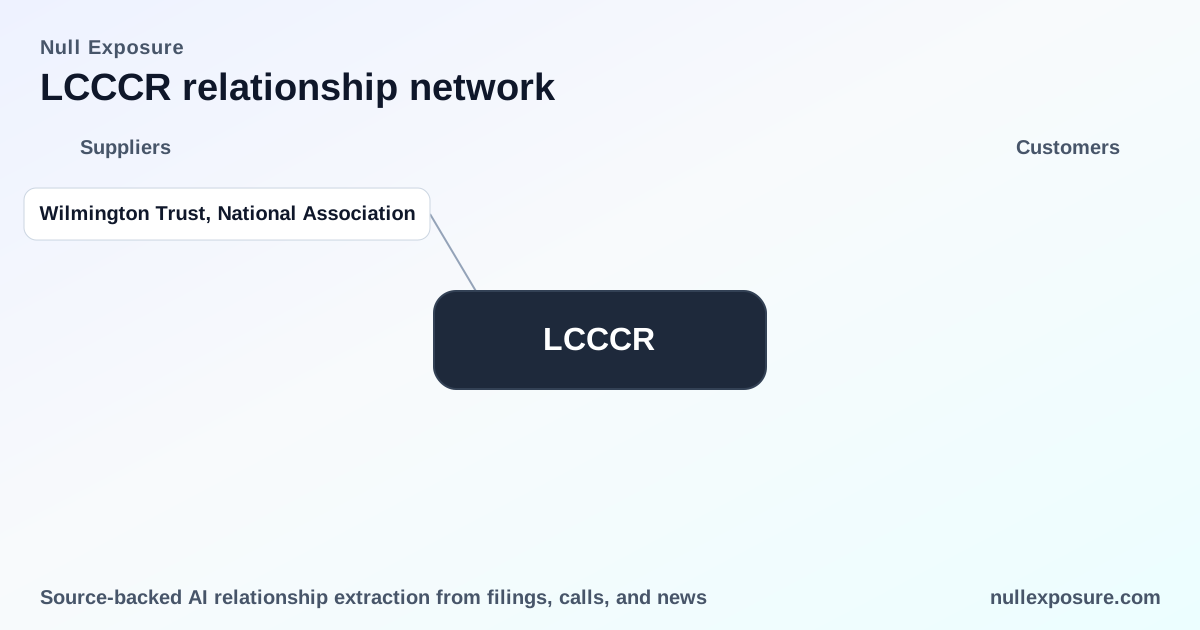
Wilmington Trust, National Association — trustee for the Trust Account
Wilmington Trust serves as the trustee holding the trust account where the SPAC deposited $69,000,000 of IPO and private placement proceeds at closing, and it therefore controls the custody of the marketable securities that underwrite public shareholder redemptions. According to the company’s Annual Report filed for FY2026 and summarized via MarketScreener, the trust account was established with Wilmington Trust acting as trustee (FY2026, annual report: https://www.marketscreener.com/news/lakeshore-acquisition-iii-annual-report-for-fiscal-year-ending-12-31-2025-form-10-k-ce7e5adad18bf72c).
Why this relationship matters: Wilmington Trust’s role is operationally critical because the trust account represents the primary liquidity backstop for public shareholders and is central to any liquidation or redemption process; custody and trustee instructions will govern how funds are invested and when distributions are made. (Source: FY2026 Annual Report via MarketScreener.)
Constraints and what they imply about operating posture
Translate the constraints in the record into operational signals investors use in counterparty diligence:
- Materiality — Critical: The trust holdings (marketable securities approximately $70.9m vs. total assets ~$71.6m) indicate that the company’s balance sheet is overwhelmingly comprised of the trust account. This is a company-level signal that liquidity, counterparty credit on the trustee, and investment policy of the trust account are mission-critical for all stakeholders.
- Relationship role — Buyer: The entity is structured to consummate an initial business combination as its operating objective. This is a governance- and deal-flow–driven posture rather than vendor purchasing behavior; the company is an acquirer/vehicle seeking counterparties to transact with for a business combination.
- Spend band — $10m–$100m: The size of deposited proceeds ($69,000,000) places the SPAC squarely in a middle-sized trust range, indicating sufficient scale to pursue meaningful targets but also concentration risk if a deal underperforms.
These constraints describe a SPAC that is highly concentrated, liquidity-centric, and reliant on a single custody relationship for the execution of its core corporate objective.
Explore provider and custody risk profiles at https://nullexposure.com/ for more granular supplier mapping.
Operational implications for investors and counterparties
Trustee and custody arrangements convert a financial instrument’s theoretical value into practical liquidity. For investors in LCCCR and counterparties that will transact with a post‑combination entity, the following operational realities follow:
- Counterparty concentration risk is real. With nearly all assets in a single trust account, any trusteeship disruption, error, or restrictive investment policy can materially affect redemptions and deal funding. Wilmington Trust’s operational reliability is therefore a primary risk vector.
- Liquidity timing is deterministic. Redemptions and distributions follow trust rules and SEC SPAC timelines; the trustee enforces those mechanics. Investors should model scenarios that assume trustee timelines and potential holdbacks.
- Rights/warrants are optionality, not guaranteed cash. LCCCR holders face binary outcomes tied to deal execution and post-deal equity performance; custody and trustee behavior primarily affect the public shareholder redemption floor.
Relationship summaries — concise and sourced
- Wilmington Trust, National Association acts as the trustee for the SPAC’s Trust Account, which held $69,000,000 of IPO and private placement proceeds at close and custody of marketable securities backing public shareholders (Annual Report, FY2026 via MarketScreener: https://www.marketscreener.com/news/lakeshore-acquisition-iii-annual-report-for-fiscal-year-ending-12-31-2025-form-10-k-ce7e5adad18bf72c).
Risks that change valuation and diligence priorities
- Custodial operational risk: Any interruption to trust operations affects liquidity and redemption mechanics. Verify counterparty operational SLAs and historical performance.
- Concentration risk: The trust account represents nearly all assets; there is no diversified operating cash flow backing the instrument.
- Event risk and timing: SPAC timelines and deal approvals determine whether rights/warrants convert into liquid value or become worthless post-liquidation.
Actionable next steps for investors and operators
- Confirm the trustee agreement terms and investment policy for the trust account, including permitted investments, counterparty exposure, and redemption mechanics.
- Model outcomes across three scenarios—successful business combination, delayed deal with extended trustee controls, and liquidation—and quantify how trustee actions affect public holder returns.
- For counterparties evaluating transaction with a Lakeshore-backed target, prioritize contractual protections that account for the trust’s custody rules and timing.
For diligence workflows, vendor scoring, and counterparty risk mapping relevant to SPAC custody and trustee arrangements, visit https://nullexposure.com/ to access supplier intelligence and relationship analytics.
Bottom line
LCCCR’s economic story is straightforward: option-like claims on a SPAC whose primary asset is a large trust account. Custody via Wilmington Trust is the single operational lever that converts the SPAC’s promise into cash liquidity, which makes trustee selection and trust-account governance the most consequential supplier relationship for investors and operating partners. Conserve due diligence effort for trustee terms, liquidity mechanics, and how those mechanics interact with any proposed business combination—these are the variables that determine whether LCCCR’s optionality translates into value or reverts to the trust-account redemption floor.
Need deeper supplier analytics or bespoke diligence on trust and custody counterparties? Visit https://nullexposure.com/ and start a targeted review.