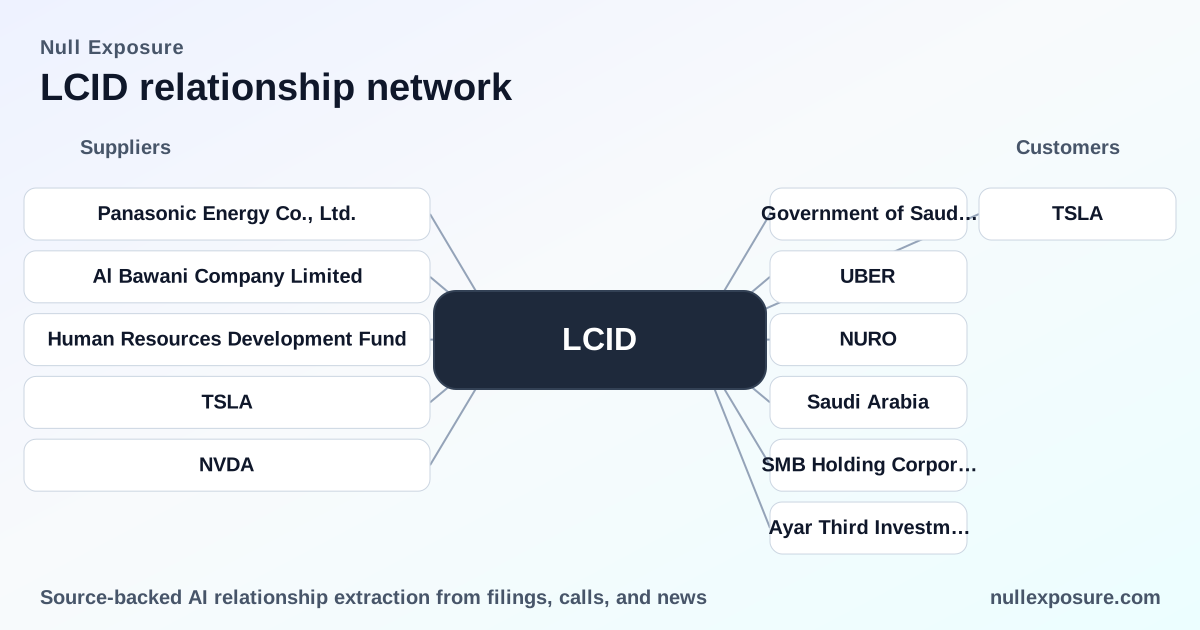
Lucid Group (LCID): Supplier relationships that shape production and valuation
Lucid is an electric vehicle manufacturer that designs and sells premium EVs and related services; it monetizes through vehicle sales, service networks, and strategic technology partnerships that enhance product differentiation and customer access. Production economics and near-term cash flow are anchored to a small set of critical suppliers — particularly battery cell partners — and to a handful of strategic technology arrangements that influence product features and market access. For investors evaluating supplier risk, Lucid’s disclosures show large, long-duration procurement commitments and concentrated single-source exposure that directly impact working capital, manufacturing cadence, and margin outlook.
Explore deeper supplier intelligence at https://nullexposure.com/.
Why supplier disclosures matter to Lucid’s risk/reward profile
Lucid’s operating model is capital-intensive and supplier-dependent: the company outsources many vehicle components while retaining design, systems integration, and customer-facing sales/service. The 10‑K frames suppliers as both executional gatekeepers and major sources of variability in cost and delivery. Key constraints disclosed include long-term non-cancelable purchase commitments (explicitly tied to battery cell supply), supplier concentration, and single-source dependence that the company classifies as potentially material to operations.
- Contracting posture: Lucid carries multi-year, non-cancelable commitments with battery cell suppliers, which creates locked-in spend and potential exposure to raw-material index volatility.
- Concentration and criticality: The company relies predominantly on single-source suppliers for many critical components; failure or disruption would materially affect production.
- Spend magnitude: Remaining minimum purchase commitments for lithium-ion cells are large relative to Lucid’s revenue base, amplifying procurement and liquidity sensitivity.
- Relationship maturity and stage: The supplier base is active and operationally embedded; Lucid reports ongoing manufacturing dependence and third-party service partner programs.
These are company-level signals drawn from Lucid’s FY2024 filings; where Lucid specifically names a partner, that excerpt is attributed directly below.
Supplier map: what Lucid discloses and why each relationship matters
Panasonic Energy Co., Ltd.
Lucid has multi‑year sourcing agreements and amended supply contracts with Panasonic Energy for lithium‑ion battery cells and has recognized remaining minimum purchase commitments of approximately $2.7 billion under those agreements in FY2024. That commitment is long-term, non‑cancelable and material to Lucid’s procurement profile, anchoring cell capacity but exposing Lucid to price and timing risk. According to Lucid’s FY2024 Form 10‑K, the amendments and commitments are explicit and quantifiable in the contractual obligations section.
Al Bawani Company Limited
Al Bawani is disclosed as a related‑party construction services counterparty in Lucid’s FY2024 filing, indicating Lucid used or contracted with Al Bawani for construction activities during 2024. The 10‑K tags the relationship under related‑party construction service contract entries, which signals local construction or site-development support tied to manufacturing or facilities expansion (FY2024 Form 10‑K).
Human Resources Development Fund
Lucid records a training reimbursement agreement with the Human Resources Development Fund in FY2024, identified in related‑party disclosures; this points to structured workforce development support and cost sharing for training initiatives recorded during the year. The arrangement is documented in the FY2024 10‑K’s related‑party section as a training reimbursement agreement.
Tesla (TSLA)
Lucid announced a commercial interoperability arrangement granting Lucid Air owners access to more than 23,500 Tesla Superchargers, expanding customer charging access and reducing a non‑product friction point that historically limits EV adoption. The company published this news on its corporate media site in March 2026, positioning the deal as an operational enhancement for range confidence and customer experience (Lucid press release, March 2026).
NVIDIA (NVDA)
Lucid describes a technology collaboration with NVIDIA to develop advanced autonomy, aiming for Level 4, point‑to‑point capabilities that integrate NVIDIA hardware and software with Lucid’s stack. Management discussed the collaboration during the 2025 Q3 earnings call, framing NVIDIA as a strategic partner for delivering higher‑level autonomous features and improving the product roadmap (Lucid 2025 Q3 earnings call).
What these relationships imply for investors
Lucid’s supplier disclosures create a mixed operational picture: battery supply is both the most critical and the most capital‑intensive dependency, with an explicit long‑term commitment that materially exceeds a single year’s revenue. That dynamic drives several investor-relevant conclusions:
- Cash flow and working capital sensitivity: The $2.7 billion in minimum battery purchase commitments (FY2024) is a structural cash‑flow obligation that constrains flexibility and amplifies downside if production or demand slips.
- Concentration risk: Single‑source dependency for critical components raises execution risk; successful scaling requires continued supplier performance and contractual stability.
- Operational hedges and strategic offsets: Partnerships like Tesla’s Supercharger access and NVIDIA’s autonomy collaboration reduce certain product and market risks (charging access and technology differentiation), but they do not substitute for component supply security.
- Contractual terms matter: Lucid’s disclosure flags that cell prices can vary with raw material indexes, so investors should monitor pass‑through mechanisms and hedge arrangements that protect margins.
For tactical diligence, prioritize review of amendment schedules, delivery phasing under the Panasonic agreements, indexed price mechanics noted in the 10‑K, and any counterparty concentration metrics management reports to investors.
Explore supplier risk analytics and monitoring tools at https://nullexposure.com/ to track how these commitments evolve alongside production metrics.
Quick operating checklist for investors
- Confirm timing and delivery profile for the $2.7 billion battery commitments versus Lucid’s planned production ramp.
- Monitor supplier concentration trends and any disclosed secondary sourcing or capacity diversification.
- Evaluate how charging and autonomy partnerships de‑risk customer adoption and influence unit economics.
Bottom line: what to watch and the investor action
Lucid’s value creation hinges on executing a capital‑intensive manufacturing ramp while managing large, long‑dated supplier commitments and single‑source concentration for key components. The Panasonic battery relationship is the dominant operational lever; Tesla and NVIDIA partnerships materially improve product access and capability but do not reduce procurement risk. Investors should track delivery performance, contract price indexing, and any signs of supplier diversification or renegotiation.
For ongoing supplier coverage, scenario analysis, and alerts on contract amendments, visit https://nullexposure.com/ — the most direct way to monitor Lucid’s supplier footprint and its impact on valuation.