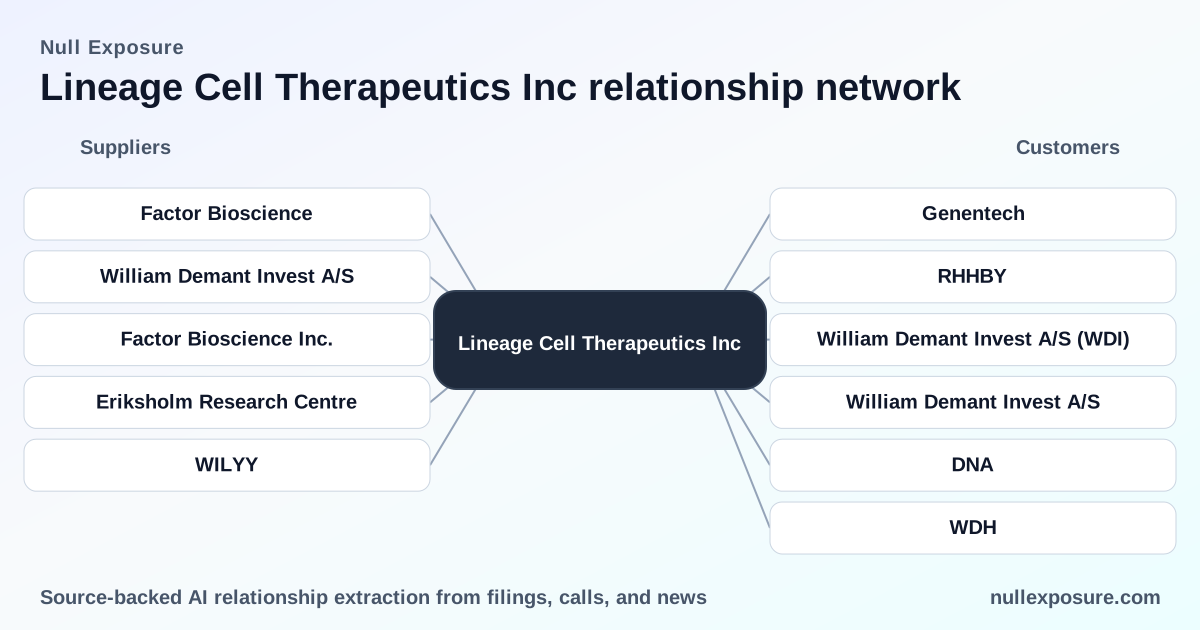
Lineage Cell Therapeutics (LCTX) — Supplier relationships and strategic constraints investors should price in
Lineage Cell Therapeutics develops and manufactures cell-based therapeutic candidates and monetizes through a mix of upfront and milestone funding from strategic partners, licensing of technology, and the future potential of product sales for approved therapies. The company operates an internal cGMP manufacturing arm (CCN) while outsourcing certain specialized inputs and R&D collaborations, which creates a hybrid supplier/partner profile that directly affects development timelines and capital intensity.
Explore supplier and counterparty signals in more depth at https://nullexposure.com/.
Why the supplier map matters to investors
Lineage’s business model is partner-driven: strategic collaborators provide specialized cell lines, co-development expertise, and project-specific funding that de-risks programs and elongates the balance between R&D spend and clinical progress. That structure produces three investment-relevant dynamics:
- Concentrated operational criticality driven by in-house CCN manufacturing and a small number of deep strategic partners.
- Convertible risk into optionality where delivered platform assets (e.g., hypoimmune iPSC lines) accelerate candidate differentiation and reduce technical execution risk.
- Funding leverage from corporate partners that can fund preclinical development to clinical filings, reducing near-term cash burn.
If you want a succinct supplier risk dashboard tied to Lineage’s public signals, start your review at https://nullexposure.com/.
Supplier relationships on the public record
The following summaries cover every counterparty listed in the supplied material, with concise source references.
Factor Bioscience / Factor Bioscience Inc.
Lineage received delivery of a novel gene-edited, hypoimmune induced pluripotent stem cell (iPSC) line from Factor under a strategic collaboration, a development intended to support immune-evasive product concepts. According to InvestingNews (reported March 10, 2026) and corroborated by a MarketScreener release (Jan 6, 2026) and a BioInformant overview (Mar 10, 2026), Factor supplied the edited cell line that feeds Lineage’s engineered-cell programs.
William Demant Invest A/S (WDI)
William Demant Invest committed up to $12 million over a three-year period to advance Lineage’s auditory neuronal transplant candidate, ReSonance (ANP1), funding preclinical work through a potential IND filing. A San Diego Business Journal article and Lineage’s own Q4 2025 earnings call referenced this funding commitment and the partnership scope.
Eriksholm Research Centre (Demant Group affiliate)
Lineage entered a multi-year research collaboration with Eriksholm Research Centre, which will jointly carry out preclinical development, manufacturing input, delivery development, translational models and regulatory strategy for the ANP1 program, with Demant funding up to $12 million in related research costs. Hearing Review reported the collaboration and its scope, noting Eriksholm’s technical role and joint management of development activities.
What these relationships mean for value creation and risk
- Factor’s supply of a hypoimmune iPSC line is a technical accelerant. Having access to gene-edited hypoimmune inputs reduces the immunogenicity hurdle for allogeneic products and shortens the roadmap to differentiated clinical programs, directly increasing the potential value of platform assets.
- Demant’s funding for ANP1 is de-risking by design. The $12 million commitment covers planned preclinical development through IND-stage readiness, transferring a meaningful portion of program-specific funding risk to a strategic partner while preserving Lineage’s upside if the program advances.
- Collaboration depth matters. Eriksholm’s hands-on role in joint development implies co-managed program execution, which shortens decision cycles but increases dependency on partner alignment and shared timelines.
Operating constraints and company-level signals investors must consider
These constraints form the backbone of Lineage’s operating posture and should be integrated into operational and valuation models:
- Licensing obligations are baked into the model. Lineage depends on third-party licensed technologies that impose payment and development obligations, which affects future cash flow and milestone schedules.
- Manufacturing concentration is high and critical. All cGMP manufacturing processes are conducted by Lineage’s subsidiary CCN at a Jerusalem facility, which makes on-site continuity central to program timelines and regulatory readiness.
- Geographic footprint is multinational but concentrated. The company operates in North America (Carlsbad office), Europe/Middle East (Jerusalem manufacturing), and APAC (subsidiary presence in Singapore), creating both diversification and cross-border operational complexity.
- Counterparty diversity includes government grants. The company receives government R&D grants (evidence cited for Israeli grants), adding non-dilutive capital but also tying aspects of programs to public-sector conditions.
- Spend envelope is material. Public filings indicate aggregate cap amounts in the range consistent with a $10M–$100M spend band (aggregate cap ~ $95.4M as of Dec 31, 2024), implying meaningful contractual financial commitments that constrain capital allocation.
These are company-level characteristics, not attributions to a specific supplier unless a public excerpt explicitly names a counterparty.
If you are benchmarking supplier concentration or contractual exposure against peers, see the structured intelligence at https://nullexposure.com/.
Investment implications and how to weigh them
- Positive thesis: Strategic supply of differentiated cell lines and third-party funding reduces technical and financing risk for prioritized programs, increasing the probability-weighted value of catalytic milestones.
- Negative thesis: Heavy dependence on a single in-house manufacturing site (CCN) and a small number of deep partners concentrates operational and counterparty risk; disruption to the Jerusalem facility or a breakdown with a strategic partner would have outsized impact.
- Valuation sensitivity: Model the ANP1 program with Demant funding offsetting near-term R&D spend and treat the Factor-supplied hypoimmune line as accelerating time-to-market rather than guaranteeing clinical success.
Final recommendation and next steps
For operators and investors focused on supplier risk and partnership optionality, prioritize:
- Monitoring operational continuity at CCN and any public updates on facility capacity or lease changes.
- Tracking milestone and funding releases from Demant tied to ANP1 to understand funded runway.
- Watching technical deliverables from Factor (acceptance criteria and integration timelines) to gauge program acceleration.
For a deeper supplier-risk profile and comparable peer maps, visit https://nullexposure.com/ to access provider-grade exposure analytics and supplier relationship summaries.
Conclusion: Lineage’s supplier ecosystem offers active de-risking through strategic collaborations and supplied platform assets, but concentration in manufacturing and material licensing obligations requires investors to price in counterparty and operational continuity risk when assessing program valuations.