LCUT supplier review: what buyers and brand mentions tell investors about supply risk and leverage
LCUT runs a sourcing- and third-party-manufacturing-centric model: the company procures finished goods and contracts third parties to produce the majority of its inventory, purchases most inventory in U.S. dollars from Asia (primarily China), and monetizes by selling those branded and private‑label products into its distribution channels. For investors, the relevant questions are concentration of procurement, contract tenor and flexibility, and how supplier geography translates into currency and geopolitical exposure.
Explore deeper supplier maps and relationship signals at https://nullexposure.com/ for a faster diligence workflow.
How LCUT’s supplier posture shapes cash flow and operating leverage
LCUT’s supplier signals point to a flexible, short‑tenor procurement posture rather than a long-term, lock‑in manufacturing strategy. According to company disclosures extracted in the relationships data, there are no formal long-term supplier arrangements, and most manufacturing is outsourced to third parties. That structure produces both operational flexibility and procurement risk:
- Contracting posture — short term and adjustable. The company’s arrangements allow modifying quantities, composition and delivery dates, which supports working capital management but limits supplier lock‑in and scale guarantees.
- Geography concentration — Asia/China dependence. LCUT sources almost all products from suppliers outside the U.S., primarily China, and makes most purchases in U.S. dollars, tying the cost base to FX and Asian supply chain dynamics.
- Relationship roles — buyer and contract manufacturer relationships. The company is both a buyer of finished goods and a contracting principal that relies on third‑party manufacturers for production.
These are company‑level signals that drive liquidity, margin and operational risk profiles: flexible buying reduces capital commitments but raises execution risk if supplier capacity tightens; APAC concentration compresses lead times and subjects margins to FX and trade policy shocks.
Check the homepage for additional supplier signals and analytics: https://nullexposure.com/
What the links in the record actually report: KitchenAid and Farberware
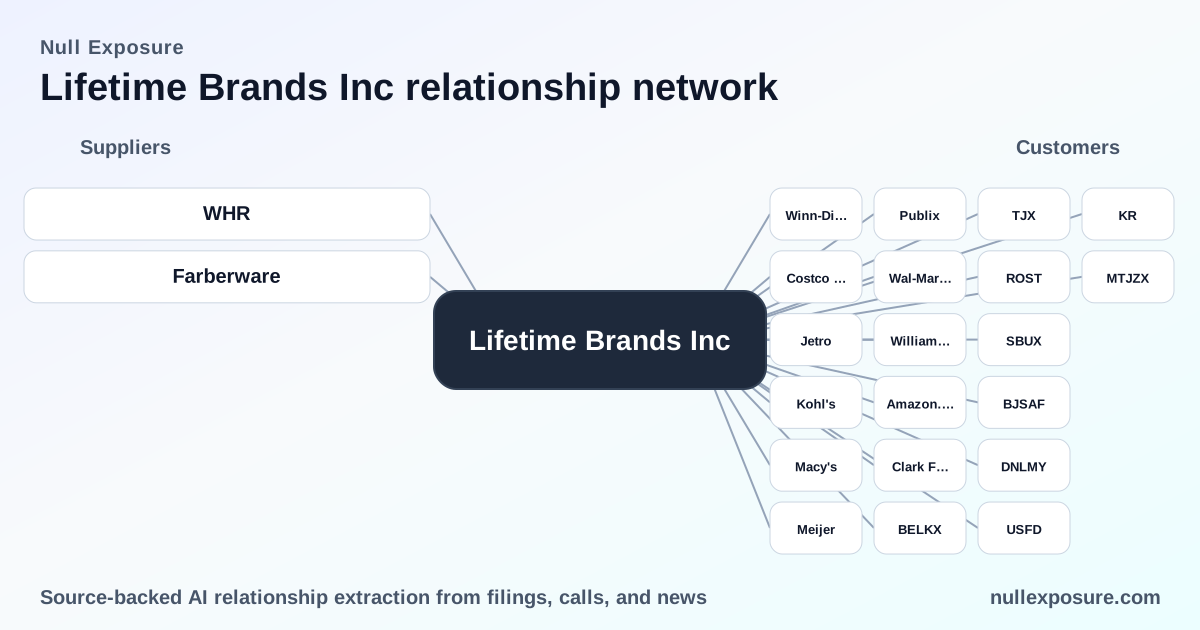
The dataset returns two brand mentions connected to LCUT’s supplier references. Both come from a Newsday piece that discusses Lifetime Brands’ asset moves and brand portfolio in a FY2016 context.
KitchenAid (inferred symbol WHR)
The Newsday article references KitchenAid as one of the branded kitchenware names operating in the same competitive and transaction context—KitchenAid appears in the discussion of brand holdings and portfolio overlap in FY2016. The mention is drawn from a Newsday report published March 10, 2026 that recounts historical brand relationships and asset sales. (Newsday, March 10, 2026)
Farberware
Farberware is cited alongside KitchenAid in the same Newsday coverage as part of Lifetime Brands’ branded kitchenware set discussed in an FY2016 frame, indicating the brands’ relevance in prior asset transactions and brand positioning. The reference originates from the same March 10, 2026 Newsday article covering Wilton-Armetale asset activity. (Newsday, March 10, 2026)
Both entries are single‑mention news sentiment hits drawn from the Newsday writeup; the fiscal period attached to these mentions is FY2016 and the article date is March 10, 2026. These relationship hits are brand‑level mentions rather than contract disclosures, so they signal market or competitive context more than supplier contract specifics.
Investment implications: what to model and where to stress test
From an investor diligence perspective, these supplier signals point to a clear set of modeling priorities:
- Stress supplier concentration. With sourcing concentrated in Asia (primarily China) and purchases made in U.S. dollars, stress tests should include FX shocks, tariff scenarios and logistics disruptions. Upstream concentration is a material operational risk.
- Model working capital under short tenors. Short‑term, flexible supplier arrangements improve agility but require careful cash/credit management when volumes spike; assume limited supplier credit and rapid cash conversion pressure during demand surges.
- Quantify manufacturing outsourcing dependency. Because the company outsources “the vast majority” of production, assume low fixed manufacturing capex but high vendor dependence for quality and lead‑time compliance.
- Consider brand/portfolio exposure separately from supplier exposure. The Newsday mentions of KitchenAid and Farberware are competitive and brand‑portfolio references; they provide context for channel strategy and pricing power but do not substitute for contract‑level supplier data.
Key takeaway: LCUT’s model favors agility over supplier lock‑in, which preserves balance sheet flexibility but increases operational execution risk if APAC supply chains or FX move materially.
Practical risk controls and monitoring actionable for operators
Operators and procurement teams should prioritize three actions to convert the supplier profile into predictable operating performance:
- Diversify sourcing lanes within APAC and increase dual‑sourcing to reduce single‑country disruption risk.
- Negotiate inventory- and capacity‑contingent clauses even within short‑term arrangements to secure prioritized production windows in peak seasons.
- Hedge USD‑denominated purchases or operationalize dynamic pricing to preserve margins against currency swings.
For an investor-grade supplier map and monitoring toolset, visit https://nullexposure.com/ and see how relationship signals tie into real‑time supplier risk scoring.
Bottom line: short-term procurement, APAC dependence, and brand context
LCUT runs a low‑capex, high‑vendor‑dependence operating model: short‑term supplier arrangements, heavy sourcing from Asia (China), and reliance on third‑party manufacturing define both upside flexibility and downside execution risk. Brand mentions such as KitchenAid and Farberware in external coverage provide competitive context but do not replace contract‑level visibility into supplier concentration or contingency capacity.
If your investment thesis relies on stable gross margins through supply certainty, prioritize contractual visibility and APAC diversification before deploying capital. For assistance converting supplier signals into investment-ready risk assessments, start with the ZeroExposure homepage: https://nullexposure.com/.