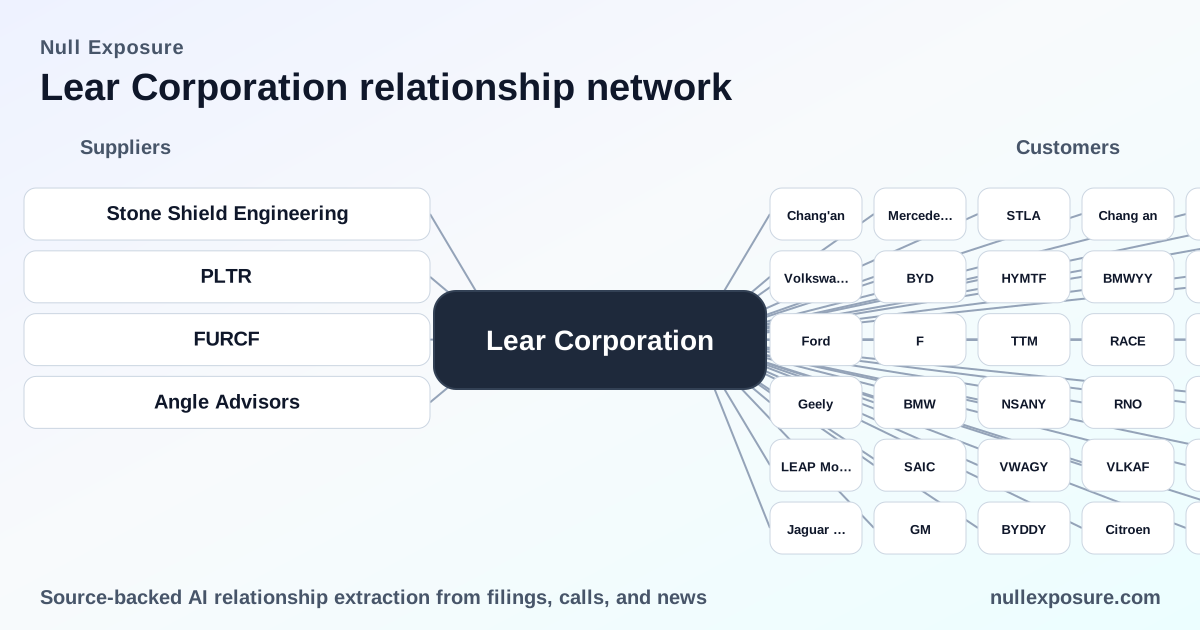
Lear Corporation (LEA) — supplier relationships that drive digital transformation and manufacturing scale
Lear Corporation operates and monetizes as a global automotive supplier: it manufactures seat systems, electrical distribution and connection systems and complementary electronic controllers, and it secures revenue through long-term supply agreements, strategic acquisitions and outsourced/insourced manufacturing relationships. Revenue is generated by component manufacturing, engineering services and multi-year commercial commitments that embed Lear into OEM production cycles. For investors, the near-term thesis is simple: growth will be driven by operational scale, targeted acquisitions to fill capability gaps, and a deepening digital partnership that converts manufacturing data into margin improvement. Learn more at https://nullexposure.com/.
What investors should know about how Lear contracts, sources and operates
Lear demonstrates a deliberate contracting posture: the company operates with long-term commitments on both the real estate/equipment side and in its supplier relations. The weighted average remaining lease term for operating leases is six years, signaling capital commitments to production footprint and stability in plant capacity. At the same time, Lear reports strategies including longer-term purchase commitments, selective in-sourcing, consolidation of the supplier base and commercial recovery mechanisms — a playbook designed to control input costs and protect margins through scale and contractual leverage.
Company-level signals on relationship roles are explicit: Lear acts as a buyer of components from multiple suppliers under varied supply agreements, uses third-party service providers for cybersecurity and advisory services, and contracts with external partners to manufacture products when customer production needs require it. These role signals underscore a hybrid business model that mixes internal manufacturing with outsourced capacity and specialist service partnerships.
Key takeaway: Lear’s operating model balances long-term fixed commitments with strategic partnerships and acquisitions to secure both capacity and technology.
Counterparties and what they mean for the business
Stone Shield Engineering
Lear acquired Stone Shield Engineering to enhance its wire-harness automation capabilities, adding technical capability and capacity in electrical systems assembly. According to Lear’s 2025 Q4 earnings call, the acquisition completed in February and is targeted at automation improvements for wiring harness production (earnings call, 2025Q4; first seen Mar 7, 2026).
Palantir / Palantir Technologies
Lear has expanded a multi-year strategic partnership with Palantir to deploy Palantir’s Foundry data integration, Warp Speed manufacturing operating system and broader AI platform across Lear’s global operations, and launched an internal Lear Fellowship as part of that collaboration. Automotive Manufacturing Solutions reported Lear’s five-year expansion of the Palantir partnership in FY2025, and Lear’s 2025 Q4 earnings call confirmed an extended collaboration; an FY2026 transcript noted an enterprise-wide solution was built rapidly in ten days as part of that rollout (Automotive Manufacturing Solutions, FY2025; Lear 2025Q4 earnings call, first seen Mar 7, 2026; InsiderMonkey FY2026 transcript).
Forvia
Lear filed a legal action in January alleging a violation of a one-year noncompete after a former executive joined Forvia as North America CFO, a matter that introduces reputational and legal friction with a peer supplier. Automotive News covered Lear’s suit against Christian Alejandro Carreon and Forvia in early 2026, framing it as a contract-enforcement dispute (Automotive News, reported Feb 2026 / suit filed January 2026; first seen Mar 10, 2026).
Angle Advisors
Angle Advisors acted as Lear’s exclusive investment banking advisor on the sale of AccuMed; that engagement reflects Lear’s use of boutique advisory relationships to execute portfolio transactions and capital allocation. The firm’s role was reported in a post about the AccuMed sale (Angle Advisors announcement, FY2025; first seen Mar 10, 2026).
How these relationships shape risk and value creation
Lear’s Palantir relationship is strategically critical: the broad deployment of Foundry and Warp Speed is designed to accelerate manufacturing optimization and reduce variable cost per vehicle — a direct lever on margins. The rapid enterprise deployment cited in transcripts signals high implementation ambition and elevated operational integration.
The Stone Shield acquisition is a classic capability buy to reduce unit costs and increase automation-driven throughput; integration execution will determine near-term returns. The legal action against Forvia introduces contract enforcement risk and illustrates management’s willingness to litigate to defend noncompete protections — a potential distraction but also a signal that Lear expects to protect human capital and competitive information.
At the company level, constraints indicate maturity and capital intensity: multi-year operating leases and explicit longer-term purchase commitments create stable capacity but increase fixed-cost leverage. Use of third-party service providers for cybersecurity and advisory services points to outsourced specialty support rather than in-house development for some enterprise capabilities.
Key risks and value drivers:
- Digital partnership concentration with Palantir is a value driver but also a single-provider operational dependency to monitor.
- Acquisition and integration execution (Stone Shield) will determine productivity gains in wiring harness automation.
- Legal and talent retention issues (Forvia litigation) are headline risks that can affect executive transitions and competitor relations.
- Capital commitment profile (six-year average lease term) improves stability but reduces nimbleness in overcapacity scenarios.
Explore a structured analysis of LEA relationships and risk signals at https://nullexposure.com/.
What investors should monitor next
- Progress metrics on the Palantir rollout: across-site Foundry adoption, Warp Speed implementation milestones, and evidence of cost-out or throughput improvement.
- Integration milestones and automation gains from Stone Shield Engineering, especially measurable improvements in wire-harness productivity.
- Legal developments in the Forvia noncompete suit and any precedent-setting outcomes that affect executive mobility.
- Follow-on M&A or carve-outs advised by boutique firms such as Angle Advisors that reveal capital allocation priorities.
For a deeper, relationship-level view and tracking of counterparties, visit https://nullexposure.com/.
Conclusion Lear’s supplier and service relationships reveal a company simultaneously locking in capacity with long-term leases, consolidating supplier exposure, and investing in digital partners and targeted acquisitions to convert data and automation into margin. Investors should treat Palantir as a strategic operational partner, Stone Shield as a capability acquisition to watch for integration returns, and the Forvia litigation as a governance and talent-protection signal. Monitor implementation milestones and legal outcomes for catalysts that will influence operational leverage and valuation.