Legacy Housing (LEGH): Turning a sales platform into a distribution advantage
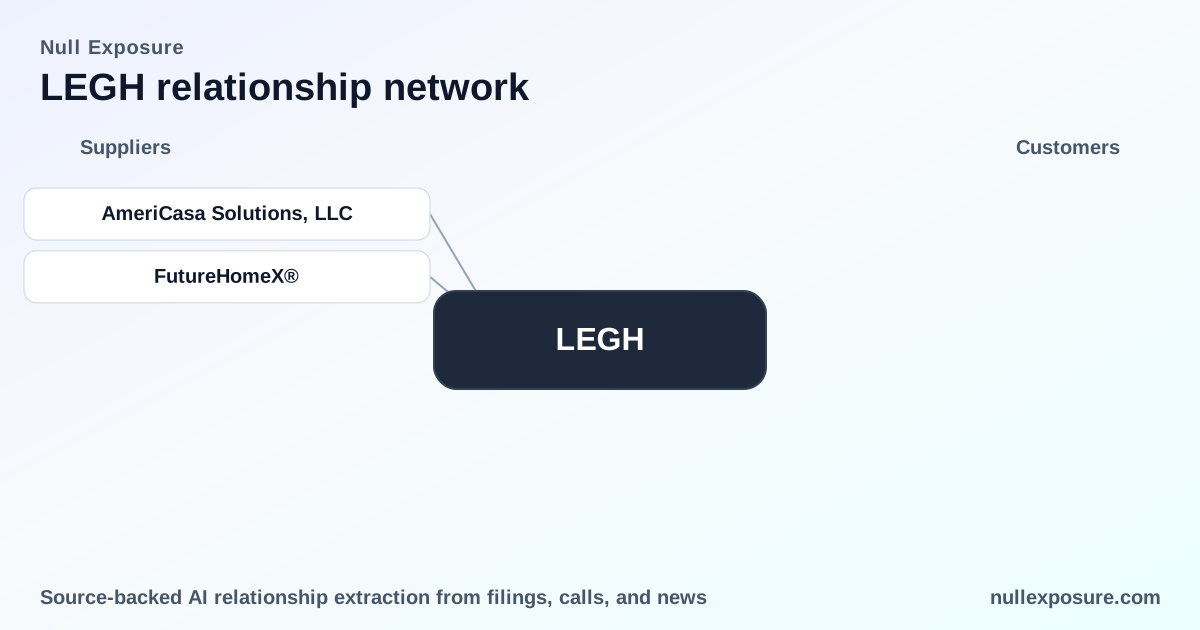
Legacy Housing manufactures community-focused manufactured homes and monetizes through factory-built home sales to retail lots, company-owned stores, and community operators. The company accelerates unit throughput and gross margins by integrating sales technology and selective asset acquisitions—most recently acquiring the assets and sales platform of AmeriCasa Solutions (FutureHomeX®)—which shifts part of the company’s operating model from pure manufacturing into vertically integrated retail and sales enablement. For investors and operators, the key question is whether the platform acquisition meaningfully increases retail velocity and margin capture without adding disproportionate execution risk. For ongoing supplier and partner monitoring, see more at https://nullexposure.com/.
What the AmeriCasa deal actually is — and why it matters
Legacy announced an all-cash agreement to acquire substantially all assets of AmeriCasa Solutions, LLC, including its proprietary sales management platform, FutureHomeX®. This is a strategic tuck-in: Legacy had already been a customer of FutureHomeX® to accelerate sales at its company-owned retail locations, and the asset purchase consolidates that capability in-house. According to the company press release distributed on GlobeNewswire on November 7, 2025, and corroborated by coverage in CityBiz and Yahoo Finance, the transaction formalizes a longstanding collaborative relationship and brings sales technology and management talent on to Legacy’s balance sheet.
Key takeaway: Bringing FutureHomeX® in-house is a horizontal integration aimed at increasing retail throughput and reducing third-party sales costs; the reported cash consideration was immaterial on a headline basis, implying a low capital strain on operations (MarketScreener noted a reported purchase consideration of $0.01 million in the transaction disclosures).
How this changes Legacy’s operating model
The acquisition adds a retail sales technology layer to Legacy’s existing manufacturing and distribution footprint. Expect three practical effects:
- Greater control over the sales funnel at company-owned retail locations, with potential for higher same-store sales conversion and faster inventory turns.
- Reduction in external vendor spend for sales management where FutureHomeX® was previously contracted, shifting costs from operating expense toward owned software and personnel.
- Modest integration overhead given the disclosed nominal purchase price, but the strategic benefit is concentrated on retail channel productivity rather than a new revenue stream.
If you track operational KPIs, focus on retail sell-through, days inventory outstanding for company stores, and incremental contribution margin from integrated sales campaigns.
For more context and ongoing supplier relationship intelligence, visit https://nullexposure.com/.
Company-level supply signals and constraints
Legacy’s procurement posture shows a classic manufacturing buyer model. Company disclosures list a broad set of principal materials — wood, steel, drywall, windows, appliances and other components — purchased from multiple third-party manufacturers and distributors. This generates several company-level signals:
- Contracting posture: Legacy operates as a buyer contracting across many suppliers rather than relying on single-source, long-term strategic exclusive suppliers; procurement is transactional with strategic relationships where necessary.
- Concentration: The vendor base is diversified across raw material manufacturers and distributors, which reduces supplier concentration risk at the company level.
- Criticality: Materials are operationally critical — interruptions in supply for key inputs would impact production — but diversification of vendors mitigates single-point failure.
- Maturity: The procurement model is mature and typical for cycle-sensitive manufactured-housing production, favoring established vendor networks and standard commercial terms.
These are company-level signals; none of the constraints explicitly tie these dimensions to AmeriCasa or FutureHomeX®.
Risks and what to watch next
- Execution risk on integration: Even with a small headline price, integrating a sales platform, data, and personnel carries execution workstreams that can distract operations. Track management commentary on integration milestones and cost synergies.
- Realized uplift vs. expectations: The promise is higher sales velocity; the investor focus should be on measured increases in retail conversion and margin expansion rather than optimistic volume projections.
- Vendor displacement effects: Moving sales capability in-house can reduce spend with third-party distributors or resellers of sales services, but this could reallocate cost rather than eliminate it — monitor SG&A trajectory and headcount changes.
- Operational criticality of acquired tech: FutureHomeX® becomes a core operational asset for company-owned retail channels; secure continuity and uptime expectations will be important as the platform drives customer-facing processes.
Relationship-by-relationship breakdown
AmeriCasa Solutions, LLC — Legacy agreed to acquire substantially all assets of AmeriCasa Solutions and its FutureHomeX® sales platform; the companies had a longstanding collaborative relationship and Legacy had previously engaged FutureHomeX® to accelerate sales at its retail locations. The acquisition was announced in November 2025 and reported across GlobeNewswire, Yahoo Finance and CityBiz. (GlobeNewswire press release, Nov. 7, 2025; CityBiz report Oct. 30, 2025; Yahoo Finance distribution Nov. 2025.)
FutureHomeX® — The FutureHomeX® platform was the operational sales management tool Legacy used at company-owned retail locations; acquiring the platform consolidates sales technology ownership and aims to accelerate sales throughput at Legacy’s retail channel. The company emphasized the role of FutureHomeX® in the announcement and related press distributions in late 2025 (Globe and Mail/press release coverage, Nov. 2025).
Practical guidance for investors and operators
- Track the first two post-acquisition quarters for measurable retail conversion lift and inventory turn improvement at company-owned stores. Those are the clearest leading indicators of ROI from this acquisition.
- Monitor SG&A and operating cash flow for any incremental investment in the platform or talent that offsets the low headline purchase price.
- Review vendor spend lines to confirm whether the move reduces third-party sales fees or simply reclassifies costs under owned operating expense.
For ongoing supplier relationship monitoring and further analysis of LEGH’s integrations and vendor posture, visit https://nullexposure.com/.
Bottom line
Legacy Housing has executed a low-cost consolidation of a sales management platform it already used, moving a formerly contracted capability onto its balance sheet to capture retail margin and improve unit velocity. The transaction is strategic, low-capital, and operationally focused; success will be measured by concrete retail performance improvements and disciplined integration. Investors should watch the next quarterly operational disclosures for evidence of improved sell-through and margin gains. For deeper supplier relationship intelligence and continuous monitoring, see https://nullexposure.com/.