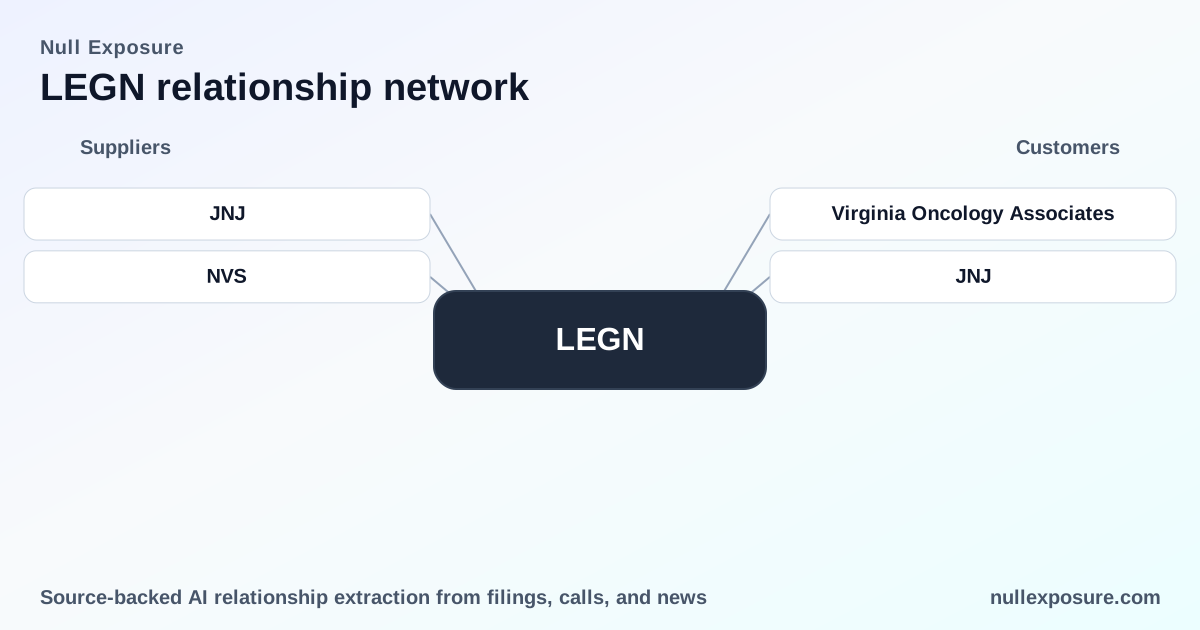
Legend Biotech (LEGN) — supplier relationships that determine commercialization and risk
Legend Biotech operates as a developer of cell therapies and monetizes primarily through strategic partnerships with large pharmaceutical companies: it advances early-stage CAR‑T and cell therapy programs internally, then leverages pharma partners for late‑stage development, regulatory execution, manufacturing scale-up, and global commercialization, collecting milestones, royalties, and shared product economics. This model concentrates commercial scale in a small number of outsized partners and transforms clinical success into royalty-like cash flow as partners commercialize approved products. For deeper vendor and counterparty analysis, review full profiles at https://nullexposure.com/.
How Legend’s partnerships convert science into cash
Legend’s operating rhythm is classical biotech partnering: internal discovery and IND‑to‑proof‑of‑concept work followed by strategic alliances that shoulder late‑stage expense and market execution. That structure reduces Legend’s capital intensity for commercialization but increases counterparty exposure — a desirable trade for growth but a governance and financial dependency investors must monitor. The company captures value through a mix of up‑front payments, development milestones, and ongoing revenue streams tied to partner commercialization.
- Commercial leverage through third parties: Partners supply global salesforce and regulatory infrastructure, enabling Legend to scale without building a full global commercial machine.
- Revenue concentration: A limited number of partners drive a disproportionate share of commercial value, concentrating execution and credit risk.
Explore supplier and partner risk indicators in depth at https://nullexposure.com/.
What the J&J and Novartis links tell investors
Legend’s public relationships signal two complementary dynamics: a mature, revenue-generating commercialization partnership and continued pipeline collaboration with other leading biopharma players. These relationships are not peripheral — they are core to how Legend realizes product value.
Johnson & Johnson — commercial partner on CARVYKTI
Johnson & Johnson is the commercialization partner on CARVYKTI (ciltacabtagene autoleucel), a BCMA‑targeted CAR‑T therapy for multiple myeloma developed with Legend; this is a live commercial program where Legend participates in economics tied to sales. According to a market report carried by ts2.tech (first seen March 10, 2026), CARVYKTI is explicitly referenced as a product developed with Johnson & Johnson, confirming the commercial partnership linkage.
Novartis — a pipeline collaboration (LB2102)
Novartis is cited in connection with an additional partnered program, LB2102, representing Legend’s continued strategy of out‑licensing or co‑developing discrete programs with large pharma to diversify clinical and commercial pathways. A ts2.tech article (first seen March 10, 2026) referenced LB2102 with Novartis as one of Legend’s partnered programs.
Operating constraints and business model signals investors should use
Even absent explicit contractual text in the source feed, a relationship map like Legend’s implies a set of operational constraints and business-model characteristics that shape investor risk/reward.
- Contracting posture — strategic, not transactional. Legend negotiates long‑term co‑development and commercialization agreements rather than one‑off supplier contracts; this creates durable dependency on partner execution and alignment.
- Concentration risk — high. With a small number of large pharma partners responsible for commercialization scale, Legend is exposed to partner credit, regulatory timing, and go‑to‑market execution.
- Criticality — commercial outcomes are partner‑mediated. Product market access and scale hinge on partner capabilities for manufacturing, distribution, and payer negotiations; that makes these supplier relationships critical to Legend’s revenue realization.
- Maturity mix — commercial and pipeline. The company runs both a mature commercial relationship (evidence: CARVYKTI commercialization) and earlier‑stage collaborations (evidence: LB2102 with Novartis), creating a ladder of short‑ and long‑term value drivers.
These signals should be treated as company‑level governance and risk factors that influence creditworthiness, partnership negotiations, and strategic optionality.
For a structured view of how supplier relationships affect cash flow forecasts and counterparty exposure, visit https://nullexposure.com/.
Relationship-by-relationship breakdown
Below are concise, plain‑English descriptions of each relationship identified in the monitoring results, with source notes.
-
Johnson & Johnson (JNJ): Legend co‑developed CARVYKTI (ciltacabtagene autoleucel), a BCMA‑targeted CAR‑T therapy for multiple myeloma, and J&J handles commercialization — a relationship that supplies Legend with downstream product economics tied to market sales. According to a news report published on ts2.tech (first seen March 10, 2026), CARVYKTI is described as developed with Johnson & Johnson.
-
Novartis (NVS): Legend has an additional partnered program designated LB2102 with Novartis, representing a pipeline collaboration aimed at advancing development beyond early‑stage work. A market write‑up on ts2.tech (first seen March 10, 2026) references LB2102 as one of Legend’s partnered programs.
Investment implications and what to watch
For investors and operators evaluating LEGN supplier relationships, the calculus is straightforward: commercial upside is tied to partner execution; downside is concentrated partner risk. Key monitoring items:
- Track partner financial health and commercial performance for products linked to Legend’s economics, particularly prescription trends and reimbursement outcomes for CARVYKTI.
- Monitor pipeline partnership cadence (new deals, milestones, and IND/phase‑readouts) to assess whether Legend is effectively diversifying partner and program risk.
- Evaluate contractual mechanics — milestone timing, royalty bands, and termination clauses — where available in filings, because those terms determine cash‑flow resilience under adverse market scenarios.
If you manage exposure to biopharma supplier risk, Null Exposure’s platform provides the counterparty profiling and alerting you need; start at https://nullexposure.com/.
Bottom line: concentrated upside, partner‑driven execution
Legend’s business model converts research into commercially realized value through strategic partnerships that supply distribution scale and regulatory muscle. That structure delivers accelerated commercialization without heavy fixed costs — but it also concentrates execution and credit risk in a few large partners. For investors, the tradeoff is clear: upside depends on partner commercial success; downside depends on partner stability and execution. Monitor J&J’s CARVYKTI dynamics and the development cadence of collaborations like Novartis’ LB2102 as the primary levers of Legend’s near‑ to mid‑term financial trajectory.
For continuing coverage of supplier relationships and counterparty risk analytics, visit https://nullexposure.com/.