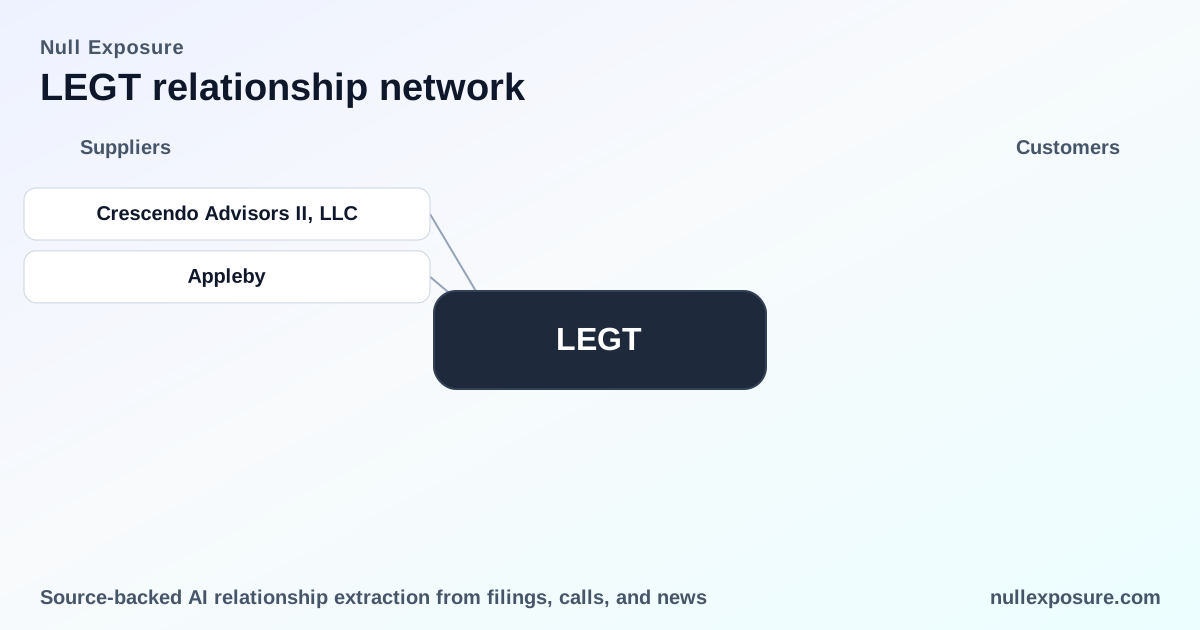
LEGT supplier map: how Legato Merger Corp. III sources services and where investor risk concentrates
Legato Merger Corp. III operates as a blank‑check acquisition vehicle that monetizes primarily through IPO underwriting proceeds and the sponsor‑driven SPAC model: it collects capital in trust, incurs underwriting and transaction fees on listing, and funds a business combination where deal fees and retained sponsor economics convert into long‑term value. The company outsources core back‑office needs and international legal work to third parties and related parties while it pursues a target combination, creating a short, concentrated supplier footprint that is service‑intensive and sponsor‑dependent.
For deeper supplier intelligence and verification, visit https://nullexposure.com/ for primary‑source extraction and relationship scoring.
What the supplier list tells investors right now
Legato’s disclosed supplier universe in filings and press coverage is compact and mission‑specific: a related‑party affiliate provides office space and administrative services, and offshore counsel supports the cross‑border transaction. Each relationship is material in different ways to SPAC execution and investor outcomes.
Crescendo Advisors II, LLC — office and G&A services
Legato occupies office space and receives general and administrative services from an entity controlled by Crescendo Advisors II, LLC under an agreed fee of $20,000 per month, payable from the IPO effective date until a business combination is consummated. This arrangement covers facilities, utilities and administrative support and is documented in the company’s FY2026 filing disclosures. (See Legato’s FY2026 filing summarized on MarketScreener and TradingView, March 2026.)
Appleby — Cayman Islands legal counsel
Appleby served as Cayman Islands legal counsel to Legato in connection with the proposed business combination with Einride AB, advising on the transaction valued at roughly USD 1.8 billion; this relationship is transaction‑level legal support for the cross‑border deal. (Reported via a March 2026 press release on Mondaq summarizing Appleby’s advisory role.)
How each disclosed relationship affects execution and investor risk
-
Crescendo Advisors II, LLC creates an operational dependency for Legato while the SPAC is pre‑combination: the sponsor‑controlled entity supplies essential office and administrative functions at a modest recurring charge, but because the counterparty is related, investors should treat payments and governance as higher‑risk points for conflict of interest. Documentation in FY2026 filings specifies monthly fees and aggregate amounts paid to affiliates in recent years. (MarketScreener / TradingView disclosures, FY2026.)
-
Appleby is a recognized international firm providing Cayman counsel for a major transformational transaction; their involvement reduces legal execution risk on cross‑border structuring but also signals that Legato is engaged in complex overseas deal work where legal fees and regulatory diligence are meaningful line items. (Mondaq, FY2025 disclosure.)
For original company disclosures and line‑item readouts, visit https://nullexposure.com/ to access source captures and relationship histories.
Company‑level constraints that shape supplier posture
Several constraints extracted from filings present a clear portrait of how Legato contracts and spends:
-
Contracting posture: short‑term engagements dominate while Legato remains a pre‑combination vehicle; service arrangements are structured to terminate or convert upon closing of a business combination. The company’s own language in filings describes service provision “until the Company consummates a business combination,” indicating tactical, event‑driven contracting.
-
Counterparty mix and concentration: disclosures show related‑party service provision and an individual sponsor providing bridge financing early in the lifecycle, signaling sponsor concentration in both operations and short‑term funding. The promissory notes from an individual sponsor were settled shortly after IPO, reflecting lifecycle transitions from sponsor debt to equity/trust capital.
-
Spend profile and criticality: Legato reported material one‑time transaction costs (totaling approximately $11.67 million for underwriting and deferred fees) alongside recurring affiliate payments in the low hundreds of thousands per annum (affiliate payments of roughly $240,000 in a recent fiscal year) and audit fees under $100k—an expense mix dominated by upfront transaction economics rather than ongoing operational cost. This concentration in transaction spend makes underwriting and sponsor terms the primary financial drivers for investors.
-
Relationship maturity: the supplier footprint is early‑stage and event‑driven. Some support arrangements exist actively through pre‑deal execution; certain sponsor loans were later settled and terminated, indicating a short lifecycle for some counterparty exposures.
These constraints are drawn from company filing language and related press summaries in FY2025–FY2026 (see Legato’s FY2026 Form 10‑K reporting and contemporaneous press coverage).
What investors should watch next
-
Related‑party economics and disclosure quality. The affiliate fee of $20,000 per month and the aggregate affiliate payments disclosed in filings are modest in isolation but important for governance; investors should insist on granular disclosure of terms, board approvals and whether services will continue post‑combination.
-
Transaction cost concentration. With underwriting and deferred fees representing the largest expense bucket, the economics of the IPO and the sponsor‑underwriter relationship will materially affect net proceeds available for an acquisition and therefore the ultimate capital deployed to target operations.
-
Cross‑border legal risk. Appleby’s role is positive for deal structuring, but the involvement underscores that regulatory and legal work is necessary and potentially expensive when completing a transaction with a European operating company.
For investor tools and to benchmark Legato’s supplier relationships against peers, check https://nullexposure.com/ for consolidated disclosures and relationship scoring.
Clear actions for operators and investors
- Request the fully executed affiliate services agreement and board minutes approving related‑party payments to verify arm’s‑length terms and termination provisions.
- Stress‑test post‑combination transition plans: who replaces sponsor‑provided services, and what are the estimated one‑time and run‑rate costs?
- Reconcile transaction cost disclosure with expected deal economics to quantify the net capital available to the combined company.
For additional supplier intelligence and authoritative sourcing, visit https://nullexposure.com/ — the hub for primary‑source relationship analysis and investor due diligence.
Bottom line: Legato runs a compact, sponsor‑centred supplier model that is short‑term, transaction‑oriented and concentrated; investors should focus on related‑party governance, transaction fee leverage and the plan for operational continuity once the business combination closes.