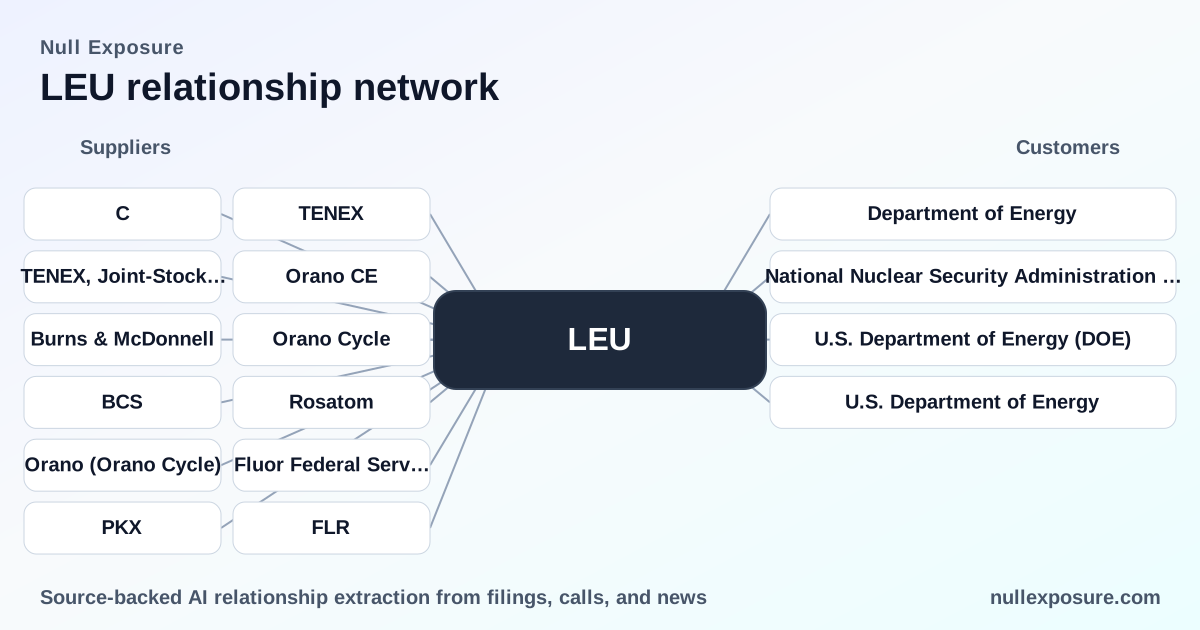
Centrus (LEU) — supplier map, contractual posture, and what investors should price in
Centrus Energy monetizes by buying, enriching and selling low-enriched uranium (LEU) and separative work units (SWU), operating a mix of inventory sales and long‑term contracts to utility customers while scaling commercial enrichment capacity through capital projects at Piketon and Oak Ridge. Revenue derives from LEU/SWU sales to utilities and governments, plus margin capture on enrichment services; growth capital is raised through equity programs and strategic partners while large-scale deployment is executed with third‑party EPC and engineering firms. For investors, the core checklist is supply concentration, contract tenor, geopolitically exposed counterparties, and the execution risk of expansion contractors. Visit the NullExposure homepage for a consolidated view of supplier relationships and filings: https://nullexposure.com/
Quick read: what moves the stock and why suppliers matter
- Supply concentration is real: Centrus discloses reliance that accounts for well over half of anticipated supply for U.S. deliveries in 2026–2027, creating a strategic single‑point sensitivity.
- Contract mix is blended: The company runs long‑term supply contracts through 2030 while retaining the option for spot purchases and loans from secondary sources to manage flexibility.
- Execution risk is front‑loaded: Major capital deployment depends on external EPC and engineering partners; successful delivery of Piketon expansion will materially affect future revenue and margins.
- Funding profile is active: Management has used at‑the‑market equity programs and is pursuing FDI and other low‑cost capital routes to fund build‑out.
If you need a consolidated supplier risk brief or bespoke relationship analysis, start here: https://nullexposure.com/
Supplier roster and what each relationship means to operators and investors
TENEX (TENEX / TENEX, Joint‑Stock Company)
TENEX is identified as a major supplier of SWU to Centrus and a material input to planned 2026–2027 deliveries; the 2025 Form 10‑K warns that U.S. prohibitions on transactions with Rosatom and its subsidiaries would prevent implementation of the TENEX Supply Contract, creating a principal geopolitical counterparty risk. This risk is reiterated across Centrus filings and recent press. (Source: Centrus FY2025 10‑K; InvestingNews reporting 2026.)
Rosatom
Rosatom is the Russian parent organization referenced as the government‑owned entity whose subsidiaries, including TENEX, are central to Centrus’s existing supply contracts; U.S. policy action against Rosatom would disrupt those contracts and Centrus’s SWU supply. (Source: Centrus FY2025 10‑K.)
Orano Cycle
Orano Cycle is the original French counterparty with which Centrus entered a 2018 long‑term supply agreement for SWU contained in LEU, establishing a European diversification point in Centrus’s portfolio. (Source: Centrus FY2025 10‑K.)
Orano CE
The Orano Supply Agreement was assigned by Orano Cycle to its affiliate Orano CE, showing corporate housekeeping on the supplier side but preserving the long‑term commitment for SWU delivery from the Orano group. (Source: Centrus FY2025 10‑K.)
Fluor Federal Services, Inc. / Fluor / Fluor Corporation
Fluor is contracted as the primary Engineering, Procurement and Construction (EPC) partner for the Piketon expansion and broader deployment of LEU and HALEU production capability, with an ACO‑Fluor contract announced in February 2026 and confirmed on the Q4 2025 earnings call. The Fluor engagement is the execution pivot for Centrus’s multi‑billion‑dollar capacity build‑out. (Source: Centrus FY2025 10‑K; InvestingNews press release March 2026; Q4 2025 earnings call.)
Burns & McDonnell
Burns & McDonnell was selected to provide design and engineering services for modernization initiatives, indicating that Centrus is layering specialized engineering contractors ahead of large EPC activity — a positive signal for staged technical execution. (Source: InvestingNews reporting on the training/operations hall, 2026.)
Citigroup
Citigroup served as one of the sales agents under an at‑the‑market equity offering program announced November 6, 2025, enabling Centrus to issue up to $1 billion of Class A common stock and thus supply growth capital for expansion and supplier commitments. (Source: Globe and Mail press release re: AT‑the‑market program, November 2025.)
Barclays
Barclays was listed alongside Citigroup as a sales agent in the $1 billion at‑the‑market equity offering program, representing active capital markets engagement to fund execution. (Source: Globe and Mail press release, November 2025.)
POSCO International
POSCO International is named in a memorandum of understanding referenced on the Q4 2025 earnings call as a potential source of foreign direct investment and low‑cost capital, validating management’s pursuit of non‑dilutive or lower‑cost funding alternatives tied to industrial partners. (Source: Q4 2025 earnings call.)
How constraints shape Centrus’s operating model and supplier posture
Centrus’s filings and disclosures signal a company operating at the intersection of long‑term contracts and tactical spot flexibility. The explicit mention that supply of SWU runs through 2030 and Centrus’s own inventory and long‑term contract set imply a contracting posture that is predominantly long‑term with spot supplementation to manage short‑term needs. The company reports a global supplier footprint, supplying LEU components from multiple geographies, which underwrites diversification but does not eliminate concentration risk: management states one set of suppliers accounts for well over one‑half of anticipated supply in 2026–2027, a company‑level concentration signal that elevates geopolitical and counterparty risk.
Contract maturity leans to the mid‑term (through 2030), but Centrus also uses short‑term purchases and loans from secondary sources to maintain operational flexibility. Procurement behavior is clearly buyer‑oriented — Centrus procures under both short‑ and long‑term contracts and holds inventories to smooth deliveries. On the procurement economics side, Centrus references IDIQ awards with a $2.0 million contract minimum, suggesting discrete spend bands for certain engineering and services work. These constraints imply that execution of large capital projects will depend on tier‑one EPC delivery, access to capital markets, and stable geopolitical conditions.
If you’re monitoring supplier concentration and the execution readiness of expansion contractors, see the centralized Centrus supplier dossier at https://nullexposure.com/ for source documents and an analyst checklist.
Investment implications and action points
- Bull case: Successful EPC execution by Fluor, staged engineering by Burns & McDonnell, and stable non‑Russian supply from Orano and alternative secondary sources support a revenue and margin ramp as new centrifuge capacity comes online.
- Bear case: Sanctions or tariffs that interrupt TENEX/Rosatom flows or execution slippage at Piketon would compress supply and force higher‑cost spot purchases, pressuring margins and liquidity.
For a deeper, exportable supplier-risk memo or to compare Centrus’s counterparty map against peers, visit NullExposure: https://nullexposure.com/
Final point: supplier concentration and EPC execution are the two levers that will move Centrus’s valuation over the next 24 months — investors should underwrite both the geopolitical risk premium and the delivery risk premium when setting positions. For tailored due diligence and per‑relationship evidence, go to https://nullexposure.com/ and download the consolidated source pack.