Levi Strauss & Co (LEVI) — supplier relationships and operating posture
Levi Strauss & Co. is a global apparel manufacturer and retailer that monetizes through wholesale, owned retail and direct-to-consumer channels, supported by a global sourcing model that procures finished goods from independent contract manufacturers. The company captures margin through brand pricing, scale in distribution and gross-profit retention, while managing working capital through standard supplier payment terms and a supplier financing program that accelerates cash to vendors. For investors and operators, the key question is how Levi’s sourcing footprint, payment posture and financial commitments shape execution risk and supplier dependency.
Explore supplier risk and exposure at https://nullexposure.com/
How Levi runs procurement and where the leverage sits
Levi sources nearly all product through independent contract manufacturers across approximately 32 countries, and the company’s global sourcing organization uses the U.S. dollar as its functional currency while procuring inventory on behalf of subsidiaries that operate in Euros, AUD and JPY. Payment terms for a majority of suppliers are typically 90 days, and the company offers a supplier financing program enabling suppliers to sell Levi’s receivables to financial institutions on a non‑recourse basis to receive earlier payment. According to company filings, confirmed obligations outstanding were $152.2 million as of December 1, 2024 and $136.5 million as of November 30, 2025, indicating meaningful committed spend in the near term.
- Sourcing footprint: Global, diversified across ~32 countries with a deliberate cap — no more than 30% sourced from any single country — which reduces single‑country concentration risk.
- Contracting posture: Short-term supplier relationships and 90‑day payment terms give Levi procurement flexibility but concentrate commercial risk into rolling cycles.
- Working capital mechanics: Supplier finance programs shift payment timing without increasing trade payables on Levi’s balance sheet; the program accelerates vendor cash conversion and offloads receivable risk to financiers.
- Financial scale: Revenue TTM $6.282 billion and gross profit $3.878 billion provide operating scale that supports negotiation leverage and investment in distribution.
Constraints that define operational risk and maturity
The company-level constraints in filings provide direct signals about Levi’s operating model and maturity:
- Short-term contracting: The majority of supplier relationships are governed by relatively short payment cycles (90 days), which indicates a transactional contracting posture suited to fast-moving consumer apparel rather than long-term, highly customized manufacturing contracts.
- Global sourcing with controlled concentration: Sourcing from ~32 countries while keeping any single country below ~30% signals geographic diversification and active supply‑chain risk management.
- Multi-role engagement: Levi functions simultaneously as a buyer (primary purchaser of finished goods), distributor (North American distribution workforce subject to collective bargaining), manufacturer customer (reliance on independent contract manufacturers), and financial services participant (use of hedging instruments and supplier financing).
- Material committed spend: Confirmed obligations in the hundreds of millions demonstrate scale and entrenched vendor relationships that are economically meaningful for suppliers and financiers.
These characteristics point to a mature, commercially disciplined sourcing organization with centralized treasury and procurement controls that favor flexibility and short contract durations over long, captive manufacturing arrangements.
What we found about Levi’s external relationships
Below is every relationship captured in the available results and a concise plain‑English summary.
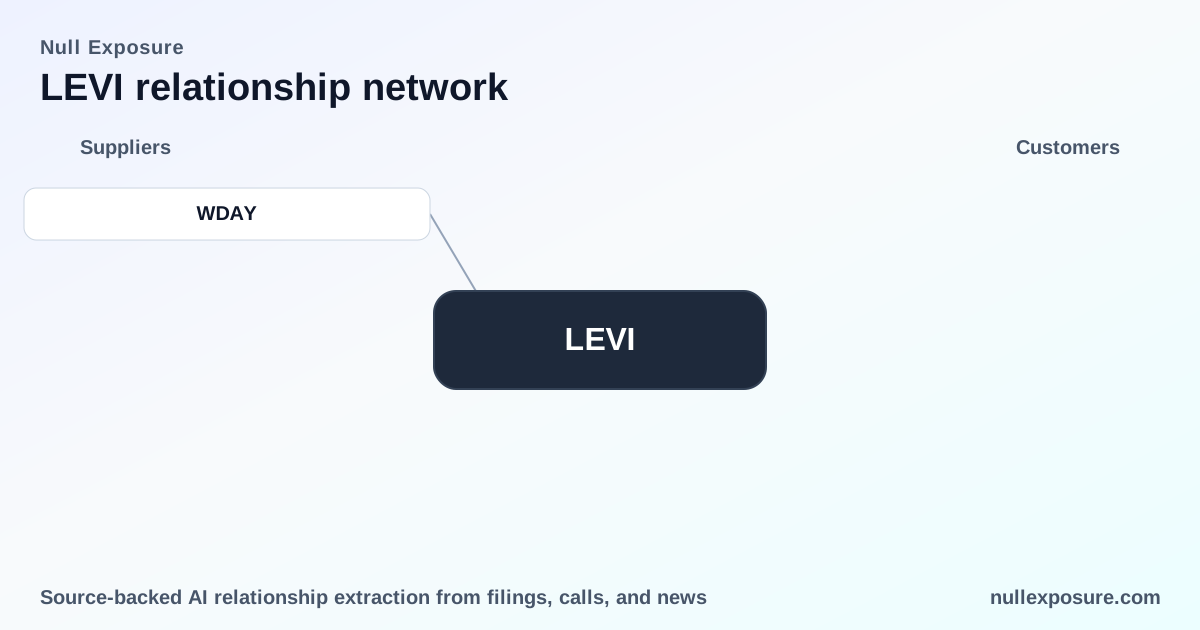
Workday, Inc. (WDAY)
A TradingView news item citing Zacks on March 10, 2026 reported that Workday noted expansion agreements with Levi Strauss as a positive factor in its FY2025 commentary, indicating an ongoing SaaS relationship and likely growth in enterprise software usage at Levi. (Source: TradingView / Zacks, March 10, 2026.)
What the relationship map implies for investors and operators
The Workday mention is notable because it highlights Levi’s investment in enterprise software and digital operations, which complements the sourcing and distribution model. Enterprise SaaS relationships are operationally critical but non-capital-intensive, meaning they affect operating expenditures, implementation risk and vendor concentration differently than manufacturing partners.
Key investment implications:
- Procurement risk is operational rather than supplier-concentration driven — diversification across 32 countries reduces geopolitical single‑point risk, but short contract tenors mean supplier turnover or disruptions can have immediate cost and availability effects.
- Working capital and vendor finance are tools, not bailouts — the supplier financing program improves vendor liquidity and preserves 90‑day contractual payment terms for Levi; this shifts some receivable risk to financiers but requires monitoring for program sizing and counterparty exposure.
- Committed spend is material — confirmed obligations in the $136–152 million range are a meaningful near‑term liability for vendors and a signal to investors about future procurement cadence.
For operational teams, the combination of short‑term contracts and large confirmed obligations necessitates active vendor management and contingency sourcing plans.
Explore supplier-level analytics and risk dashboards at https://nullexposure.com/ for deeper vendor mapping.
Actionable next steps for investors and operators
- Conduct a vendor-criticality assessment that ranks suppliers by dollar exposure and single-country concentration; focus on suppliers that could produce disruption if commodity or currency volatility spikes.
- Review the supplier financing program’s scale and counterparties to assess off‑balance sheet liquidity transfer and third‑party credit exposure.
- Validate enterprise-software rollouts (e.g., Workday) against internal process sensitivity: SaaS expansions reduce manual overhead but increase dependence on vendor SLAs and data continuity.
Decisive monitoring of procurement cadence, supplier financing scale and software vendor SLAs is the priority. For further engagement and tailored supplier exposure intelligence, visit https://nullexposure.com/.
Final takeaway
Levi operates a global, diversified sourcing model with short‑term contracting and substantial near‑term procurement commitments, balanced by a supplier financing program and enterprise-grade software partnerships. That combination provides commercial flexibility and scale advantages, but it also places emphasis on active vendor governance and treasury oversight. Investors should treat the procurement function as a source of both cost control and operational risk; operators should prioritize continuity planning and supplier performance metrics to protect margin and availability.