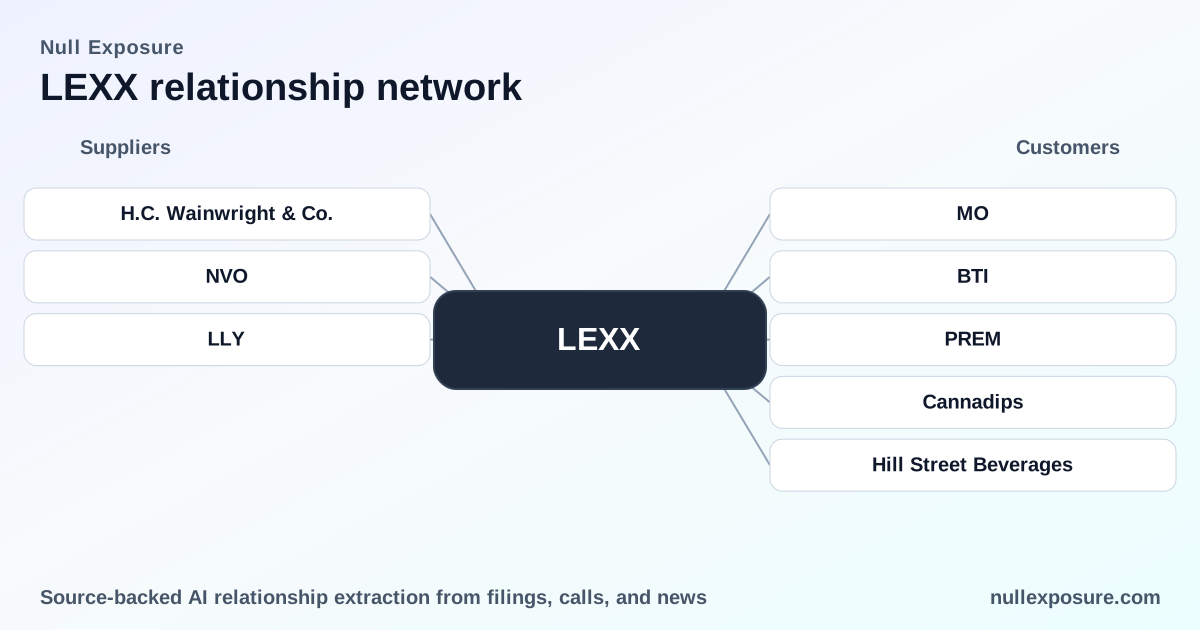
Lexaria (LEXX) supplier profile: what operators and investors need to know
Lexaria develops and licenses its DehydraTECH oral delivery platform and monetizes through B2B formulation agreements, research collaborations, and periodic equity financings that underwrite development. The company outsources manufacturing and analytical work, sells technology-enabled ingredients and formulations to partners, and supplements cash flow with registered-direct offerings and placement-agent led financings. For a focused supplier-risk view and relationship map, visit https://nullexposure.com/.
How Lexaria runs its business and where revenue comes from
Lexaria’s operating model centers on intellectual property and formulation know‑how rather than large in‑house manufacturing. The firm licenses DehydraTECH to customers and supports research programs and B2B sales through third‑party manufacturers and independent analytical labs. With reported revenue of roughly $522k TTM against a negative EBITDA and small market capitalization (~$17.6M), the business model relies on outsourced execution and external capital to advance clinical and commercial initiatives.
- Primary monetization channels: licensing/formulation fees, B2B product sales to partners, research collaborations, and equity financings used to fund R&D and working capital.
- Capital posture: frequent use of registered-direct offerings and placement agents to raise cash indicates ongoing capital dependence rather than cash-flow self-sufficiency.
Explore how supplier exposures affect investment thesis at https://nullexposure.com/.
Who Lexaria is working with — and what those links imply
Below are all supplier/partner mentions returned in the supplier-scope results. Each relationship summary is concise and sourced to the underlying press coverage.
H.C. Wainwright & Co.
H.C. Wainwright served as exclusive placement agent for Lexaria’s $3.5 million registered direct offering priced at the market under Nasdaq rules, facilitating short-term capital raise activity in FY2025. According to TradingView’s Reuters posting and related investingnews coverage (December 2025), the firm executed the financing and closed the offering that provided immediate liquidity for operations. (Sources: TradingView/Reuters and InvestingNews, Dec 2025.)
Rybelsus ® (Novo Nordisk — inferred NVO)
Lexaria’s Phase 1b study GLP‑1‑H24‑4 referenced a reformulated SNAC‑inclusive Rybelsus® as an input for semaglutide in comparative evaluations, indicating Lexaria’s work interacts with commercially produced oral semaglutide formulations in its research protocols. The company press release hosted on JSONLINE described the composition used in the study and its role in benchmarking DehydraTECH performance (reported 2026). (Source: JSONLINE press release, 2026.)
Zepbound ® (Eli Lilly — inferred LLY)
In the same Phase 1b program, Lexaria notes the DehydraTECH tirzepatide composition used pure tirzepatide rather than reformulated commercial Zepbound®, highlighting product‑level differentiation when converting clinical comparators into investigational inputs. That distinction was documented in the company release available via JSONLINE (reported 2026). (Source: JSONLINE press release, 2026.)
What the relationship map signals about Lexaria’s operating posture
The relationships and corporate disclosures generate clear company‑level operating signals:
- Outsourcing and global supplier footprint: Lexaria states it outsources virtually all analytical work to independent third‑party laboratories in the USA, Canada, Europe, and Australia, indicating a geographically distributed supplier network that reduces single‑jurisdiction concentration but increases coordination complexity. This is a company-level signal derived from corporate statements.
- Role mix — manufacturer and service provider: Lexaria explicitly relies on third‑party suppliers and manufacturers to produce DehydraTECH compounds for both research programs and B2B customers, establishing the company as IP/licensor and orchestrator rather than an owner‑operator of large-scale production facilities.
- Contracting posture: The firm’s use of external placement agents and registered direct offerings implies short-term financing strategies are central to sustaining development timelines; procurement and supplier contracts likely reflect project-based, pay‑as‑you‑go engagements rather than long-term captive manufacturing agreements.
- Maturity and concentration: Low revenue and negative EBITDA combined with outsized reliance on financing reflect an early-stage commercial profile with potential supplier concentration in critical service areas (analytical labs and specialized manufacturers). These are company-level risk characteristics, not claims about any single supplier.
Investment implications and a practical risk checklist
For operators and investors, the supplier profile boils down to a few actionable points:
- Capital dependence is the dominant risk driver. The December 2025 registered direct offering executed with H.C. Wainwright evidences recurring financing as a key element of runway management. (Source: TradingView/Reuters; InvestingNews, Dec 2025.)
- Supply execution risk is operationally critical. Outsourcing both manufacturing and analytical work means Lexaria’s timelines and data integrity depend on third‑party compliance and capacity across multiple jurisdictions.
- Comparators and reputational linkage matter. Public references to Rybelsus® and Zepbound® in study materials position Lexaria’s platform in direct technical conversation with incumbent oral peptide formulations, which supports commercial relevance but also heightens regulatory and IP scrutiny. (Source: JSONLINE press release, 2026.)
- Concentration assessment required. While geographic dispersion exists for labs, the firm’s small scale increases the impact of any single supplier failure; investors should prioritize counterparty diversity, contract terms, and contingency plans in due diligence.
Learn how to map supplier exposures to portfolio actions at https://nullexposure.com/.
Final read and recommended next steps
Bottom line: Lexaria operates as an IP‑centric developer that outsources execution and regularly taps capital markets to fund progression. The H.C. Wainwright relationship confirms active financing channels; the Rybelsus® and Zepbound® mentions illustrate how Lexaria positions its DehydraTECH platform against existing oral peptide formulations in clinical work. Investors should treat supplier reliability, financing cadence, and comparator engagement as the three levers that will determine near‑term valuation trajectories.
Actionable next steps:
- Review recent financing terms and placement‑agent agreements to understand dilution risk.
- Verify contractual durations and backup providers for key labs and manufacturers.
- Monitor clinical communications referencing commercial comparators for regulatory exposure.
For a deeper supplier-risk brief and ongoing monitoring, visit https://nullexposure.com/ and request the extended supplier dossier tailored for institutional due diligence.