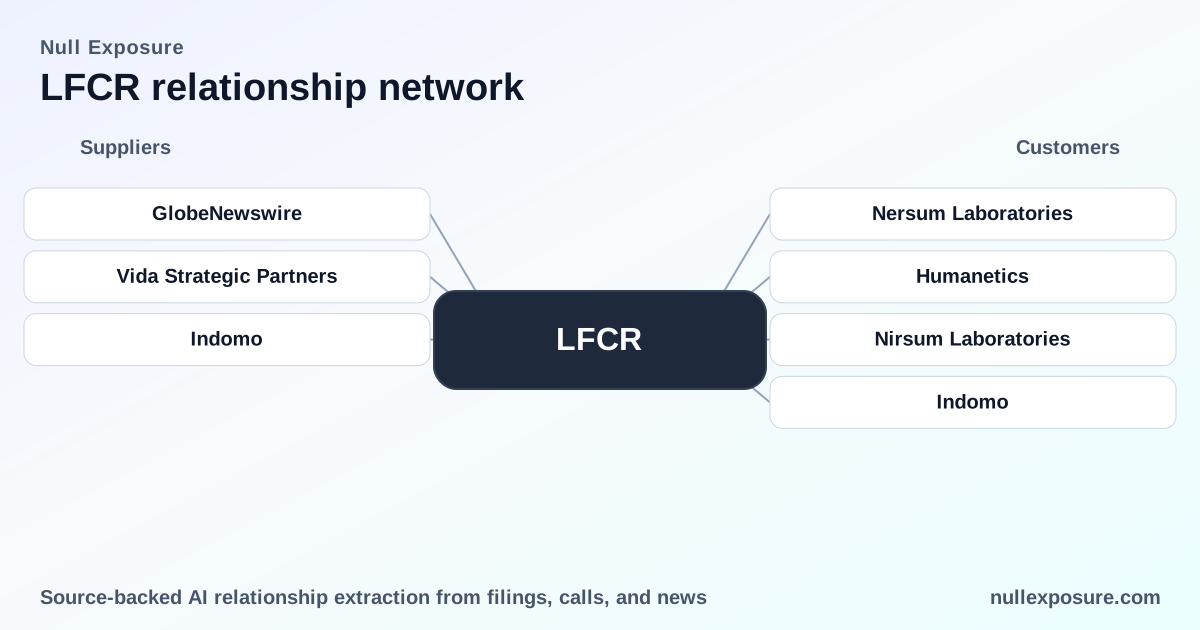
Lifecore Biomedical (LFCR) — Supplier Relationship Briefing
Lifecore Biomedical operates as a specialty materials supplier and contract manufacturer focused on hyaluronic acid (HA) and related biologic components, monetizing primarily through manufacturing contracts, product sales to pharma/device customers, and strategic partnerships that commercialize combination drug/device programs. Revenue depends on contract throughput, the sale of specialty HA products, and collaboration deals that migrate development-stage projects into recurring manufacturing revenue. For investors and operators assessing counterparty risk, the supplier map for Lifecore is compact but consequential: raw-material sourcing and a small number of product partnerships determine both operational continuity and growth optionality. For full supplier intelligence and ongoing monitoring, visit https://nullexposure.com/.
What public signals reveal about Lifecore’s operating posture
Lifecore’s disclosures and filings frame the company as a buyer of specialized raw materials and as a manufacturing partner to innovators. Company-level signals show a buyer contracting posture with meaningful supplier concentration for inputs used in HA products. That dynamic creates an operational profile with clear strengths and measurable risks:
- Concentration: Lifecore reports that several raw materials for its HA products are purchased from a single source, which creates single-vendor exposure for critical inputs.
- Criticality: Those inputs are directly tied to product manufacturing; any disruption would have immediate effects on production schedules and revenue recognition.
- Contracting posture: As the buyer, Lifecore has negotiating leverage in some situations, but single-sourcing diminishes that leverage and raises supplier-replacement costs.
- Maturity of relationships: The nature of the materials and the industry implies long-standing, technical supplier relationships rather than ad hoc spot purchases; expect multi-year engagements or qualified-supplier processes.
Key takeaway: supply-concentration for HA inputs is a supply-chain risk that translates into operational and margin volatility unless mitigated through dual-sourcing, inventory strategy, or contractual guarantees.
Relationship inventory — the items you need on your map
Below are the relationships surfaced in public results. Each entry is a concise, business-focused summary with source context for validation.
GlobeNewswire / Quarterly results announcement (press release repost)
Lifecore scheduled a Q4 and transition-period financial results announcement for March 16, 2026, publicized via a GlobeNewswire release and reposted on QuiverQuant on March 10, 2026; the notice is a standard earnings-event communication for investors. (Source: GlobeNewswire press release repost, March 10, 2026.)
Vida Strategic Partners — investor & media contact
Vida Strategic Partners is listed as Lifecore’s investor and media relations contact, providing outreach and investor communications support; the QuiverQuant repost of the earnings notice includes Vida’s contact details (Stephanie Diaz). (Source: QuiverQuant repost of GlobeNewswire contact info, March 10, 2026.)
Indomo — R&D / development partnership for drug/device acne treatment
Lifecore signed an agreement with Indomo to support a drug/device combination acne treatment, positioning Lifecore as a manufacturing and development collaborator on a specialty program that can convert into recurring manufacturing revenue if development advances. (Source: GlobeNewswire release dated December 16, 2025.)
Why each relationship matters to investors and operators
- Earnings communications and investor relations (GlobeNewswire / Vida Strategic Partners): These outlets are gateways for market signals — watch timing and tone for guidance on order-book health, backlog, and capital expenditures that fund capacity expansion. The presence of a retained investor-relations firm signals active market engagement and an emphasis on clarity for liquidity events.
- Indomo partnership: This is a growth vector; collaboration on a drug/device combination adds product diversification and potential high-margin manufacturing services if the candidate proceeds to commercial scale. That upside is conditional on clinical and regulatory progress but represents a clear pipeline relationship that converts R&D activity into future manufacturing demand.
Operational and investment implications of the single-source constraint
Lifecore’s admission that several raw materials for HA products come from a single vendor is a company-level signal with several concrete implications:
- Operational risk: Single-sourcing of critical inputs increases the likelihood of production interruptions. Inventory buffers or alternate qualified vendors are necessary to reduce downtime risk.
- Commercial leverage and cost exposure: Supplier concentration reduces Lifecore’s pricing leverage and exposes margins to input-cost shocks or supplier negotiation leverage.
- Regulatory & quality implications: For GMP-relevant inputs, supplier changes require validation and regulatory documentation; single-source status can lengthen recovery time after a disruption.
- Mitigation pathways: Investors should look for capex or supply agreements aimed at dual-sourcing, validated second sources, or higher finished-goods inventory as indicators the company is addressing this constraint.
Key takeaway: single-vendor exposure for HA inputs is a clear, monitorable supply-chain vulnerability that directly ties to manufacturing continuity and margin stability.
For deeper supplier-insight tools and ongoing tracking of these signals, visit https://nullexposure.com/ to access the full supplier profile and alerts.
What to watch next — concrete monitoring and engagement items
Active investors and operational leaders should prioritize the following actions:
- Track quarterly commentary and management Q&A (next results release scheduled March 16, 2026) for updates on backlog, supplier mitigation strategies, and capital spend to expand capacity.
- Monitor commercialization progress on the Indomo program — any advancement toward pivotal studies or scale-up contracts materially increases future contract-manufacturing revenue.
- Request or review supplier continuity evidence (dual-source status, inventory targets, long-term purchase agreements) in investor presentations or direct diligence.
- Watch for pricing or margin guidance changes tied to raw-material cost statements; single-source exposure will show up first in gross-margin variability.
Bottom line and recommended next steps
Lifecore combines a focused product/manufacturing model with selective partnerships that can convert into recurring revenue, but supply concentration on HA inputs is a salient risk that investors must factor into valuation and scenario analysis. The Indomo collaboration is a positive growth signal, while investor communications cadence indicates active market engagement.
For operators and investors doing next-stage diligence, prioritize supplier continuity documentation and commercial milestones on partnership programs — and sign up for ongoing supplier monitoring at https://nullexposure.com/ to receive timely alerts and deeper relationship mapping.
Actionable insight: Confirm whether Lifecore has executed dual-sourcing or long-term supply agreements for HA inputs; absence of those mitigations increases probability-weighted downside in stress scenarios.