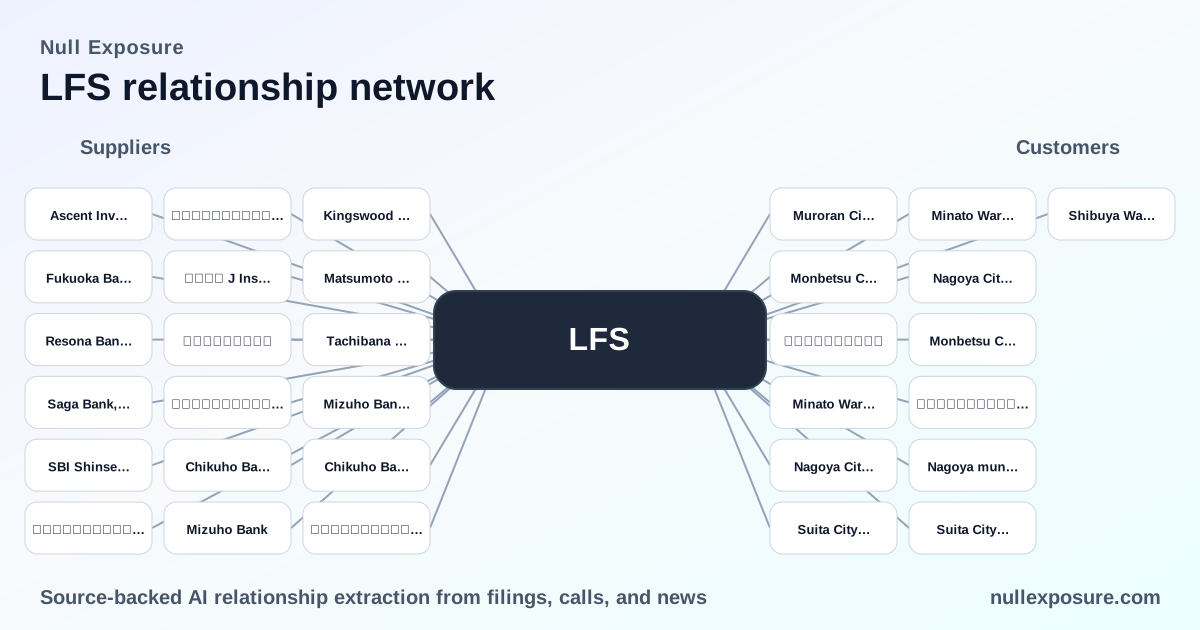
LFS supplier map: what the latest partner disclosures tell investors
Leifras Co., Ltd. (ticker LFS) operates as a sports-education and community-activity operator that monetizes through program fees, management contracts and project-based funding while leveraging local partnerships to scale school- and community-focused initiatives. Recent filings and press releases show the company funds growth through bank commitment lines and occasional equity offerings, and it outsources key program delivery to specialist partners and educational institutions. For a practical supplier and partner view, see https://nullexposure.com/.
Short read: the partner set in plain English
Below I list every partner disclosed in the recent public feed, with a concise, investor-oriented one- or two-sentence description and the source for each mention. These are operational relationships — lenders, project partners, program vendors, and investor-relations providers — that govern how Leifras delivers and funds its services.
-
Kingswood Capital Partners — acted as the underwriters’ representative for a small capital raise that generated $5.0 million in gross proceeds, signaling episodic equity financing as part of the capital stack (Benzinga, Nov 2025: leifras LFS stock trending).
Source: https://www.benzinga.com/markets/equities/25/11/48795127/leifras-lfs-stock-trending-overnight-after-576-massive-rally-on-tuesday -
Matsumoto Co., Ltd. — provides land and facilities and oversees execution for a Kitakyushu City project, effectively supplying the physical infrastructure for a joint education initiative with Leifras (Benzinga / ManilaTimes PR Newswire, Dec 2025).
Source: https://www.benzinga.com/markets/small-cap/25/12/49591591/leifras-secures-16-million-funding-line-to-power-expansion-push and https://www.manilatimes.net/2025/12/26/tmt-newswire/pr-newswire/leifras-co-ltd-to-launch-collaborative-project-addressing-school-refusal/2249649 -
Tachibana Gakuen Educational Institution — provides school-management guidance and student support on collaborative projects, positioning Leifras to rely on established educational operators for program credibility and delivery (ManilaTimes PR Newswire, Dec 2025).
Source: https://www.manilatimes.net/2025/12/26/tmt-newswire/pr-newswire/leifras-co-ltd-to-launch-collaborative-project-addressing-school-refusal/2249649 -
Mizuho Bank, Ltd. — served as agent/arranger on a 2.5 billion JPY commitment line that underpins near-term operations and expansion, reflecting institutional bank financing in the capital structure (company notice / Yahoo Finance, Mar 2026).
Source: https://finance.yahoo.com/news/leifras-notice-regarding-conclusion-commitment-140000634.html -
Chikuho Bank, Ltd. — co-arranger on the same 2.5 billion JPY commitment line, demonstrating Leifras’ use of regional bank syndication to match local project footprints (company notice / Benzinga, Dec 2025).
Source: https://www.benzinga.com/markets/small-cap/25/12/49591591/leifras-secures-16-million-funding-line-to-power-expansion-push and https://finance.yahoo.com/news/leifras-notice-regarding-conclusion-commitment-140000634.html -
Fukuoka Bank, Ltd. — listed as a participating lender in the lender group supporting the commitment line, indicating a diversified roster of regional lenders backing operations (Yahoo Finance, Mar 2026).
Source: https://finance.yahoo.com/news/leifras-notice-regarding-conclusion-commitment-140000634.html -
Resona Bank, Ltd. — included among lenders to the commitment line, further broadening Leifras’ banking relationships across national/regional institutions (Yahoo Finance, Mar 2026).
Source: https://finance.yahoo.com/news/leifras-notice-regarding-conclusion-commitment-140000634.html -
Saga Bank, Ltd. — named as a lender on the 2.5 billion JPY facility, aligning local banking capacity with regional project needs (Yahoo Finance, Mar 2026).
Source: https://finance.yahoo.com/news/leifras-notice-regarding-conclusion-commitment-140000634.html -
SBI Shinsei Bank, Ltd. — appears in lender disclosures alongside Chikuho Bank, showing Leifras’ access to non-traditional and national banking channels (Yahoo Finance, Mar 2026).
Source: https://finance.yahoo.com/news/leifras-notice-regarding-conclusion-commitment-140000634.html -
ライフイズテック株式会社 (Life is Tech) — listed as a programming partner for education content, reflecting outsourcing of curriculum or technology-enabled instruction to third-party specialist vendors (ATPress, FY2022 disclosure).
Source: https://www.atpress.ne.jp/news/317219 -
一般社団法人エスコートダンス協会 (Escort Dance Association) — named as an activity partner for dance/escort-dance programming, indicating Leifras’ use of niche organizations to populate its extracurricular offerings (ATPress, FY2022 disclosure).
Source: https://www.atpress.ne.jp/news/317219 -
株式会社 J Institute — provides English Club services in Leifras programs, showing reliance on established language-instruction vendors for supplementary education revenue streams (ATPress, FY2022 disclosure).
Source: https://www.atpress.ne.jp/news/317219 -
株式会社東京ダイム (Tokyo Dime) — partnered on 3x3 (three-on-three) basketball programming, reinforcing a strategy of collaborating with sports operators to deliver sport-specific products (ATPress, FY2022 disclosure).
Source: https://www.atpress.ne.jp/news/317219 -
株式会社東京商工リサーチ (Tokyo Shoko Research) — engaged as the investigative/verification agency for disclosures, a common practice to validate corporate announcements and counterparties (ATPress / FY2024 disclosure).
Source: https://www.atpress.ne.jp/news/390574 -
東北楽天ゴールデンイーグルス (Rakuten Eagles / Rakuten Baseball) — historically signed an official sponsorship agreement, indicating the company uses sports-brand partnerships for marketing reach and credibility (Newscast.jp, FY2017 announcement).
Source: https://newscast.jp/smart/news/0433314 -
Ascent Investor Relations LLC — acts as an investor-relations contact for press releases, providing U.S.-market communications support and investor outreach (PR Notice, Mar 2026).
Source: https://www.manilatimes.net/2026/03/05/tmt-newswire/pr-newswire/leifras-co-ltd-awarded-contract-to-manage-community-based-club-activities-in-muroran-city-hokkaido/2293572
What this partner mix means for investors
The partner roster shows a two-pronged operating model: program delivery through specialist educational and sport vendors, and financing through a syndicated regional bank network. That duality defines Leifras’ cash flow mechanics: revenue generation is program-driven and operationally outsourced, while liquidity and growth capital come from arranged bank facilities and periodic equity raises.
- Contracting posture: Leifras leans toward variable-cost, partnership-based delivery rather than heavy asset ownership—partners supply curriculum, facilities and local execution. This lowers fixed-cost leverage but increases dependency on third-party performance for topline delivery.
- Concentration: Financially, reliance on a defined group of regional banks for a material commitment line creates concentration risk in lenders, though the presence of multiple banks dilutes single-counterparty exposure. Operationally, the presence of multiple niche program partners reduces concentration in curriculum suppliers.
- Criticality: Bank relationships are critical to short-term liquidity; facility announcements are cited as the instrument supporting operations and expansion. Program partners are operationally important because they deliver the paid services that generate revenue.
- Maturity: Partnerships range from long-term sponsorships (Rakuten Eagles) to transactional vendor contracts (program delivery), indicating a mix of mature brand alliances and newer, project-level collaborations.
For more granular supplier risk scoring and counterparty mapping, visit the supplier hub at https://nullexposure.com/.
Risk and upside in the relationship map
- Upside: Access to a 2.5 billion JPY commitment line provides a clear runway for scaling regional projects, and specialist partners enable rapid roll-out without capital-intensive buildouts.
- Risk: The business model transfers execution risk to partners and liquidity risk to banks; a withdrawal of bank support or deterioration in partner performance would compress cash flow quickly. The small equity raise led by Kingswood Capital Partners signals occasional capital raises that dilute but shore up growth capital.
Constraints and company-level signals
There are no explicit constraint excerpts in the disclosed feed to attribute to a single relationship. Company-level signals derived from the relationship set are: a financing-first approach to growth (bank commitment + periodic equity), operational outsourcing to specialized service providers, and regional focus evidenced by local bank syndication and project locations. These signals define the company’s contracting posture (partner-heavy), concentration (bank syndicate exposure), criticality (banks and program partners are essential), and maturity (a mix of legacy sponsorships and recent project partnerships).
Bottom line and next steps
Leifras runs a lean, partnership-led delivery model financed by a small set of regional and national banks and supported occasionally by equity placements. Investors should watch lender relationships and partner performance as the primary drivers of near-term liquidity and revenue delivery. For a deep supplier breakdown and ongoing monitoring, go to https://nullexposure.com/ and review the supplier hub.
If you want a tailored supplier-risk briefing or portfolio impact assessment for LFS counterparties, request a supplier map at https://nullexposure.com/ and we will produce a focused memo.