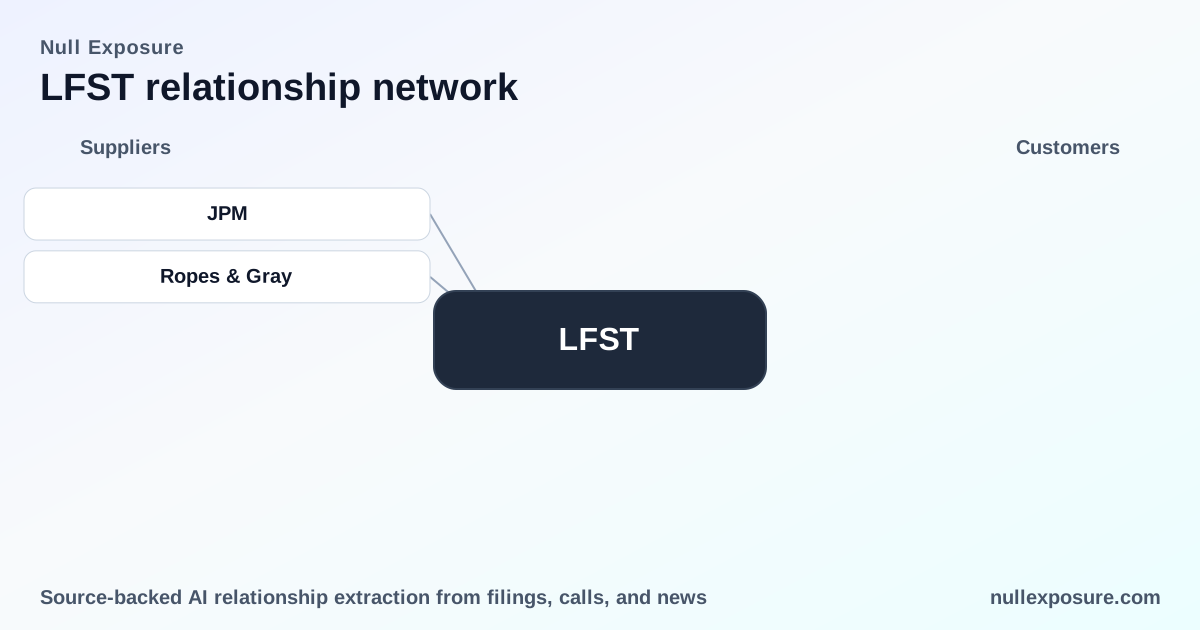
LFST Supplier Relationships: Capital-market and legal partners that keep the wheels turning
LifeStance Health Group (LFST) is a behavioral healthcare platform that monetizes through fee-for-service and payer contracts across an integrated clinical network; its capital and legal suppliers enable liquidity events and compliance rather than core clinical delivery. LFST outsources capital markets execution and external legal opinions for securities offerings, and engages third parties for cybersecurity testing, signaling a supplier mix focused on transactional, high-skill services rather than operational providers. For a technician-free view of supplier exposures and partner identity, visit https://nullexposure.com/.
How the supplier set maps to the business model
LifeStance’s supplier footprint in the observed records is concentrated, high-visibility and transactional. Two categories dominate: (1) investment banking/underwriting for equity raises, and (2) external legal counsel for securities opinions and compliance. Separately, the company uses outside cybersecurity auditors and penetration testers as part of risk management. This combination reflects an operating posture that relies on large incumbent professional-service firms for episodic, high-impact needs rather than on a broad base of small operational vendors.
- Contracting posture: engagements are formal, high-stakes and governed by underwriting agreements and regulatory filings, indicating standardized, lawyered contracts with well-established terms.
- Concentration: the public record shows a small number of named suppliers for capital markets and legal functions, implying concentrated supplier relationships for critical corporate finance activities.
- Criticality: underwriting and external counsel are critical for access to capital and compliance with securities law; cybersecurity providers are critical for operational resilience and regulatory preparedness.
- Maturity: the use of top-tier firms signals a mature approach to capital markets and compliance—LFST leverages experienced partners to execute complex offerings and filings.
The suppliers in the public record — what each relationship is, plain and simple
J.P. Morgan — J.P. Morgan is acting as the underwriter for LifeStance’s secondary public offering, consistent with an underwriting agreement covering an offering of 25,000,000 common shares; this places J.P. Morgan as LFST’s capital markets intermediary for FY2026. According to a GlobeNewswire press release dated Feb 25, 2026, J.P. Morgan is named as the underwriter for the offering, and TradingView coverage (Mar 2026) confirms the underwriting agreement includes a 25 million-share registration.
Ropes & Gray — A legal opinion from Ropes & Gray is filed as Exhibit 5.1 in connection with the offering filings, positioning the firm as external securities counsel providing the legal opinion required for the offering. A TradingView report (Mar 2026) notes that the Ropes & Gray opinion is included in the offering exhibits.
What these relationships mean for investors and operators
These supplier links expose LFST to a classic set of corporate-finance dependencies. Underwriters and external counsel are single-purpose but high-leverage partners: they are not part of day-to-day clinical service delivery, yet their effectiveness determines access to equity capital and regulatory-compliant transactions. For investors, this implies that execution risk on capital raises is tied to the relationship and terms LFST secures with these institutions.
- Operational impact: underwriting execution affects balance-sheet flexibility and dilution; legal opinions influence filing timelines and disclosure risk.
- Negotiation leverage: top-tier providers suggest LFST can attract market-standard terms, but concentrated reliance increases the governance importance of contract terms and indemnities.
- Financial exposure: finance-leases are disclosed as immaterial on the consolidated balance sheet, which reduces worries about vendor financing creating hidden balance-sheet leverage.
Company-level constraints and what they imply for supplier risk
Two constraint signals surfaced that shape the supplier risk profile.
- Finance leases are explicitly described as immaterial in the consolidated balance sheets. This is a company-level signal that lease financing tied to suppliers does not materially alter LFST’s creditor profile or vendor-credit exposure, reducing systemic operational leverage from vendor-supplied capital.
- LFST describes itself as a buyer in the context of cybersecurity risk management and engages outside providers to perform penetration testing and other audits. This positions the company as a contracting party procuring specialist security services rather than owning in-house testing infrastructure.
Taken together, these signals point to a supplier model where the company is a discerning buyer of professional services, maintains low balance-sheet exposure to vendor financing, and concentrates critical functions (capital markets, legal, security testing) with a small set of specialized providers. Concentration creates counterparty risk for capital access and legal signoff; immaterial lease exposure reduces vendor-financing vulnerability.
Practical risk checklist for diligence
- Confirm underwriting fee schedules, overallotment options and any repurchase commitments tied to the offering to quantify dilution and cash costs; the public filings (Feb–Mar 2026) name J.P. Morgan as the underwriter.
- Validate the scope and limitations of the Ropes & Gray legal opinion (Exhibit 5.1) to understand reliance and any carve-outs.
- Review contracts with cybersecurity vendors for SLAs, breach notification timelines and indemnities—these are operationally critical given the buyer posture for security services.
If you want a consolidated view of these supplier interactions and the language that governs them, start with the public offering materials and exhibit filings available through SEC channels or summarized at https://nullexposure.com/.
Bottom line for investors
LFST’s supplier profile is streamlined and centered on transactional, high-skill partners whose performance directly affects capital access and regulatory posture. The named relationships—J.P. Morgan as underwriter and Ropes & Gray as legal counsel—are typical for a company executing a secondary offering, and the immateriality of finance leases lowers vendor-financing exposure. However, the concentration of critical functions in a few relationships elevates counterparty and execution risk around future equity raises and compliance events.
For boards and operating executives, the focus should be on contract terms, contingency plans for alternate underwriters or counsel, and robust oversight of cybersecurity suppliers. For market participants evaluating LFST, these supplier dynamics are a lens into corporate maturity and potential execution risk during capital transactions.
Explore deeper supplier intelligence and regulatory exhibits at https://nullexposure.com/ to inform transaction-level diligence and portfolio risk assessments.
To commission a targeted supplier-risk briefing on LFST or comparable names, begin at https://nullexposure.com/ and request tailored coverage.