Lument Finance Trust (LFT): supplier map, operating constraints, and counterparty risk for investors
Lument Finance Trust (LFT) is an externally managed finance trust that monetizes commercial real estate credit exposure through structured financings and market funding, while outsourcing investment advisory and day‑to‑day operations to an external manager. The company funds portfolio growth and liability management through securitizations, book‑runners and secured financing facilities; those supplier relationships drive liquidity, structuring capability and operational delivery. Investors should treat LFT’s supplier network as central to both execution and risk management.
For more on supplier footprints and counterparty tracking, visit https://nullexposure.com/.
What the supplier map tells investors about LFT’s business model
LFT’s operating model is externally managed and service‑centric. The manager executes the business strategy, runs investment advisory functions, and performs day‑to‑day operations. At the same time, the company uses capital markets partners to structure and distribute securitizations and uses bank counterparties for secured funding. These relationships are not peripheral — they are the plumbing that funds originations, stabilizes liquidity and allows the trust to execute CLO issuance and secured borrowings.
- Contracting posture: The management arrangement is governed by a renewal mechanism with one‑year terms that reset annually, which signals a short‑term contracting posture at the company level and regular renegotiation points for the core services that run the business.
- Operational concentration and criticality: LFT reports high dependence on the communications and information systems of its manager and related service providers, a company‑level signal that operational continuity is material to enterprise value.
- Service role and maturity: The Manager (Lument Investment Management, LLC) is an active, incumbent service provider responsible for investment and operational delivery, indicating a mature external management relationship rather than an ad‑hoc vendor arrangement.
Supplier relationships you must model (and why they matter)
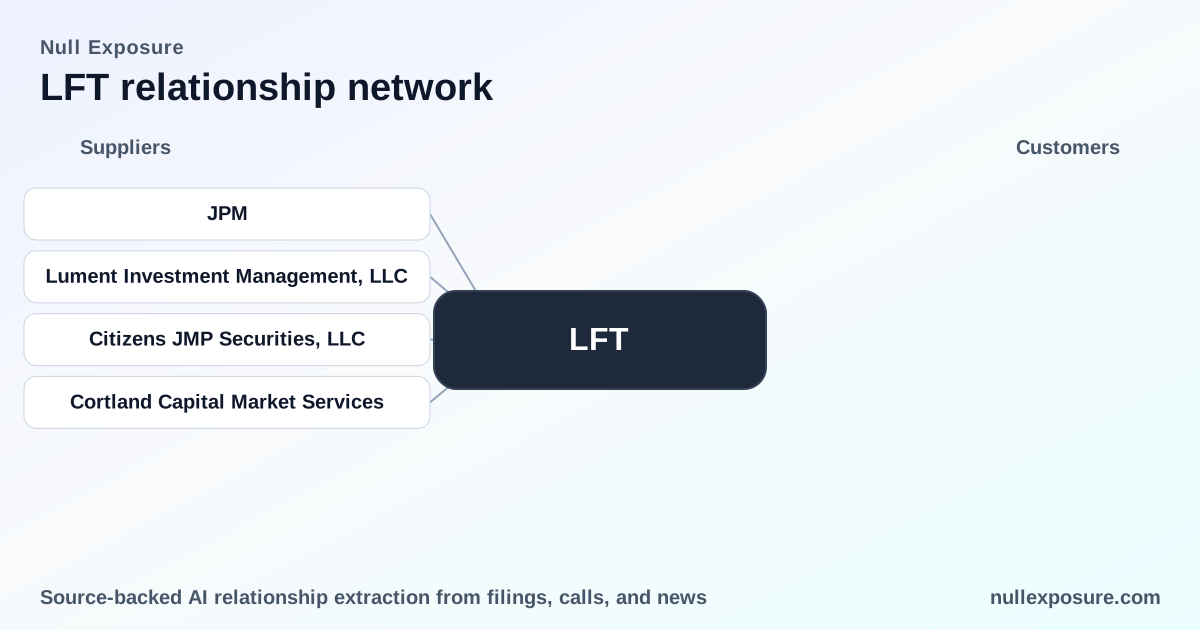
Below are every supplier relationship captured in the public record for this review, with concise investor‑oriented summaries and source references.
JPMorgan (JPM)
LFT entered a repurchase agreement with JPMorgan that provides the company with up to $450 million in aggregate advances, delivering committed secured funding capacity to support balance‑sheet liquidity. This is a direct funding relationship reported on the company’s 2025 Q3 earnings call. (LFT 2025 Q3 earnings call.)
J.P. Morgan Securities LLC
J.P. Morgan Securities served as the sole structuring agent, lead manager and sole bookrunner for LFT’s LMNT 2025‑FL3 commercial real estate CLO, underpinning LFT’s access to capital markets distribution and deal execution. (PR Newswire and Sahm Capital coverage of the LMNT 2025‑FL3 pricing, FY2025.)
Lument Investment Management, LLC
Lument Investment Management is the external manager and advisor that implements LFT’s business strategy, performs investment advisory services for LFT’s assets, and manages day‑to‑day operations under a management agreement. This role is documented in company announcements and press coverage of dividends and CLO transactions. (PR Newswire announcements and The Globe and Mail reporting, FY2025.)
Citizens JMP Securities, LLC
Citizens JMP Securities acted as a co‑manager on the LMNT 2025‑FL3 CLO transaction, supporting distribution and underwriting alongside J.P. Morgan Securities. This reflects a secondary capital markets relationship used to syndicate structured offerings. (PR Newswire and Sahm Capital, FY2025.)
Cortland Capital Market Services
Cortland Capital Market Services is named as a counterparty and lender in a term‑loan arrangement that extended secured debt maturity to 2030, indicating use of institutional lending partners beyond major banks. (TradingView summary of LFT term loan, FY2026.)
Constraints and what they mean for investors
The public relationship signals establish clear constraints that affect valuation and operational risk.
- Short‑term contracting posture (company signal): The management agreement automatically renews for successive one‑year terms, which creates recurring decision points and potential renegotiation risk that investors should monitor around each renewal window.
- Operational criticality (company signal): LFT’s operations are highly dependent on the communications and information systems of its Manager and service providers; any outage or control failure at the manager level directly threatens LFT’s asset management and reporting capabilities.
- Service provider role (relationship‑level, Lument IM): Lument Investment Management is the primary service provider and implements core strategy and operations; this makes Lument a single point of execution and a central counterpart for operational and governance oversight.
- Active relationship stage and services segment (company signal): The manager relationship is live and operational, executing investment advisory and cybersecurity responsibilities on LFT’s behalf.
Risk‑reward implications and what to watch next
LFT’s supplier footprint gives it market access and funding flexibility, but concentrates execution risk in a small number of counterparties and an externally managed structure. Key investor action items:
- Monitor the annual management agreement renewal cycle and any changes to economic or termination terms; short‑term annual renewals concentrate governance risk at predictable dates.
- Track counterparty exposure to large funding providers — especially the JPMorgan repurchase facility — because secured advances can compress liquidity risk if market conditions tighten.
- Follow the performance and collateral composition of LMNT 2025‑FL3 and future CLO issuances; bookrunner and co‑manager roles determine distribution reach and pricing when markets reprice risk.
Key takeaways: Lument IM is the operational hub; major banks and capital markets firms supply funding and structuring; and short renewal horizons plus reliance on manager systems create concentrated operational and counterparty risk.
For a deeper supplier risk map and ongoing alerts on counterparties, visit https://nullexposure.com/.
Bottom line: how to price LFT’s supplier risk into a model
Price LFT with three levers tied to the supplier map: funding availability (repurchase lines and term loans), structuring/distribution capability (bookrunners and co‑managers), and operational continuity (manager systems and governance). Stress test scenarios should include a loss of a major funding line, a significant disruption at the manager, and adverse CLO market conditions that reduce issuance capacity.
If you need a tailored counterparty exposure report or monitoring on LFT’s suppliers and contract renewals, start here: https://nullexposure.com/.