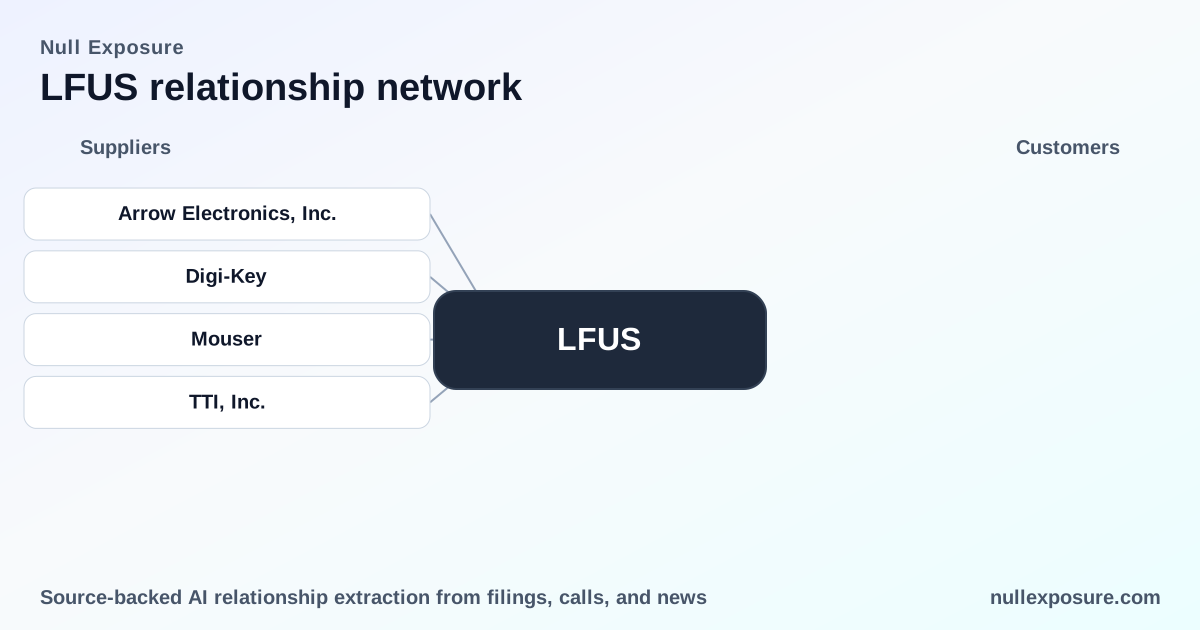
LFUS supplier map: distribution partners, manufacturing posture, and investor implications
LFUS operates as a hardware-focused firm that sells semiconductor and electronic components through third-party distributors and outsources manufacturing steps for its semiconductor lines. The company monetizes by designing and marketing components, capturing margin through branded product sales, and leveraging a multi-channel distribution network that scales reach without heavy capital expenditure on global logistics. For investors evaluating supplier exposure, the relevant signals are distribution breadth, contract posture with manufacturers, and the degree of outsourced fabrication/test dependency. Learn more about supplier intelligence at https://nullexposure.com/.
How LFUS goes to market and captures margin
LFUS sells finished components largely through distribution partners rather than direct retail channels. According to the FY2024 Form 10‑K, the company fulfills product orders through a mix of broad-line distributors and regional high-service distributors, which reduces LFUS’s need to run an extensive direct sales and fulfillment network. This structure converts fixed logistics cost into variable channel costs and accelerates market reach while concentrating counterparty risk in a handful of large distributors.
The distribution roster you need to know
LFUS’s FY2024 disclosures list a clear set of distribution partners that handle fulfillment and market access.
Arrow Electronics, Inc.
LFUS identifies Arrow Electronics as one of its broad-line distribution partners used for product fulfillment, reflecting a channel relationship for wide geographic reach and inventory placement. This listing comes directly from LFUS’s FY2024 Form 10‑K filing.
Digi‑Key
The FY2024 Form 10‑K names Digi‑Key among LFUS’s regional and high-service distributors, indicating a relationship geared to rapid order fulfillment and catalog-driven sales to a broad industrial and design engineering base.
Mouser
LFUS cites Mouser in the FY2024 10‑K as another regional/high-service distributor, supporting the company’s access to engineering purchasing and small-batch buyers who drive new-product adoption cycles.
TTI, Inc.
TTI, Inc. is listed in LFUS’s FY2024 Form 10‑K as a broad-line distribution partner, signaling a channel relationship focused on high-volume placement across industrial customers and electronic manufacturers.
Each of the above relationships is documented in LFUS’s FY2024 10‑K, which explicitly enumerates these distributors as fulfillment partners.
Manufacturing and subcontracting: a company-level signal
LFUS discloses that it utilizes external wafer foundries and subcontracted test and assembly facilities for a portion of its semiconductor business, as noted in the same FY2024 10‑K. This positions LFUS as a fabless or partially fabless operator for those product lines, which has several operational consequences:
- Contracting posture: Outsourced fabrication places LFUS in a customer role vis‑à‑vis foundries and test houses, relying on external suppliers for capacity and yield performance rather than owning the process nodes.
- Concentration risk: Dependency on external foundries concentrates operational risk when capacity tightness or technology transitions occur in the contract manufacturing market.
- Criticality: Foundry and test relationships are critical to product delivery timelines and cost of goods sold; disruptions to those suppliers translate directly into shipment delays and margin pressure.
- Maturity: Using established distributors like Arrow and Digi‑Key indicates a mature go‑to‑market distribution model, while reliance on external fabs suggests a capital-light manufacturing stance consistent with peer fabless business models.
What this means for investors: risk and opportunity
LFUS’s supplier footprint combines strengths and exposures that investors should weigh when evaluating operational resilience and margin sustainability.
- Strength — Scalable distribution without heavy capex: Broad-line partners such as Arrow and TTI provide LFUS with rapid market penetration and inventory coverage, enabling revenue scale while avoiding significant investments in global logistics.
- Exposure — Counterparty and concentration risk: Centralizing fulfillment through a small set of large distributors concentrates credit, service-performance, and inventory risks. Any contractual dispute, policy change, or sudden de‑listing would materially affect channel throughput.
- Operational leverage — Outsourced manufacturing: External wafer foundries and subcontracted test and assembly reduce fixed asset intensity but transfer technology and capacity risk to suppliers; this structure accelerates product development cycles but creates tight coupling to third‑party process capacity and test yield performance.
- Commercial agility — Access to engineering buyers: Relationships with online/high-service distributors such as Digi‑Key and Mouser give LFUS advantageous access to design engineers and fast-turn prototypes, supporting faster revenue ramp for new SKUs.
For an active investor or an operator evaluating counterparty health, these are the decision points: validate distributor contractual terms, monitor distributor inventories and payment terms, and track foundry/test partner capacity and roadmap alignment. If you want a concise supplier impact briefing tailored for board-level reviews, visit https://nullexposure.com/ for structured supplier profiles and exposure scoring.
Practical signals to monitor
- Track distributor shipment concentration by customer and region to detect single‑point failures.
- Monitor foundry backlog and technology node transitions that could increase unit manufacturing costs or introduce yield risk.
- Review LFUS’s working capital trends in subsequent filings to see whether distributor credit terms or inventory build affect free cash flow.
Conclusion: balance capital-light execution with concentrated supplier exposure
LFUS executes a capital-light channel and manufacturing model: broad distributors amplify reach while outsourced fabrication reduces capex but concentrates execution risk. Investors should treat distributor relationships (Arrow, Digi‑Key, Mouser, TTI) as strategic operational partners and foundry/test outsourcing as a critical dependency that directly influences margins and delivery. For deeper supplier-by-supplier diligence and a tailored exposure assessment, return to https://nullexposure.com/ and request a supplier intelligence brief.