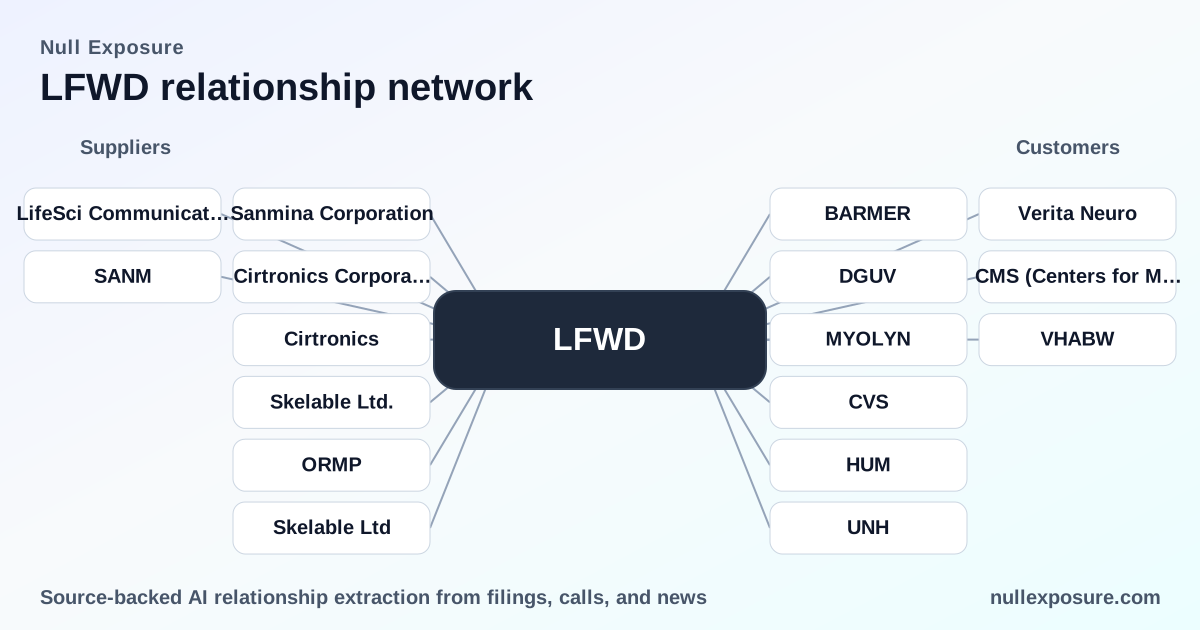
Lifeward (LFWD) supplier map: how outsourced manufacturing shapes commercial risk and optionality
Lifeward designs and commercializes rehabilitative medical devices (ReWalk, ReStore, AlterG) and expands capability through selective technology acquisitions; the company monetizes by selling finished systems and by acquiring/licensing complementary technologies while outsourcing manufacturing to specialized contract manufacturers. For investors, the critical lens is supplier concentration and contract posture: Lifeward’s product delivery and gross margin profile are tightly coupled to a small set of external manufacturers and a mix of short‑term purchasing arrangements. Learn more about supplier relationships and risk signals at https://nullexposure.com/.
What investors need to understand first: a concentrated, outsourced operating model
Lifeward operates with a high degree of outsourcing. The company has contracted Sanmina and Cirtronics to manufacture its product lines and relies on component suppliers across the United States, Europe, China, Taiwan and Israel. This structure drives three practical implications:
- Contracting posture is short-term and purchase‑order driven, increasing supply volatility and negotiating leverage for manufacturers; the FY2024 filing states Lifeward, Sanmina and Cirtronics do not have long-term supply agreements.
- Supplier concentration is material: a small number of manufacturers produce multiple product families, making operational continuity dependent on those relationships.
- Geographic dispersion creates geopolitical and logistics exposures, with production and key components tied to Taiwan (APAC risk), Israel (EMEA exposure via Sanmina’s Ma’alot facility) and the U.S. (Cirtronics’ Milford, NH site).
These points are documented in Lifeward’s FY2024 Form 10‑K and related news releases. For a tactical view into how these relationships affect value and execution, visit https://nullexposure.com/.
Supplier roster: who does what and why it matters
Below are concise, plain‑English descriptions of each supplier or partner named in Lifeward’s public disclosures and press reports, with source context.
-
Sanmina Corporation / Sanmina
Lifeward depends on Sanmina as the contract manufacturer for its ReWalk and ReStore product lines, with assembly performed at Sanmina’s Ma’alot, Israel facility; this relationship underpins production for core SCI products. According to Lifeward’s FY2024 10‑K, Sanmina manufactures ReWalk and ReStore products pursuant to Lifeward’s specifications. (FY2024 Form 10‑K) -
Cirtronics Corporation / Cirtronics
Beginning January 2025, Lifeward contracted Cirtronics to manufacture and assemble the AlterG anti‑gravity rehabilitation systems at Cirtronics’ Milford, New Hampshire facility, making Cirtronics the dedicated contract manufacturer for AlterG. The FY2024 Form 10‑K documents the Cirtronics engagement and its role in AlterG production. (FY2024 Form 10‑K) -
Skelable Ltd.
Lifeward entered a definitive agreement to acquire certain technology assets and prototypes from Skelable Ltd., acquiring an upper‑body robotic orthotic with AI capabilities for consideration in Lifeward equity and milestone payments; the transaction is a capability‑building acquisition rather than a supplier contract. GlobeNewswire reported the definitive agreement and payment structure in February 2026. (GlobeNewswire, Feb 25, 2026) -
Oramed Pharmaceuticals Inc. (ORMP)
Lifeward’s announced transaction with Oramed transfers Oramed’s Protein Oral Drug (POD™) delivery technology to Lifeward while Oramed receives a 49.9% beneficial ownership interest in Lifeward upon satisfaction of certain terms — a strategic technology acquisition/ownership arrangement rather than a manufacturing supplier relationship. Coverage of the strategic transaction appeared on industry news sites in March 2026. (Industry news, March 2026) -
LifeSci Communications
Lifeward uses LifeSci Communications for media relations; the relationship is a PR/media services engagement cited in public reporting and press materials. A FY2024 media contact listing includes LifeSci Communications as Lifeward’s media relations partner. (Media disclosure reflected in FY2024 coverage)
Each relationship above is documented either in Lifeward’s FY2024 Form 10‑K or in public press releases during FY2025–FY2026; the 10‑K is the principal source for manufacturing arrangements and supplier concentration, while news releases cover acquisitions and strategic transfers.
Constraints and company‑level signals that drive investor risk
Several constraint signals from Lifeward’s disclosures frame near‑term operational risk and upside optionality:
- Short‑term contracting posture: Lifeward (and its named contract manufacturers Sanmina and Cirtronics) rely largely on purchase orders rather than long‑term supply agreements, elevating renegotiation and supply disruption risk. (FY2024 Form 10‑K)
- Geographic exposure: Components and manufacturing touch APAC (notably Taiwan for certain components), EMEA (Sanmina’s Israel facility), and NA (Cirtronics in New Hampshire); geopolitical instability in any of these nodes is a revenue and delivery risk. (FY2024 Form 10‑K)
- Material dependence: The company characterizes reliance on a limited set of third‑party suppliers as material to operations, increasing vulnerability to capacity constraints, component shortages, and schedule slippage. (FY2024 Form 10‑K)
- Supplier role maturity: The named relationships are with established contract manufacturers experienced in medical devices, indicating operational competence but not removing concentration risk. (FY2024 Form 10‑K)
- Spend and contractual obligations: Lifeward reported approximately $7.3 million of non‑cancellable obligations as of December 31, 2024, placing supplier spend in the $1M–$10M band and indicating committed near‑term cash outflows. (FY2024 Form 10‑K)
Together, these signals describe a classic outsourced manufacturing model: experienced suppliers, short contracts, high concentration, and geographically distributed component sourcing — a profile that supports scalability but concentrates operational risk.
What investors should watch next
- Contract tenor and granularity: Any movement from purchase‑order arrangements to multi‑year supply agreements with Sanmina and Cirtronics would materially reduce execution risk and improve predictability.
- Inventory and backlog disclosures: Near‑term production constraints will surface first in backlog and inventory lines; monitor quarterly operational metrics.
- Integration of acquired technologies: Skelable and Oramed transfers change the product roadmap; track milestones and integration costs tied to the equity/milestone payments disclosed in the press releases.
For a deeper supplier risk analysis and to track future disclosure changes, visit https://nullexposure.com/.
Bottom line: concentrated manufacturing is a double‑edged sword
Lifeward’s strategy of outsourcing to established medical‑device contract manufacturers allows rapid scaling and lower fixed manufacturing overhead, but the combination of short‑term purchase arrangements, supplier concentration, and cross‑border component sourcing creates a meaningful operational risk vector. Investors should weigh the upside from strategic technology acquisitions against the execution risks inherent in a small roster of critical suppliers.
If you want ongoing supplier monitoring and disclosure‑driven signals for Lifeward and its peers, explore our coverage and alerts at https://nullexposure.com/.