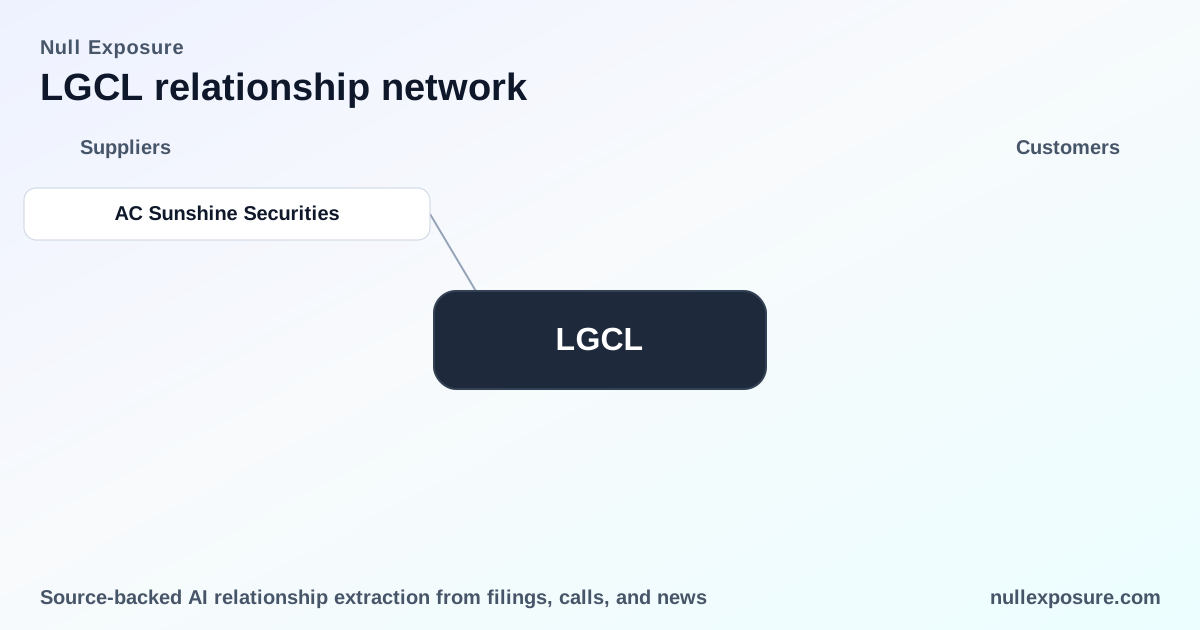
LGCL supplier profile: placement-agent signal and what it means for counterparties
LGCL operates as a supplier counterparty that engages external capital markets and financial intermediaries to support corporate funding and transactional needs, monetizing through its core supplier services to customers and intermittently through equity/debt transactions that rely on placement agents for distribution. Investor attention should focus on the firm’s counterparty posture — transactional, concentrated, and oriented toward short-window capital-market interactions — because these characteristics drive funding access and counterparty risk.
For a structured vendor-risk view and relationship mapping, visit https://nullexposure.com/ for full methodology and extended coverage.
One clear relationship in the public record — what it is and why it matters
A single, concrete supplier-side relationship appears in the public signals for LGCL: AC Sunshine Securities acted as placement agent for an offering in FY2025. According to a Yahoo Finance report dated March 10, 2026, AC Sunshine Securities served as the placement agent for the Offering (https://finance.yahoo.com/news/lucas-gc-prices-32-15m-131512711.html). This is the only supplier-role relationship surfaced in the reviewed records.
- AC Sunshine Securities — AC Sunshine executed placement-agent duties for LGCL’s FY2025 offering, handling distribution and investor placement responsibilities tied to that financing. The Yahoo Finance article (March 10, 2026) documents the firm’s role in the transaction.
Why a placement-agent relationship matters to investors and operators
Placement agents are not routine operational suppliers; they signal capital markets activity, access to distribution channels, and episodic reliance on external financial intermediaries. For investors evaluating LGCL as a counterparty:
- Capital access: The presence of a placement agent shows LGCL uses third-party distribution to raise capital, which is relevant for liquidity planning and funding runway assessment.
- Counterparty exposure: Because placement agents are transaction-specific, they are low-frequency but high-impact relationships — a single failed or delayed placement can materially affect near-term liquidity.
- Visibility: Public disclosure of a named placement agent increases transparency about who handles LGCL’s dealings with investors and underwrites distribution risk.
Operating model signals and business-model constraints
Null Exposure’s supplier review returned no explicit contractual constraints tied to LGCL. That absence itself is a signal: no public constraints were found in supplier-level records for LGCL.
From the relationship evidence and the lack of other supplier entries, infer these company-level characteristics:
- Contracting posture — transactional. LGCL’s supplier interactions, as observable, are organized around discrete capital events rather than ongoing platform-level vendor relationships.
- Counterparty concentration — high concentration in observable data. Only one external financial intermediary is visible; that implies limited public supplier breadth or a preference for ad hoc engagements.
- Criticality — transactionally critical but operationally peripheral. Placement-agent roles are critical when capital is being raised, but they do not indicate dependency for day-to-day supply chain operations.
- Maturity — relationship-level maturity is unclear but likely opportunistic. Placement agents are engaged for specific financings rather than long-term supplier contracts; the single record suggests episodic rather than ongoing dependency.
These signals are company-level assessments because the constraints review returned no named contractual limits tied to any specific supplier.
Visit https://nullexposure.com/ for a deeper supplier-risk score and to compare LGCL against peer counterparties in the same funding corridor.
Relationship-by-relationship briefing (complete, no omissions)
Below is the full list of supplier relationships surfaced in the reviewed records, with an investor-oriented summary and source reference.
- AC Sunshine Securities — AC Sunshine acted as placement agent for LGCL’s offering in FY2025, executing investor placement and distribution functions for that financing. The engagement is documented in a Yahoo Finance dispatch dated March 10, 2026 (https://finance.yahoo.com/news/lucas-gc-prices-32-15m-131512711.html).
Risk implications and monitoring checklist
With only a placement-agent relationship visible, the principal operational risk items for investors and operators are funding execution and transparency around ongoing supplier commitments. Key monitoring actions:
- Track future capital raises and whether LGCL repeats with AC Sunshine or diversifies placement agents; repeated use indicates a stable intermediary relationship, while rotation signals market-discovery or distribution challenges.
- Assess liquidity buffers around announced offerings; because placement agents provide distribution but not necessarily bridge financing, look for independent working capital or committed facilities.
- Request contractual clarity in diligence: understand engagement terms with placement agents (fees, exclusivity, termination rights) and whether any side arrangements create contingent liabilities.
Major takeaway: a named placement agent is a signal of capital-market activity and discrete counterparty exposure — not necessarily a broad supplier dependency — but it is material to near-term funding risk.
Tactical recommendations for investors and operators
- In diligence, obtain the placement-agent engagement letter or a summary of material terms to quantify fee exposure and exclusivity provisions. This clarifies both cost of capital and distribution risk.
- Include a monitoring covenant or trigger that alerts stakeholders to any new placement-agent or underwriter relationships, as changes indicate shifts in funding access or strategy.
- Maintain a short list of alternative distribution channels for contingency planning; episodic reliance on a single placement agent increases execution risk during volatile market windows.
For a practical supplier-risk dashboard and to map LGCL’s counterparties across other supplier classes, see https://nullexposure.com/.
Bottom line
Public records show one supplier-side relationship for LGCL — AC Sunshine Securities as placement agent for the FY2025 offering — and no explicit supplier constraints were returned in the reviewed records. That pattern points to a business posture focused on transactional capital-market engagements rather than a broad, mature supplier ecosystem. Investors should treat placement-agent relationships as high-impact, episodic exposures and prioritize contractual transparency and contingency planning when evaluating LGCL as a counterparty.
If you need an exportable relationship map and an audit-ready report for LGCL, start here: https://nullexposure.com/.