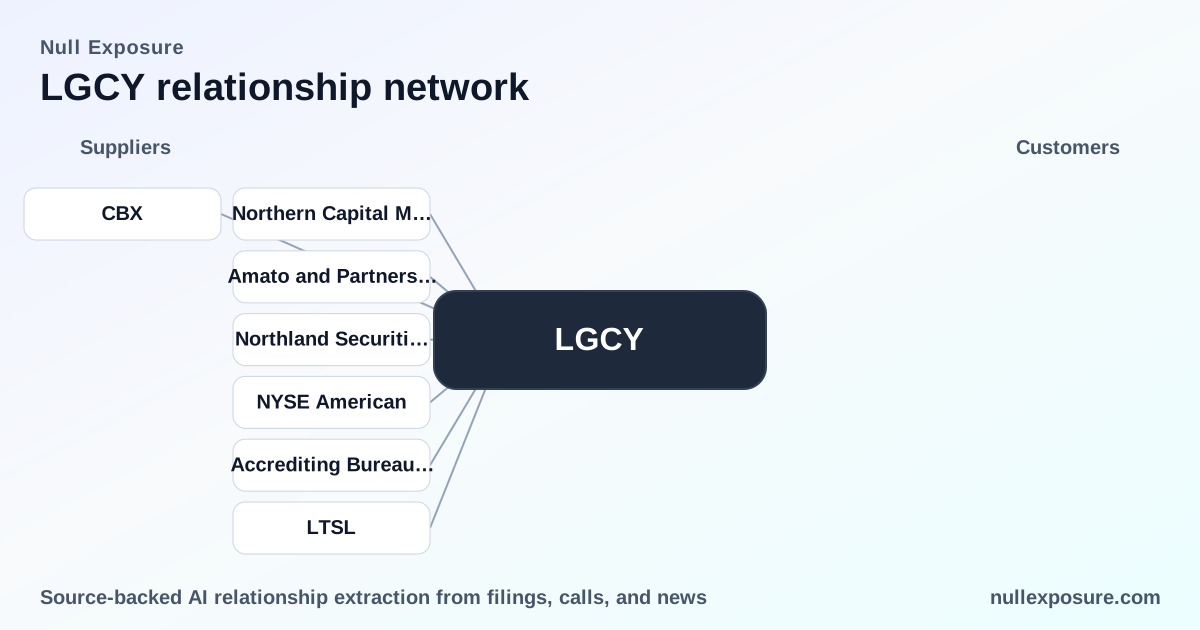
Legacy Education (LGCY): supplier network, underwriting partners and operational constraints investors should price in
Legacy Education operates a multi-campus career-education platform focused on healthcare programs and monetizes through tuition, campus operations and selective acquisitions financed in part by capital markets activity; public-market liquidity and underwriting arrangements have been central to funding scale. The company runs campuses, leases long-dated property, relies on third‑party investor relations and underwriting partners, and depends on programmatic accreditation to sustain enrollment-driven revenue. Learn more or track counterparties at https://nullexposure.com/.
Operating thesis and how the money flows Legacy sells career-focused post-secondary education—revenue is largely tuition‑driven, supported by rolling campus acquisitions and public-equity capital raises. Public listing proceeds and underwriter support financed near-term expansion (the company closed an initial public offering and began trading under LGCY), while accreditation status and campus leases underpin the operational runway that generates cash flow from student tuition and related services.
Who Legacy contracts with — the counterparties you need to know Below are every relationship flagged in available reporting, each with a concise description and source note so you can map counterparty roles to commercial and market risk.
- Northern Capital Markets — Northern Capital acted as the sole bookrunner on the offering, positioning it as the primary underwriter that executed Legacy’s market access for that financing. According to Renaissance Capital’s IPO coverage (reported March 10, 2026), Northern Capital Markets served as the sole bookrunner.
- Amato and Partners, LLC — Amato and Partners is identified repeatedly as Legacy’s investor relations counsel and the listed contact for press releases and earnings communications, anchoring external communications and IR execution. Multiple press releases and investor notices list Amato and Partners as investor relations counsel (PR Newswire and company press material, FY2024–FY2026).
- Northland Securities, Inc. — Northland Securities acted as the sole book‑running manager on the initial public offering noted in company filings and press releases, indicating a lead underwriting role for that transaction. A PR Newswire release on the IPO closing (FY2024) states Northland Securities served as sole book-running manager.
- NYSE American — The company’s common stock began trading on the NYSE American on September 26, 2024 under the ticker LGCY, establishing the firm’s public-market listing venue and liquidity channel. PR Newswire’s IPO closing announcement notes the NYSE American listing (September 26, 2024).
- Accrediting Bureau of Health Education Schools (ABHES) — ABHES granted a six‑year reaccreditation to Integrity College of Health, an important credential that supports program legitimacy and student enrollments. A press release and industry coverage (Sahm Capital news, February 17, 2026) announced the six‑year reaccreditation.
- Ladenburg Thalmann — Ladenburg Thalmann is listed as a lead manager on the offering, indicating participation on the underwriting syndicate and execution support for capital markets activity. The IPO closing disclosure (PR Newswire, FY2024) identifies Ladenburg Thalmann as a lead manager.
- NYSE (Renaissance Capital coverage) — Renaissance Capital’s IPO reporting referenced plans to list under the symbol LGCY; this coverage captures the pre‑listing capital markets narrative and syndicate placement. Renaissance Capital’s IPO report (March 10, 2026) noted planned listing details.
Operating constraints and what they imply for suppliers and investors Company-level documents and public disclosures provide several persistent signals about Legacy’s supplier posture and operational constraints:
- Long-term real-estate commitments increase fixed-cost leverage. Legacy discloses multi-year property leases for academic operations and corporate functions, including a lease for property in Antioch, CA extending to 2035, which signals material fixed obligations that will affect cash flow flexibility. This is presented as a company filing excerpt summarizing leased properties as of June 30, 2025.
- Global reach through internet‑enabled services elevates third‑party vendor dependence. The company states its services and vendor‑provided information are accessible globally via the Internet, which implies both the potential to scale enrollments internationally and a dependence on distributed technology and vendor support (company filing language).
- Vendors act as critical service providers with elevated operational risk. Filings highlight that vendors manage confidential information and operate networks that are potential targets for unauthorized access, underscoring that Legacy’s relationship posture is one of reliance on external service providers for enrollment services, IT, and student‑facing systems (company disclosures on network and vendor risk).
What those constraints mean for financial and operational risk
- Capital structure sensitivity: Underwriting relationships (Northern Capital, Northland, Ladenburg) and a completed IPO demonstrate that market access is a lever Legacy uses to finance growth; expect periodic dependence on external capital markets, particularly if campus acquisitions continue.
- Fixed-cost and timing risk: Long-term leases create revenue-coverage exposure—enrollment dips or accreditation delays could compress operating margins because of inelastic lease obligations.
- Execution and vendor concentration risk: Reliance on IR counsel (Amato and Partners) for consistent market communications and on technology vendors to manage student records and enrollment systems is a potential single-point vulnerability; operational disruption or reputational lapses can have outsized impact on enrollment flows.
- Accreditation as a binary commercial input: ABHES reaccreditation is a positive operational signal—accreditation status is directly tied to enrollment and revenue recognition—and should be treated as a material operational liability or asset in investor models.
Strategic takeaways for investors and operators
- Underwriting and IR relationships are intentionally stacked to provide market access and consistent investor messaging; track interactions with Northern Capital, Northland and Ladenburg for signs of future financing or dilution.
- Operational stability depends on accreditation and long-term lease management; enforce scenario models where temporary enrollment shortfalls interact with fixed lease obligations.
- IT and vendor governance is a near-term priority: because the company flags vendor network risk, investors should require clear evidence of vendor oversight, SLAs and contingency planning from management.
If you want a concise vendor-counterparty map, or a transaction history tied to counterparties and filings, see more at https://nullexposure.com/.
Conclusions and immediate next steps Legacy presents a classic roll‑up education model: growth financed through public markets and supported by accreditation and long‑dated leases. Key investor focus should be on funding cadence, accreditation continuity, and vendor governance—these are the levers that determine revenue stability and margin resilience. For a deeper counterparty analysis and ongoing tracking of Legacy’s supplier and underwriting relationships, visit https://nullexposure.com/ to subscribe to continuous monitoring and get direct access to our relationship intelligence.