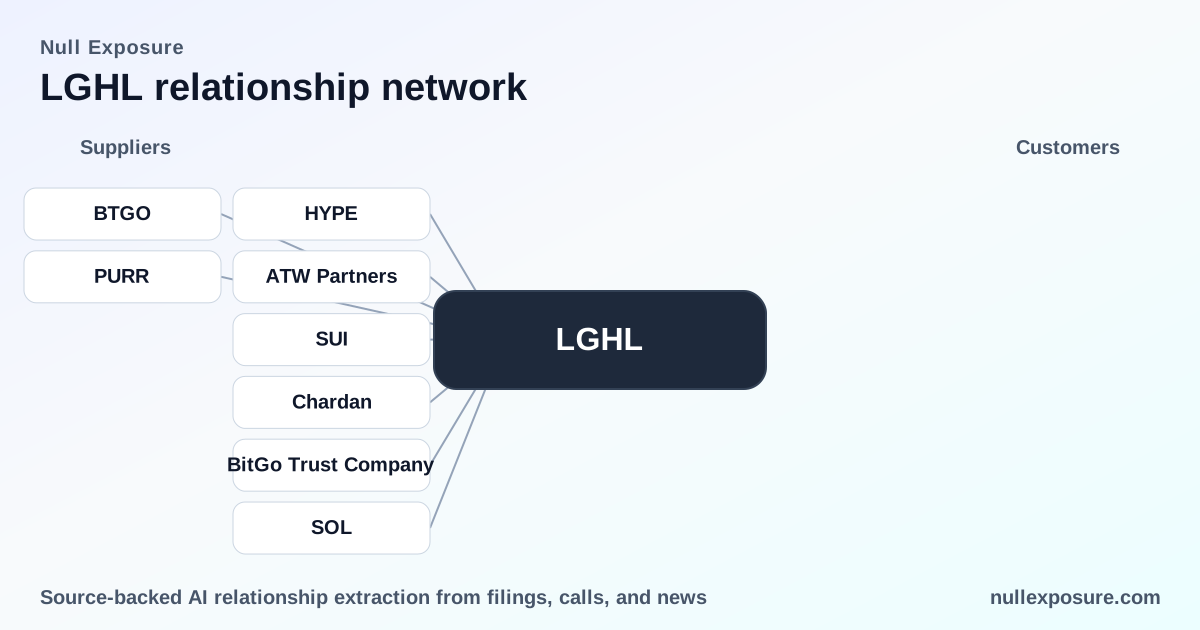
Lion Group Holding (LGHL): A supplier-focused read on the HYPE treasury pivot
LGHL is executing an explicit treasury reallocation strategy: the company is monetizing balance-sheet optionality by converting cash and digital asset holdings into a concentrated portfolio of blockchain tokens and staking arrangements. Revenue and value for investors now depend on token price appreciation, staking yields and the company’s ability to finance and custody large-scale digital-asset positions, rather than traditional operating cashflow. This shift creates a network of critical counterparties—funders, custodians, placement agents and token issuers—that define LGHL’s operational and counterparty risk profile.
Read more about counterparty exposures and supplier risk at the Null Exposure homepage: https://nullexposure.com/
Why this matters to investors and operators
LGHL’s announced moves transform the company’s supplier map from conventional service providers to a short roster of high-leverage crypto counterparties. A single large financing facility, a named custodian with staking arrangements and a placement agent together concentrate execution risk. Operators evaluating supplier relationships should treat these counterparties as strategic suppliers: their contract terms, custody experience and commercial incentives are now material to LGHL’s balance-sheet health and investor returns.
If you want a consolidated supplier risk report and ongoing monitoring, start here: https://nullexposure.com/
Relationship ledger: who LGHL is dealing with and what each does
Hyperliquid (token HYPE)
LGHL completed an initial purchase of Hyperliquid’s HYPE tokens as the opening act of its crypto-treasury strategy, signaling a direct economic exposure to this token’s performance. According to CoinCentral’s coverage (March 10, 2026), the HYPE acquisition is positioned as the nucleus of LGHL’s HYPE Treasury.
ATW Partners
LGHL secured a $600 million financing facility from ATW Partners to underwrite its initial HYPE purchases and scale subsequent token acquisitions. The Defiant reported (March 10, 2026) that this facility is the primary funding source for the HYPE Treasury and that proceeds will be deployed into digital-asset purchases.
Sui (token SUI)
Management indicated that at least 75% of net proceeds from subsequent closings will be allocated to acquiring tokens including Sui, placing SUI among the core tokens LGHL intends to hold and stake. CoinCentral documented management’s disclosure of SUI as a targeted token (March 10, 2026).
Chardan
Chardan is acting as sole placement agent for subsequent closings tied to LGHL’s treasury program, which centralizes primary-market distribution and investor onboarding through one securities intermediary. Intellectia’s reporting (FY2026 reference) identifies Chardan in this placement agent role.
BitGo / BitGo Trust Company
LGHL is using BitGo for custody and staking services: the company converted SUI holdings into HYPE through BitGo Trust Company and will store and stake SOL and SUI through a commercial relationship with BitGo. A Globe and Mail press release and coverage in The Defiant (March 10, 2026) describe the custody and staking arrangements with BitGo.
Solana (token SOL)
SOL is listed alongside HYPE and SUI as a target for at least 75% of net proceeds from the financing, making Solana a material part of LGHL’s targeted crypto allocation. CoinCentral reported LGHL management’s allocation plan that includes Solana (March 10, 2026).
(Each relationship note above is drawn from LGHL-targeted press coverage and market reporting in March 2026—see CoinCentral, The Defiant, Globe and Mail, Intellectia and related press items for the company statements.)
What the relationship map reveals about LGHL’s operating model
With no explicit third-party constraints listed in recent company disclosures, the public evidence itself functions as a company-level signal about LGHL’s operating posture:
- Concentrated contracting posture. The funding and placement functions are effectively centralized (ATW Partners for financing, Chardan for placement), which accelerates execution but concentrates counterparty risk.
- High counterparty criticality. Custody and staking are outsourced to a single named custodian (BitGo), making custody SLAs and operational continuity critical to treasury stability.
- Strategic immaturity and volatility exposure. The move is a deliberate treasury reallocation rather than a mature diversified investment program; token price and staking yield volatility are primary earnings drivers.
- Funding dependency. A large single-facility structure creates refinancing and covenant sensitivity that investors must monitor closely.
These characteristics translate into both upside (levered exposure to token rallies and yield capture) and downside (single-counterparty, market and custody concentration).
Risk and operational checklist for counterparties and investors
- Confirm the commercial terms and covenants of the ATW facility and any margin/repurchase triggers that could force asset sales.
- Verify custody SLAs, insurance coverages and cold-storage practices with BitGo for large token holdings and staking operations.
- Scrutinize placement economics and investor protections under Chardan’s role to understand dilution, lockups and fund governance.
- Monitor token concentration and on-chain liquidity for HYPE, SOL and SUI to assess exit risk and price impact on large trades.
If you need a tailored counterparty risk brief for LGHL-style treasury exposures, request one here: https://nullexposure.com/
Recommendations and three actionable next steps
- Require transparent reporting of financing covenants and a rolling 12-month liquidity plan tied to token valuation scenarios.
- Obtain custody proof points: third-party audits, insurance limits and staking risk disclosures from BitGo.
- Insist on placement governance terms that protect minority investors from single-round dilution and clarify proceeds allocation.
Bottom line
LGHL’s supplier relationships now define its balance-sheet execution: ATW supplies the leverage, BitGo supplies custody and staking, Chardan supplies distribution, and Hyperliquid/Solana/Sui supply the economic exposure. Investors and operators must treat these counterparties as strategic suppliers—contract terms, operational reliability and on-chain liquidity determine whether the HYPE Treasury is a value-creating reposition or a concentrated risk.
For continuing coverage and supplier risk intelligence on LGHL and comparable treasury programs, visit https://nullexposure.com/ and request monitored reports tailored to your portfolio.