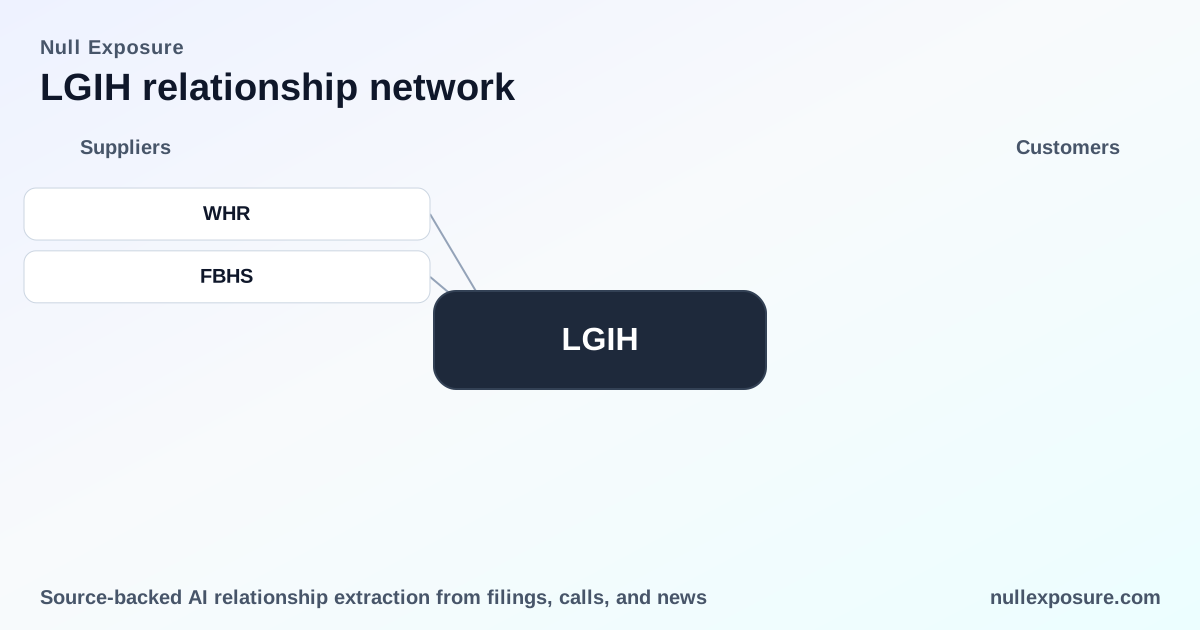
LGI Homes (LGIH) — supplier relationships that shape margins and delivery
LGI Homes builds and sells entry-level to move-up single-family homes, monetizing through home sales and controlled-cost construction execution. The company captures margin by standardizing interior packages, contracting materials and labor for the build period, and leveraging repeat trade partnerships to reduce warranty and rework costs. Supplier relationships for core components — appliances, plumbing fixtures, flooring and garage systems — are a direct lever on gross margin, build cycle time and warranty exposure.
Explore more supplier intelligence at https://nullexposure.com/ for a concise view of counterparty footprints and contractual posture.
Why supplier choices matter to investors
LGI’s operating model is built on replicable home packages sold at scale. That model depends on three connected realities: consistent, commodity-style inputs that are contracted around each build; long-duration capital obligations that require predictable cash flow; and repeat trade partners that lower warranty and coordination costs. For investors, the health of supplier relationships translates into predictable construction costs and therefore more reliable margin and free cash flow conversion.
Who supplies LGI Homes — the visible relationships
Below I cover every supplier relationship mentioned in the available reporting and news flow.
Whirlpool (WHR)
LGI includes a full suite of energy-efficient Whirlpool kitchen appliances as part of its CompleteHome™ Plus package across multiple new communities, reflecting a standardized appliance selection built into home pricing and merchandising. This is documented in LGI Homes’ community press materials and media reports for FY2026. According to a GlobeNewswire press release (Feb 27, 2026) and follow-up FinViz coverage (Mar 10, 2026), Whirlpool appliances are a core element of LGI’s included home package.
Moen (inferred through Ferguson/FBHS trade)
LGI lists Moen faucets and related bathroom plumbing fixtures among standard interior finishes, signaling reliance on established plumbing brands to meet buyer expectations and reduce warranty callbacks. FinViz coverage of LGI community openings in FY2026 highlights Moen-branded faucets and related fixtures as part of the standard offering (reported Mar 10, 2026).
(These two suppliers are the only named third parties in the available news coverage for FY2026; LGI’s published community releases emphasize bundled interior packages that rely on recognized consumer brands.)
What the corporate constraints reveal about how LGI contracts suppliers
The reported constraints form a set of company-level operating signals that clarify how LGI manages supplier relationships and capital:
-
Contracting posture mixes short- and long-term elements. LGI generally contracts materials and labor at fixed prices for the anticipated construction period of a home (short-term transactional contracting per project), but the company also operates under long-dated financial obligations (for example, the issuance of 2032 Senior Notes), which requires predictability in procurement and cash flow management. This dual posture forces suppliers to service both project-level orders and the company’s longer-term cash conversion needs.
-
Geography is domestic-first. The company reports that raw materials and components are readily available in the United States, indicating supply chains are primarily NA-focused and less exposed to off-shore sourcing risk for core inputs.
-
Supplier relationships are operationally critical. LGI describes the consistency of trade partners as integral to homebuilding operations and warranty cost control, signaling that supplier continuity is a material operational dependency.
-
LGI is a buyer and manager of outsourced services. While employees handle purchasing, construction management and QA, third-party subcontractors supply material and labor; LGI therefore operates as an active buyer and coordinator of service providers rather than a passive purchaser.
-
Maturity and repetition matter. Several trade partners have subcontracted with LGI since its founding in 2003, implying established procurement relationships and a playbook for supplier onboarding and performance standards.
Taken together, these constraints show a company that controls procurement at the project level, prefers domestic supply, and relies on repeat partnerships to manage quality and warranty costs — a profile that supports predictable margins but creates dependence on a core set of trade partners.
Investment implications — risk and opportunity
-
Cost control is a primary margin lever. Standardized branded packages (Whirlpool, Moen) reduce SKU proliferation and bargaining friction, which supports gross margin sustainability. Strong supplier standardization is a positive for predictable cost-of-goods sold.
-
Concentration and criticality heighten operational risk. Consistency of trade partners reduces variability but increases exposure if a key provider faces supply disruption. Supplier continuity is critical to build cadence and warranty performance.
-
Domestic sourcing reduces geopolitical tail risks. With materials and components largely available in the U.S., LGI is less exposed to shipping disruptions and tariffs on non-U.S. inputs.
-
Short-term contracting on materials benefits price capture but transfers market volatility to LGI. Fixed-price contracts for the construction period lock in costs per home but leave LGI exposed to broader input inflation between contracts.
-
Long-term financial obligations demand supply predictability. The existence of multi-year debt (e.g., 2032 Senior Notes) elevates the importance of reliable procurement to ensure cash-flow coverage of interest and maturities.
Practical checklist for investors and operators
- Monitor supplier continuity and substitution activity: brand changes in standard packages are an early signal of procurement stress or renegotiation.
- Track the cadence of community openings and standard package disclosures for signs of product re-specification.
- Watch input-cost inflation and LGI’s contract terms for labor and materials: fixed short-term contracts lock costs per build and can compress margin if inflation accelerates.
- Evaluate warranty reserve trends in LGI filings as a proxy for supplier workmanship and long-run quality.
Explore our deeper supplier profiles and counterparty risk models at https://nullexposure.com/ if you want a direct supplier map and risk scoring for homebuilders and their top trade partners.
What to watch next and final takeaways
LGI’s business design hinges on repeatable product packages delivered through a trusted set of trade partners. The inclusion of major consumer brands like Whirlpool and Moen as standard offerings is a positive for buyer perception and resale value, and it supports streamlined procurement. However, the combination of short-term build contracts and long-term financial commitments makes supplier continuity and domestic availability central to the investment thesis.
If you are evaluating LGI from the supplier or investor side, prioritize evidence of supplier stability (multi-year relationships, minimal re-specs) and watch warranty metrics as the bellwether for supplier performance. For more context, comparable supplier footprints and contract-profile analysis are available at https://nullexposure.com/ — visit for supplier-level detail and scoring.
Key takeaway: LGI’s supplier strategy emphasizes standardized, branded packages and repeat trade partners to protect margins and reduce warranty costs; the company’s exposure is operationally critical but concentrated, making supplier continuity a central risk to monitor.