LGL Group (LGL) — supplier relationships, operating posture, and what investors should price in
LGL Group is a small-cap, publicly traded company that funds and runs its operations through a combination of operating revenue and capital markets activity; it monetizes both through its core business and routine equity instruments (common stock and detachable warrants). Outsourced financial and corporate services—transfer agent functions and cash/marketable-securities management—are central to how LGL executes corporate actions and manages short‑term liquidity, so investors should treat those vendor relationships as functional parts of the company’s operating model rather than peripheral admin items.
Learn more about supplier exposures and how they affect corporate risk at https://nullexposure.com/.
The service relationships that matter right now
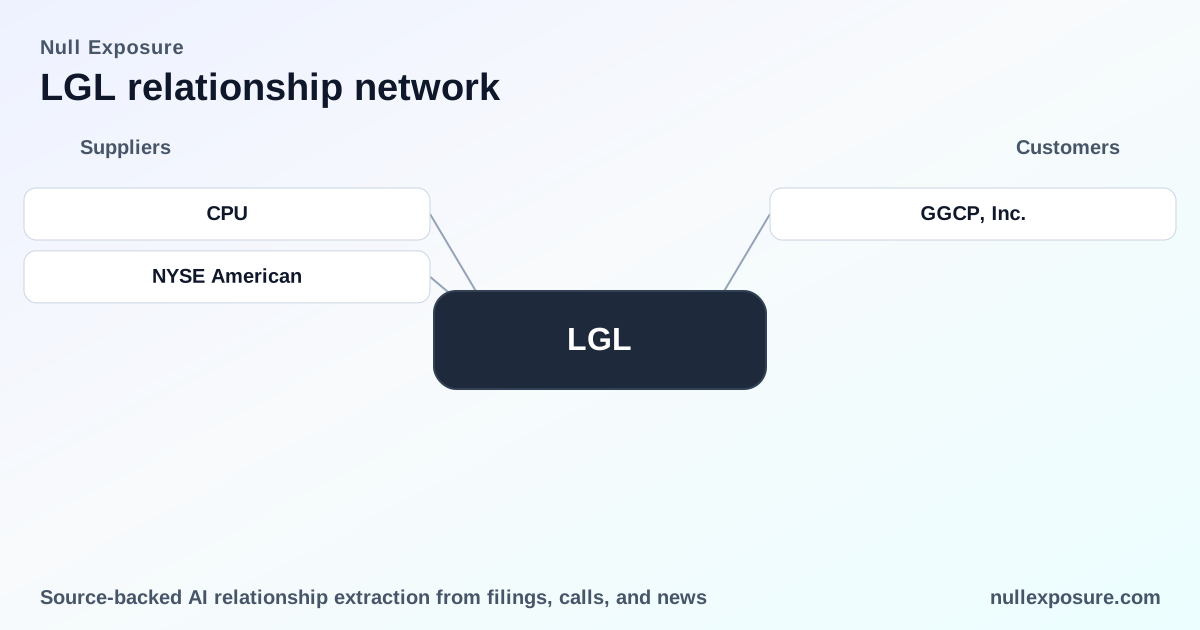
Below are the two supplier relationships identified in public disclosures and press releases. Each relationship summary is concise and sourced to company press materials and market outlets.
Computershare Trust Company, N.A.
Computershare is acting as the transfer agent/agent for warrant exercises: the company’s press releases set specific deadlines for the delivery of exercise notices and payments to Computershare in connection with extended warrant expiration dates. According to a Newsfile press release (Dec 2025), all exercise notices and payments for LGL warrants had to be received by Computershare Trust Company, N.A. by 5:00 p.m. Eastern on December 16, 2025; a subsequent Newsfile release referenced a December 30, 2025 deadline for a later extension. (Sources: Newsfile press releases, Dec 2025; FinancialContent republication, Dec 3, 2025.)
NYSE American
LGL Group’s common stock and warrants are listed and traded on the NYSE American under the symbols “LGL” and “LGL WS,” providing the company with a regulated public market for liquidity and capital-raising. This listing is noted in the company’s December 2025 press materials and FinancialContent coverage that accompanied the warrant-expiration notices. (Source: FinancialContent/WRAL republication of company press release, Dec 3, 2025.)
What the constraints in filings tell investors about LGL’s operating model
Public excerpts and company disclosures point to several company-level operating characteristics that shape supplier risk and contract posture:
- Contract tenor and maturity: LGL leases property and equipment under operating leases with terms of one to five years, indicating a short‑to‑medium maturity profile for facility and equipment commitments rather than long‑dated lockups. (Company filing language on lease term lengths.)
- Low contract criticality for fixed assets: The company states its lease agreements do not contain material residual value guarantees or restrictive covenants, implying those arrangements are operationally non‑burdensome and financially immaterial in the context of corporate liabilities. Lease costs reported were modest ($95 and $74 for 2024 and 2023), indicating low cash draw from these contracts.
- Cash management and related-party service provider exposure: LGL holds cash equivalents and marketable securities that are managed or advised by GAMCO Investors, Inc., a related-party fund manager identified in filings; balances reported with the Fund Manager were $34,242 and $32,568 (in thousands) as of Dec 31, 2024 and 2023 respectively, placing that relationship in an intermediate spend band (roughly $10M–$100M nominal exposure in account balances). (Company disclosures on fund manager balances.)
- Low transactional spend relationships: The company’s transitional service agreement with MtronPTI produces a net monthly payment of $4, and total operating lease costs are small, signaling a collection of low-dollar transactional supplier engagements alongside the larger cash-management relationship.
These signals combine into a clear operating posture: LGL runs a lean supplier stack—small operational contracts, a medium-sized custodial/cash-management exposure, and critical capital-market service relationships (transfer agent and exchange) that must function correctly for equity and warrant mechanics to operate.
Investment implications: concentration, criticality, and short-term risks
- Concentration of financial controls. The presence of a single named fund manager (GAMCO) with tens of millions in managed balances suggests a moderate concentration of short‑term liquidity management. If that manager relationship were disrupted, LGL would face operational friction in cash placement and marketable securities handling, though the balances do not match large-scale corporate funding needs.
- Operational criticality of shareholder services. Computershare’s role in warrant exercise processing is operationally critical for equity-holder mechanics: extensions, deadlines, and agent errors directly affect outstanding warrant conversion and expected dilution timing. The December 2025 warrant-extension notices are an example of routine corporate action where the transfer agent’s functioning materially affects investor outcomes. (Company press releases, Dec 2025.)
- Low legacy contractual burden. Lease exposures and transitional service fees are immaterial to cashflow, so operational supplier risk is more about service continuity (transfer agent, fund manager) than about large fixed-cost contracts.
For investors valuing the business, the short‑term counterparty exposure to service providers is manageable but nontrivial: liquidity managers control deployed cash, and the transfer agent controls the administrative execution of equity instruments. These are operational risks priced into a small‑cap equity where market liquidity and warrant mechanics influence valuation.
Explore supplier risk profiles and disclosure-driven exposure analysis at https://nullexposure.com/ for deeper workflows and alerts.
What to watch next
- Warrant exercise outcomes and dilution timing. Track follow-on notices to Computershare and any settlement anomalies; successful, timely processing reduces execution risk for corporate finance events. (Source: company press releases, Dec 2025.)
- Fund manager balances and disclosures. Monitor the Fund Manager account balances in subsequent filings to see whether cash allocation shifts materially change short‑term liquidity posture. (Source: LGL filings listing GAMCO balances.)
- Any changes to listing status or trading venue terms. NYSE American listing status is a structural element of public liquidity; any listing-related notices will materially affect tradability. (Source: market press republishing company notices.)
Bottom line and next steps
Key takeaway: LGL’s supplier footprint shows a mix of low-dollar operational contracts and a few high‑leverage financial service relationships—Computershare for shareholder mechanics and GAMCO for cash management—that are essential to short‑term corporate operations but are not large, long‑term fixed-cost commitments. For investors, the focus is on service continuity and correct execution of capital‑markets events rather than legacy vendor liabilities.
If you are evaluating supplier counterparty risk across small-cap issuers or building an investment diligence checklist, start with vendor continuity and cash‑management exposure analysis at https://nullexposure.com/.
For a tailored review of supplier concentration and service-provider criticality across your portfolio, visit https://nullexposure.com/ and sign up for alerting and relationship intelligence.