Longeveron (LGVN) — supplier relationships, operational signals, and what investors should price
Longeveron is a clinical-stage regenerative medicine company that monetizes by licensing and developing cell-therapy intellectual property and advancing clinical-stage product candidates toward commercial approval; near term value capture comes from licensing deals, equity financings, and milestone-triggered partner payments, while longer-term upside depends on manufacturing scale-up and third-party distribution of Lomecel-B and related products. Investors should treat LGVN as a development-stage biopharma whose value is tightly coupled to IP licensing, CRO execution, and the stability of its bone‑marrow supply chain. Learn more at https://nullexposure.com/.
How Longeveron runs the business and turns science into revenue
Longeveron operates as a small-cap biotech that licenses core stem‑cell patents, outsources trial execution and specialized lab services, and uses capital markets to fund development. The commercial model is straightforward: secure and extend IP rights, demonstrate clinical efficacy through outsourced CRO and imaging partners, and then either commercialize via third‑party manufacturers and distributors or monetize through partnerships and licensing. Public disclosures and press releases show the company relies on placement agents for financing and on third parties for manufacturing and distribution support.
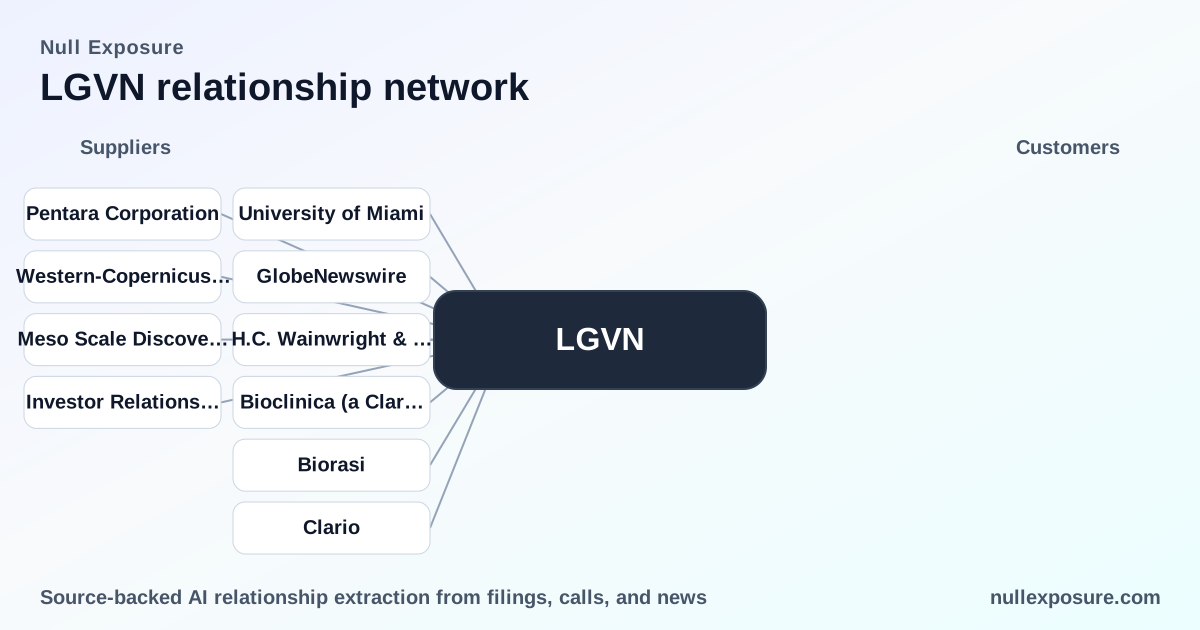
Supplier and CRO ecosystem: the partner map investors should track
University of Miami
Longeveron licensed an issued U.S. patent (12,168,028 B2) from the University of Miami covering stem‑cell technology that supports cardiomyogenic and other indications; this license was disclosed in the company’s November 4, 2025 business update and reported subsequently by BioInformant and Yahoo Finance. According to the Nov 4, 2025 GlobeNewswire filing and press coverage in FY2025, the University of Miami relationship is a strategic IP source that expands Longeveron’s therapeutic reach.
GlobeNewswire
GlobeNewswire served as the distribution channel for Longeveron’s Q3 2025 financial results and business update (Nov 4, 2025), which communicated the University of Miami license and program status; a QuiverQuant summary in March 2026 also captured a subsequent leadership announcement distributed via GlobeNewswire. GlobeNewswire is the company’s public communications conduit for material updates.
H.C. Wainwright & Co.
H.C. Wainwright & Co. acted as the exclusive placement agent for a recent financing, underlining the company’s reliance on equity capital markets to fund operations, as reported on Yahoo Finance in FY2025. The placement‑agent relationship is material to near‑term liquidity and funding pathways.
Bioclinica (a Clario company)
Bioclinica provided independent central imaging services for Longeveron’s clinical work, according to a Nature Medicine report on the trial protocols in FY2025. This relationship supports imaging standardization and regulatory-grade data capture, making it critical for readouts tied to safety and efficacy.
Biorasi
Biorasi acted as the clinical research organization that generated random allocation sequences and assigned patients to intervention groups in the referenced trial, per Nature Medicine in FY2025. Biorasi’s role indicates Longeveron’s reliance on established CROs for trial integrity and execution.
Clario
Clario produced code for volumetric MRI and DTI image analysis used in the trial; the Nature Medicine article notes that the code is not public and special requests are handled by Clario. Clario supplies specialized analytic tools that underpin primary imaging endpoints.
Pentara Corporation
Pentara Corporation was engaged as a statistical consulting group to develop a secondary endpoint in the trial, cited in the Nature Medicine methods section. This engagement is a signal that Longeveron uses third‑party statistical expertise to design and validate trial endpoints.
Western‑Copernicus Group Institutional Review Board (WCG IRB)
WCG IRB granted formal Institutional Review Board approval on 24 November 2021 for the trial described in the Nature Medicine paper, demonstrating regulatory governance over human-subject research. IRB oversight is a necessary control for trial progress and data acceptability.
Meso Scale Discovery (MSD)
Assay work for biomarkers (sTIE2) used an MSD electrochemiluminescence platform and angiogenesis panel kit, as documented in the Nature Medicine methods. MSD provides the assay infrastructure for biomarker readouts that inform mechanism and go/no‑go decisions.
Investor Relations Advisory Solutions
Investor Relations Advisory Solutions (contact Derek Cole) is listed as the investor and media contact in a March 2026 QuiverQuant summary of a press release, signaling contracted investor‑relations support for market communications. IR outsourced support supports capital‑markets engagement and message discipline.
Operational constraints and what they imply for investors
The company disclosures highlight a set of operating constraints that translate into concrete investment signals:
- U.S.-centric biological sourcing. Fresh bone marrow is procured from licensed U.S. third‑party tissue suppliers, which implies geographic concentration in supply and regulatory exposure to U.S. tissue‑donor rules (company-level signal drawn from FY2025 disclosures).
- Dependency on third parties for manufacture and distribution. Longeveron explicitly relies on third parties for services and raw materials for manufacturing and intends to use third parties for distribution if products are commercialized; this is a structural operating choice that keeps capital intensity lower but increases counterparty risk.
- Multiple active suppliers but limited redundancy risk. The company states it has multiple suppliers for GMP‑grade bone marrow that currently meet needs, but loss of one or more suppliers would require alternates or could impact production of Lomecel‑B; treat this as moderate supplier concentration risk that is operationally critical.
- Service‑heavy trial execution. The mix of CROs, imaging vendors, statistical consultants, and IRB approvals shows that Longeveron’s trial maturity depends on external service providers rather than in‑house scale.
Collectively, these signals describe a contracting posture that trades capital expenditure for supplier reliance, elevating counterparty and operational execution risk while preserving balance‑sheet flexibility.
Investment implications and tactical takeaways
- Short-term valuation drivers are binary: patent licensing milestones, trial readouts supported by Bioclinica/Clario/Biorasi, and successful capital raises via placement agents such as H.C. Wainwright.
- Operational risk concentrated in supply and service partners: loss of a GMP bone‑marrow supplier or failure by a CRO/imaging partner to deliver usable data would materially delay timelines.
- Upside is asymmetric but conditional: the University of Miami license expands therapeutic scope, but commercialization will depend on securing stable manufacturing and distribution partners.
For investors performing due diligence, review counterparties’ contractual terms, notice periods, and contingency plans for supplier replacement. For a concise partner risk brief and ongoing alerts on LGVN, visit https://nullexposure.com/.
Bottom line and next steps
Longeveron’s value hinges on intellectual property execution and the robustness of a service‑provider ecosystem that runs its clinical programs and supplies biological materials. The University of Miami license broadens scientific optionality; CROs and specialized vendors supply execution capacity; financing is driven by placement agents and investor‑relations support. Monitor trial milestones, supplier contracts for GMP bone marrow, and any shifts from outsourcing to in‑house manufacture or long‑term commercial distribution agreements.
Explore a tailored supplier-risk profile and ongoing monitoring for LGVN at https://nullexposure.com/ — and for a full overview of corporate relationships and operational constraints, return to https://nullexposure.com/.