Lianhe Sowell (LHSW): Supplier relationships and the strategic path from machine vision to AI robotics
Lianhe Sowell International Group Ltd (NASDAQ: LHSW) builds and sells machine-vision products and solutions in China and is now pivoting capital and partnerships into AI-powered robotics and international manufacturing. The company monetizes through hardware and solution sales in industrial/automation markets, recurring services and integration work, and increasingly through strategic project investments where it takes equity or cornerstone stakes to catalyze larger external financing. Investors should evaluate LHSW not just as a small-cap technology vendor, but as a project sponsor that leverages partner capital to scale physical manufacturing initiatives. For a quick view of supplier and partner exposure across LHSW’s announced deals, visit https://nullexposure.com/.
Executive snapshot: what the numbers say about operating posture
LHSW is a small-cap, high insider-owned electronics supplier: market capitalization is roughly $8.9 million, revenue TTM about $36.5 million, and trailing P/E around 2.86. Profit margins and operating margins are positive (roughly 8.6% and 9.7% respectively), indicating a profitable, product-driven business at current scale. Insiders control roughly 67% of the float, while institutional ownership is negligible, which concentrates decision-making and strategic direction.
- The company’s capital-light product and solutions base historically generates gross profit but has limited institutional market coverage and thin liquidity — facts that shape contracting posture and counterparty negotiations.
- Return on equity (ROE ~32.6%) signals strong earnings efficiency relative to its book equity, but that is coupled with a small asset base and low enterprise value.
Visit https://nullexposure.com/ for deeper supplier mapping and risk scoring.
Why the UAE robotics project rewrites supplier exposure
Lianhe Sowell has announced a strategic project to establish an AI robot manufacturing and R&D base in the UAE, and that project is now the focal point of its public supplier and funding relationships. This shifts the firm from a pure product supplier to an active project sponsor—a material change in counterparty scope, contract terms, and financial structure.
Key business-model implications:
- Contracting posture: LHSW’s willingness to take a 20% cornerstone investment position in the project suggests a sponsor role that increases exposure to non-traditional financing counterparties and structured credit instruments.
- Counterparty concentration and criticality: The announced lead external financier for the UAE project is a single infrastructure fund providing senior secured credit support for the bulk of the capital; that creates concentration risk around that counterparty for the project’s success.
- Maturity and execution risk: Non-binding term sheets are an early-stage commitment; project execution, permitting, and local JV structures will determine cashflow timing and supplier criticality.
The relationships you need on your model (every disclosed link)
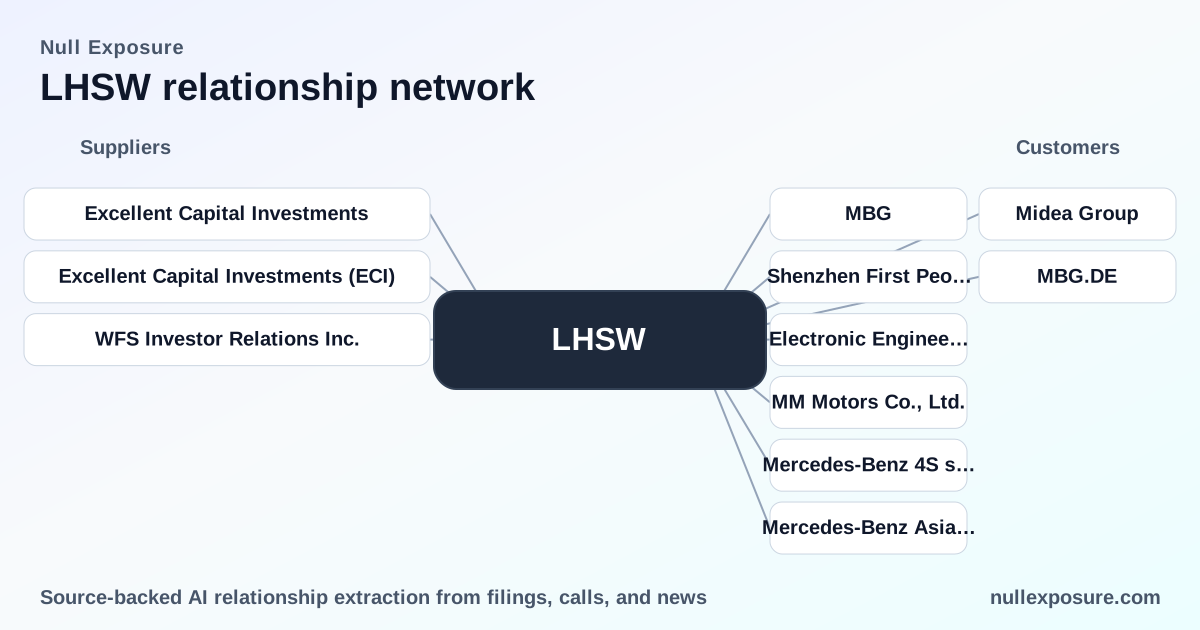
Excellent Capital Investments — $105 million term sheet (project financier)
Lianhe Sowell signed a non-binding term sheet with Excellent Capital Investments (ECI) for a $105 million financing package to build the UAE AI-robot manufacturing and R&D base, with ECI providing 80% of the project financing in the form of structured senior secured credit support while LHSW contributes 20% as a cornerstone investor. This is the single largest disclosed external funding relationship tied to LHSW’s international expansion. According to a GlobeNewswire release on October 21, 2025, the arrangement is framed as structured senior secured credit support and a project-level finance agreement.
Source: GlobeNewswire press release, October 21, 2025.
Excellent Capital Investments — independent reporting of the same deal
A contemporaneous industry report described the same agreement, noting the non-binding $105 million term sheet and characterizing the financing as the means for LHSW’s first AI-powered robot manufacturing and R&D base in the UAE. This independent media coverage reinforces that the ECI transaction is the central financing mechanism for the project and has been reported in multiple outlets.
Source: The AI Insider, October 22, 2025.
WFS Investor Relations Inc. — investor communications and IR conduit
LHSW’s public announcements and investor contact information list WFS Investor Relations Inc. (services@wealthfsllc.com) as the IR contact for this strategic initiative, indicating that WFS is the external communications and investor-relations conduit for the company’s project communications and capital-market messaging. The investor-relations relationship is how LHSW routes updates, which matters for transparency, timing, and control of public disclosures.
Source: Sahm Capital press release / investor relations notice, January 26, 2026.
How these relationships change supplier and counterparty risk
The ECI-led financing structure is a material strategic shift in how LHSW will fund and scale manufacturing. For suppliers and operators evaluating LHSW, three implications are immediate:
- Counterparty concentration risk is elevated because the project relies heavily on one external financier for the majority of capital; any renegotiation or withdrawal affects project continuity and supplier payment flows.
- Contractual complexity rises: structured senior secured financing implies project-level liens and prioritized creditor claims; suppliers should expect project-level contracting terms and possibly supply-security provisions.
- Operational criticality increases: if the UAE facility becomes a key production node, suppliers integrated into that supply chain gain strategic importance — and risk — relative to purely domestic suppliers.
Company-level signals and operating constraints
There are no explicit constraint entries tied to these relationships in the disclosed material, which is itself a signal: the company-level disclosure set contains no flagged contractual constraints in the provided record. That absence should be interpreted operationally as an early-stage project posture where binding commitments and long-form contracts have not been publicly filed, not as their nonexistence.
- Because LHSW is taking a 20% cornerstone stake, the company is increasing balance-sheet and reputational exposure to project outcomes.
- High insider ownership means decisions on these partnerships are concentrated and implemented without broad institutional investor negotiation, accelerating execution but raising governance considerations for external suppliers and financiers.
Bottom line for investors and operators
Lianhe Sowell is transitioning from a China-focused machine-vision supplier into a project sponsor for AI robotics manufacturing, and the Excellent Capital Investments term sheet is the headline counterparty that defines near-term supplier and financing risk. Suppliers should negotiate for project-level security and clear payment terms; investors should price concentrated-financier risk and execution timelines into valuation.
For a tailored exposure map and counterparty scoring on LHSW and similar small-cap suppliers, go to https://nullexposure.com/.
If you track counterparties, need a supplier risk dossier, or want the underlying source trail assembled for diligence, explore the platform at https://nullexposure.com/ for downloadable relationship summaries and evidence-traced notes.
Concluding takeaway: LHSW’s pivot to project-financed manufacturing materially increases its counterparty and execution risk profile, but also creates an asymmetric growth vector if the ECI financing closes and the UAE facility reaches scale. For active investors and procurement teams, the upcoming contract terms and the conversion of the non-binding term sheet into definitive agreements are the single most important events to monitor. Visit https://nullexposure.com/ to monitor updates and source documents in one place.