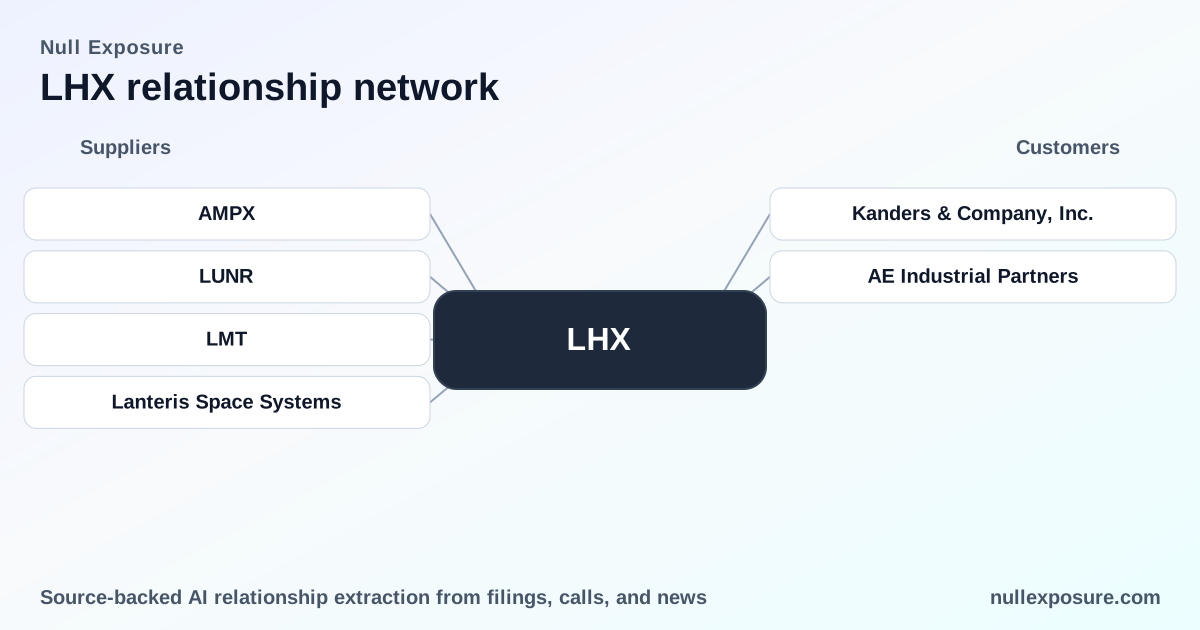
LHX Supplier Landscape: Strategic partners, critical dependencies, and what investors should price in
L3Harris Technologies (LHX) operates as an integrated defense and aerospace systems provider, monetizing through long-term government contracts, systems integration services, and component sales across space, air, land, sea and cyber domains. Its revenue stream is driven by program awards and sustained supplier networks that deliver specialized components, spacecraft platforms and mission-critical subsystems—contracts that convert engineering work into multi-year cash flows and high switching costs. For investors evaluating supplier counterparty risk, the relevant questions are: which suppliers are strategically critical, which provide differentiated technology, and how mature and concentrated are those relationships?
Learn more about supplier-level intelligence and how it maps to financial exposure at https://nullexposure.com/.
The supplier map investors need to read
Below I cover every supplier relationship surfaced in the latest surveillance results and explain the economic relevance to L3Harris.
Amprius Technologies (AMPX) — battery cells to defense programs
Amprius indicated readiness to supply domestic lithium battery cells to customers such as L3Harris, positioning Amprius as a supplier for power-dense components used in L3Harris integrated solutions across multiple domains. This disclosure came from Amprius’ Q4 2025 earnings call transcript reported March 10, 2026, which linked Amprius’ domestic cell supply capability directly to companies including L3Harris (InsiderMonkey, March 2026).
Intuitive Machines (LUNR) — spacecraft platforms for SDA tracking layer
Intuitive Machines was selected by L3Harris to design, build and deliver 18 advanced spacecraft platforms supporting the U.S. Space Development Agency’s Tranche 3 Tracking Layer, making Intuitive Machines a supplier for a high-profile, mission-critical space architecture. The selection is documented in Intuitive Machines’ announcement outlining its role on the SDA Proliferated Warfighter Space Architecture (company press release, March 2026).
Lanteris Space Systems — the subsidiary role inside the Intuitive Machines award
Lanteris Space Systems, a wholly owned subsidiary of Intuitive Machines, was explicitly named by L3Harris as a production partner for spacecraft platforms on the SDA tracking layer contract, indicating subcontractor-level integration into the program delivery chain. Intuitive Machines’ release references Lanteris’ participation in the award supporting L3Harris (company press release, March 2026).
Lockheed Martin (LMT) — systems and propulsion ecosystem mention in L3Harris’ call
Lockheed Martin is referenced in L3Harris’ own earnings commentary in the context of program-level propulsion and system support (THAAD example), highlighting the ecosystem of prime/subprime relationships and the operational reality that L3Harris coordinates with other large defense primes on overlapping programs. This point comes from L3Harris’ Q4 2025 earnings call transcript (LHX earnings call, Q4 2025).
How L3Harris contracts and what the constraints tell investors
L3Harris’ filing language and the collected excerpts convey a contracting posture built on multi-sourced supply chains but with concentrated critical nodes. The company states it “depends on suppliers and subcontractors for a large number of components and subsystems” and relies on a “limited number of certified microelectronics component suppliers.” That language signals high criticality where single- or few-source suppliers supply specialized components, increasing supplier leverage on schedule and quality.
A separate company disclosure also underlines that L3Harris treats certain external relationships as formal service-provider arrangements (the company referenced Ernst & Young LLP in its control reporting), which signals mature governance over external providers and the use of established professional service relationships to support compliance and controls. These excerpts are company-level signals about supplier concentration, criticality and governance rather than statements about any single counterparty.
Taken together, these operating-model facts imply:
- Contracting posture: Program-based awards with embedded supplier tiers and long lead times; L3Harris leverages both captive engineering and third-party suppliers.
- Concentration: While many parts are multi-sourced, certain microelectronics and specialized subsystems are supplied by few certified vendors, creating points of failure.
- Criticality: Suppliers that deliver propulsion, space platforms, or mission-unique batteries are critical to program delivery and schedule.
- Maturity and governance: Formal control and audit relationships show the company enforces supplier oversight, reducing but not eliminating operational risk.
Financial and program implications investors should price
L3Harris’ financial profile—annual revenue above $21.8 billion, operating margin in the mid-teens, and a program-heavy backlog—derives directly from its supplier ecosystem. Program awards like the SDA tracking layer create predictable revenue streams but deliver concentrated operational risk around suppliers who provide mission-critical hardware (spacecraft, propulsion, certified microelectronics, battery systems).
Risk vectors to monitor:
- Schedule slippage from a single-source component can delay acceptance milestones and revenue recognition.
- Supplier solvency or capacity constraints (for example, a battery cell supplier scaling capacity) affect L3Harris’ ability to meet defense deadlines.
- Technical integration risk where L3Harris coordinates multiple primes and subs, as shown by the Lockheed Martin reference on propulsion systems.
For investors, monitor award-level disclosures and supplier press releases (e.g., Intuitive Machines/Lanteris selection announcements and Amprius supply statements) because they provide leading indicators of program scope, timelines and subcontract revenue capture.
Find deeper supplier relationship analytics and risk-mapped exposure at https://nullexposure.com/.
What to watch next and portfolio actions
- Track milestone disclosures for the SDA Tranche 3 Tracking Layer and related subcontract milestones from Intuitive Machines and Lanteris; these events convert supplier activity into L3Harris revenue recognition. (See Intuitive Machines press release, March 2026.)
- Monitor battery-supply confirmations from Amprius as those agreements affect product qualification and sustainment schedules (Amprius Q4 2025 earnings transcript, March 2026).
- Watch program-level commentary in L3Harris earnings calls for mentions of single-source suppliers and supplier remediation steps; any extension of the Lockheed/LHX coordination language should be treated as operational detail that affects schedule risk (LHX Q4 2025 earnings call).
If your strategy is program-driven long-only exposure, prioritize scenario analysis around supplier delays and margin sensitivity; if your strategy is event-driven, short windows around supplier qualification announcements and milestone misses present asymmetric opportunities.
For institutional access to supplier-level coverage tied to balance-sheet exposure, visit https://nullexposure.com/ to see how supplier intelligence maps directly to cash-flow risk.
Bottom line
L3Harris monetizes through major government contracts that are only as reliable as an often-complex supplier network. Key suppliers—spacecraft integrators (Intuitive Machines/Lanteris), specialized battery providers (Amprius) and large systems primes (Lockheed Martin on shared program elements)—are not peripheral; they are program enablers whose schedules and certifications materially affect revenue timing and margin realization. Investors must price both the reward of multi-year program cash flows and the concentrated operational risk around a handful of mission-critical suppliers.