Li Auto (LI): Supplier relationships, strategic posture, and what investors should price in
Li Auto designs, develops and sells smart electric SUVs in China and monetizes through vehicle sales, recurring software/features and aftersales services while selectively internalizing strategic components. The company markets premium, software‑rich SUVs and funds growth with vehicle revenue and margin expansion; investors should focus on how Li balances in‑house technology (M100 driving chip) with tier‑1 supplier partnerships (e.g., Qualcomm) because that mix determines capex cadence, supply risk and product cadence. For a consolidated view of supplier exposures and structural implications, see https://nullexposure.com/.
Executive snapshot investors need up front
Li Auto is a large China EV OEM with TTM revenue of ¥112.3 billion and a market capitalization near $18.7 billion. Profitability sits under pressure: TTM operating margin is negative (-1.54%) while trailing PE sits at 114x, reflecting high growth expectations against uneven quarterly performance (quarterly revenue down 35% YoY). Management is executing a product refresh cycle while shifting some compute in‑house; that strategy influences supplier negotiations, development timelines and unit economics.
How Li structures supplier relationships — a mixed model with strategic internalization
Li Auto runs a hybrid sourcing model. The company is actively developing and deploying proprietary components (the M100 smart driving chip) while continuing to rely on established semiconductor suppliers for cockpit and infotainment compute. That contracting posture signals a selective vertical integration strategy: Li internalizes high strategic value elements to control features and margins, and outsources commodity or high‑scale components to tier‑1 suppliers to preserve time‑to‑market.
Concentration and criticality: chips are a critical input for Li’s software‑driven value proposition; reliance on a small number of advanced suppliers for cockpit and connectivity components creates meaningful supply concentration risk even as in‑house efforts reduce that exposure over time. In the absence of explicit contractual constraint disclosures in the supplier scope, treat that as a company‑level signal: Li has not flagged supplier contractual restrictions in the available supplier dataset, which implies standard OEM supplier relationships rather than exclusive long‑term constraints.
Maturity and operating posture: Li is in a product‑refresh phase — deploying next‑generation vehicle models and evolving its ADAS and cockpit stack — so supplier relationships will be dynamic and renegotiated on model cycles. Investors should expect periodic supplier concentration spikes around new model launches and steady capex to support internal silicon development.
For detailed third‑party relationship work and ongoing monitoring, visit https://nullexposure.com/.
Supplier relationships in the record
This section covers every supplier relationship identified in the available results.
-
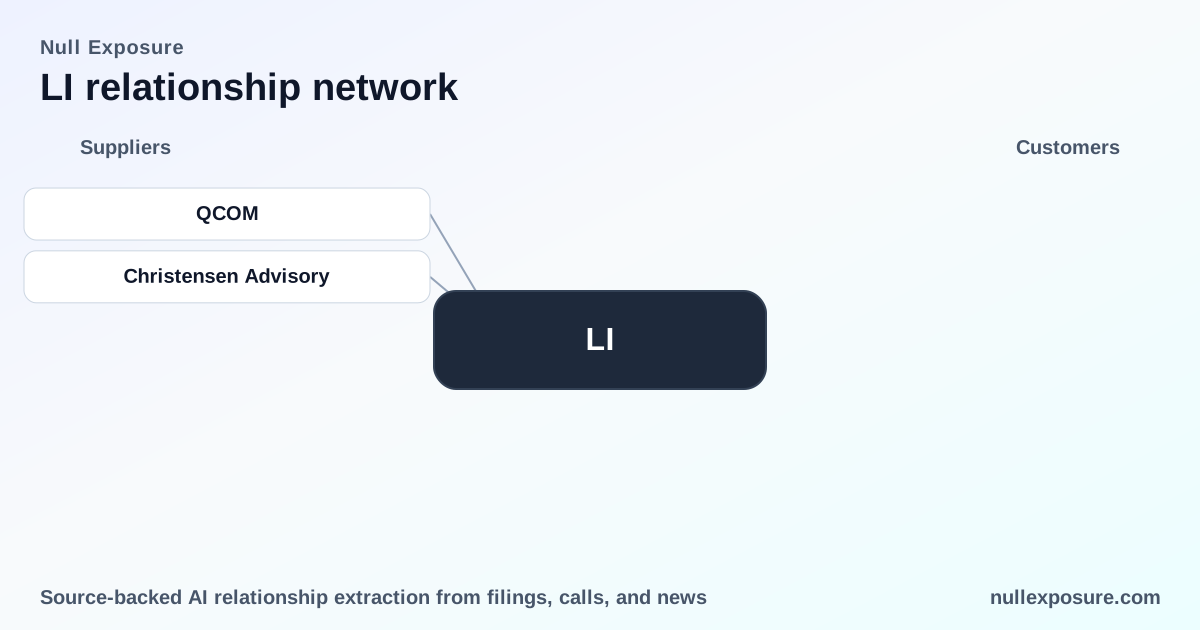
Qualcomm — cockpit chip supplier for Li L9; M100 debuts as Li’s driving chip. The company will ship its in‑house developed M100 smart driving chip in the Li L9 while the vehicle’s cockpit compute transitions to Qualcomm’s Snapdragon 8797 for the cockpit, indicating a split between Li’s strategic driving compute and an outsourced infotainment/cockpit stack. This was reported by CNEVPost in January 2026. (CNEVPost, Jan 21, 2026)
-
Christensen Advisory — investor relations and media contact for earnings communications. Christensen Advisory is listed as Li Auto’s investor and media relations contact for the Q4 and full‑year 2025 earnings release, indicating the firm handles Li’s external financial communications and investor outreach. This was disclosed in a financial notices posting in late February 2026. (Markets/FinancialContent, Feb 27, 2026)
What these relationships imply for valuation and risk
-
Product differentiation through in‑house silicon increases long‑term margin control. The M100 rollout signals Li’s intention to capture more of the value chain for ADAS and driving compute, which supports higher lifetime unit economics if Li executes on software monetization and cost reduction through scale.
-
Outsourcing cockpit compute to Qualcomm reduces execution risk and shortens development cycles. Relying on Qualcomm’s Snapdragon 8797 allows Li to ship contemporary infotainment and connectivity features without the delay and capital intensity of developing equivalent chips in‑house.
-
Supplier concentration risk remains non‑trivial for chips. Even with partial internalization, criticality of advanced semiconductors is high; a disruption to a tier‑1 supplier, or timing mismatch between Li’s internal chips and supplier roadmaps, would compress margins or delay launches.
-
Communications outsourcing via Christensen Advisory standardizes investor outreach and reduces disclosure friction. This is an operational detail that reduces reputational and executional investor‑relations risk but does not materially affect product delivery.
Mid‑analysis resource: for a structured supplier risk assessment and ongoing monitoring, visit https://nullexposure.com/.
Key takeaways for operators and investors
-
Strategic vertical integration is real and consequential. The M100 indicates Li will internalize high‑value compute, which supports long‑term margin expansion if software monetization follows.
-
Tier‑1 partnerships remain essential to time‑to‑market. Qualcomm’s role in the cockpit stack reduces launch risk and eases certification and supply scaling for infotainment systems.
-
Balance of internal vs external components drives near‑term capital intensity. Investors should model elevated R&D/capex in the near term for silicon development, offset by potential gross margin improvements over time.
-
Communication and disclosure are centralized. The use of an external IR firm simplifies external messaging at earnings and product milestones.
Final view and recommended investor action
Li Auto’s supplier posture is pragmatic: it pursues selective internalization of strategic compute while leveraging tier‑1 suppliers for complementary systems, a configuration that supports product differentiation without sacrificing cyclical time‑to‑market. Investors should weight near‑term margin pressure and capex for chip development against multi‑year upside from proprietary software and hardware integration.
For tracking supplier dynamics and monitoring future relationship shifts tied to model launches and financial disclosures, return to the centralized supplier intelligence hub at https://nullexposure.com/.
If you need a tailored supplier risk brief or ongoing alerts for Li Auto’s supplier moves, the research tools and monitoring services at https://nullexposure.com/ provide structured coverage and alerting.