Lichen China (LICN) — what its supplier footprint tells investors
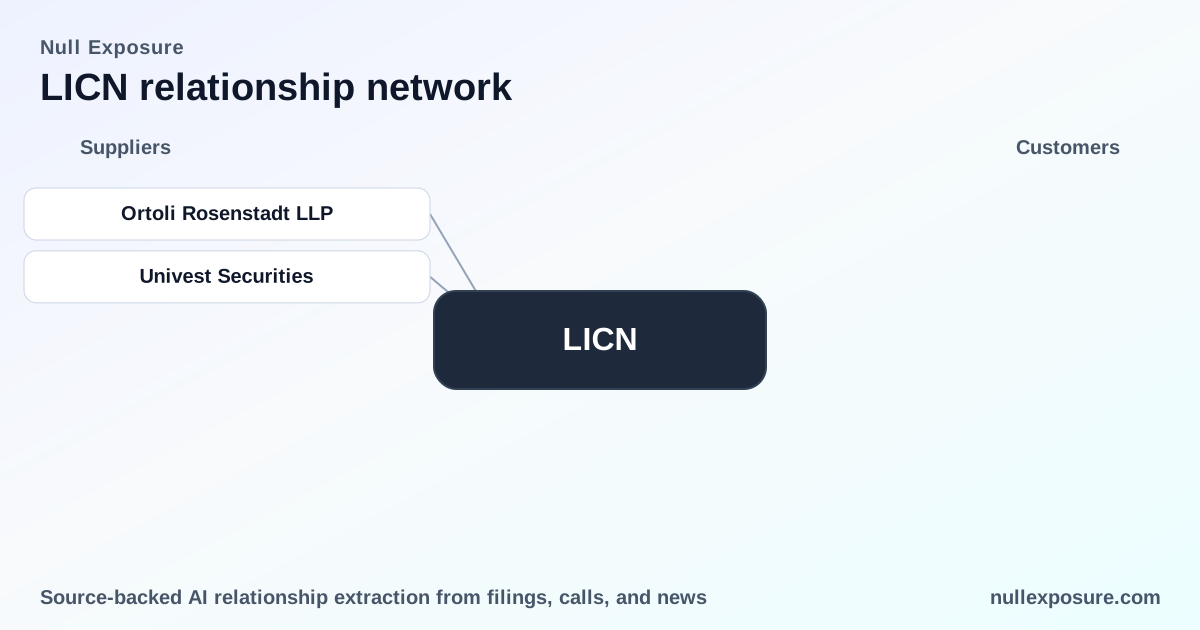
Lichen China Limited is an investment holding company that generates revenue from financial and taxation services, education support and software maintenance services in mainland China. The company monetizes through contractual service fees and recurring maintenance arrangements; its trailing twelve‑month revenue was $37.64 million with a gross profit of $21.30 million, while operating performance remains under pressure (TTM operating margin -36.8%, net loss per share wide negative). For investors and operators, the supplier picture is narrow but meaningful: legal counsel and an underwriting partner facilitated the company’s Nasdaq listing, signaling exposure to capital‑markets funding dynamics and a transactional supplier posture. Learn more at https://nullexposure.com/.
The two supplier relationships that show up in the record
The source material for LICN’s supplier relationships is concentrated and public-facing. Below are the relationships the available coverage documents.
Ortoli Rosenstadt LLP — U.S. securities and IPO counsel
Ortoli Rosenstadt LLP served as U.S. legal counsel for Lichen China in connection with its Nasdaq listing and related transactional work, assisting with regulatory and listing documentation for the $16 million offering. Source: Lawyer Monthly, April 2023 (reporting on counsel role for the Nasdaq listing; https://www.lawyer-monthly.com/2023/04/enabling-ipo-success-for-chinese-companies-in-the-us/).
Univest Securities — underwriting role on the Nasdaq listing
Univest Securities acted as the underwriter that took Lichen China public on Nasdaq on 6 February 2023, enabling the $16 million listing during the Chinese New Year period. This underwriter relationship is the primary capital‑markets supplier recorded in the public coverage. Source: Lawyer Monthly, April 2023 (coverage notes Univest Securities as the underwriter; https://www.lawyer-monthly.com/2023/04/enabling-ipo-success-for-chinese-companies-in-the-us/).
What the supplier list implies about operating posture and risk
There are no supplier constraints explicitly recorded in the provided relationship data. That absence is itself a signal: the supplier footprint in public coverage is narrow and event‑driven (IPO support) rather than broad ongoing supply relationships.
Company-level operating model signals derived from public financials and the supplier mix:
- Contracting posture: transactional and event-driven. The only suppliers documented in the public record relate to the corporate listing event rather than a broad, strategic vendor ecosystem; this suggests supplier engagements are currently oriented around discrete, short‑term mandates rather than long‑dated, mission‑critical outsourcing arrangements.
- Concentration: high single-event concentration. Publicly visible supplier activity centers on IPO execution, not diversified vendor panels; combined with a small market capitalization (~$47.2 million) and a very small institutional ownership (0.1%), this indicates concentration risk both in capital sources and in vendor visibility.
- Criticality: capital‑markets services are materially important. The company relied on underwriting and U.S. counsel to access public capital; while those suppliers are transactional, their services were critical to achieving public status and any near-term financing pathway.
- Maturity: early public‑company phase. Lichen China listed on Nasdaq in February 2023 and continues to show negative profitability (TTM net margin -43.2%) and negative EBITDA, positioning it as an early‑stage public issuer that is still scaling or restructuring its business model.
How these signals translate into investor due diligence
For investors and operators assessing LICN supplier risk and operational resilience, the practical takeaways are:
- Counterparty risk is concentrated and event-centric. The supplier footprint documented in public coverage does not show a diversified, strategic supplier ecosystem. Operational continuity risks should be evaluated by probing beyond public filings for ongoing vendors delivering software maintenance, education services platforms, and tax/financial outsourcing.
- Capital access is a tangible supply‑chain vector. Given the company’s small float (shares outstanding ~16.2 million, shares float ~0.76 million) and low institutional ownership, future financing will continue to be an active supplier relationship (underwriters, placement agents, legal counsel). Monitor upcoming fundraising needs and the marketplace for underwriter support as part of credit or equity diligence.
- Financial fragility elevates supplier negotiation leverage. Negative operating and net margins give suppliers and counterparties leverage in contract renewals and pricing discussions; secure favorable service levels and understand termination provisions before committing to material commercial dependence with LICN.
Explore supplier and counterparty exposure analysis at https://nullexposure.com/ for a deeper view into concentrated supplier events and public filing traceability.
Practical checks for operators and procurement teams
When evaluating LICN as a client, partner, or investment, make these checklist items part of the engagement protocol:
- Confirm ongoing vendor lists and contract lengths for software maintenance and education service delivery; public records show no long-term vendor roster.
- Validate the company’s access to working capital beyond the IPO window, including any follow‑on financing mandates or covenants tied to underwriting partners.
- Verify counterparty credit limits and payment histories, given the company’s negative EBITDA and sizeable quarterly revenue declines year over year (quarterly revenue growth YOY -21.2%).
Conclusion — where LICN stands from a supplier-risk lens
Lichen China’s public supplier footprint is narrowly focused on capital‑markets providers that executed its Nasdaq listing: Ortoli Rosenstadt LLP for legal counsel and Univest Securities as underwriter. The absence of broader supplier disclosures in public coverage, combined with small market cap, high losses, limited institutional ownership, and a small float, frames LICN as a company still reliant on transactional supplier engagements and public capital access. Investors should treat supplier risk as an extension of financing risk: legal and underwriting relationships are necessary but not sufficient indicators of a resilient vendor ecosystem.
For a structured supplier-risk briefing tailored to LICN or similar small‑cap, recently listed companies, visit https://nullexposure.com/ and request a focused report on supplier concentration and contractual maturity.