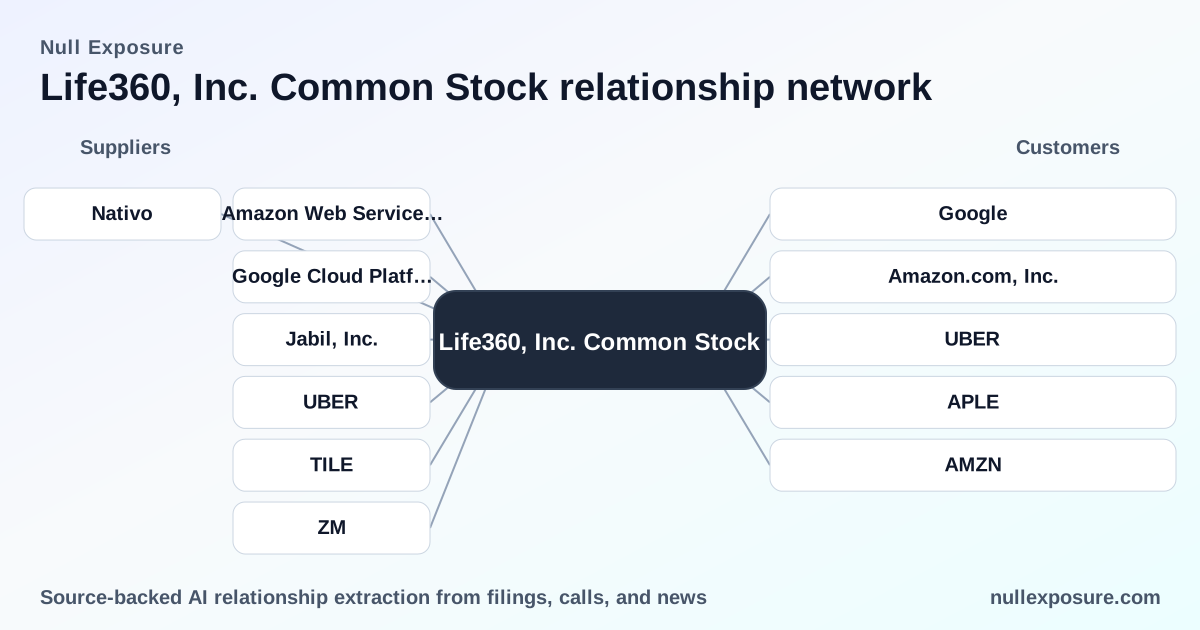
Life360 supplier map: what operators and investors need to know
Life360 operates a location and family-safety platform that monetizes primarily through subscription services and hardware sales (Tile and Jiobit devices), while outsourcing critical infrastructure and manufacturing functions to third parties. The company’s operating model depends on cloud providers for core compute and storage, a concentrated manufacturing footprint in Asia, and an expanding set of commercial integrations (notably with Uber and through M&A). For a quick, structured read on supplier risk and strategic exposure, see more at https://nullexposure.com/.
The short investment thesis: platform-led subscriptions, outsourced operations
Life360 drives recurring revenue from subscription tiers layered on its location and safety app, supplemented by hardware sales of Tile and Jiobit trackers and advertising capabilities after the Nativo acquisition. Margins and growth are sensitive to supplier continuity (cloud and manufacturing) and to execution on partner integrations that expand distribution and product utility. Investors should treat supplier relationships as operational levers: they are both efficiency multipliers and concentration risks.
How the procurement posture shapes competitive economics
Life360 runs a lean, asset-light core: it builds the product and user experience while outsourcing heavy lifting. That posture creates four actionable characteristics investors and operators should monitor:
- Contracting posture — third-party dependence: Life360 relies on external cloud and infrastructure providers and licenses third-party technology, implying fixed contractual costs and vendor SLAs that influence uptime and costs.
- Concentration risk — manufacturing and cloud: The company outsources a significant portion of hardware manufacturing to Asia and relies for primary data storage and compute on major cloud providers, increasing single-point-of-failure exposure.
- Criticality — operations tied to suppliers: Disruption of cloud or manufacturing contracts would be material to revenue delivery and device fulfillment.
- Maturity and optionality — commercial partnerships and acquisitions: Strategic integrations (Uber) and the Nativo acquisition broaden channels and revenue types, reducing some single-product dependency while adding integration execution risk.
For deeper supplier intelligence and monitoring tools, visit https://nullexposure.com/.
Supplier roster and what each relationship delivers
Below are the supplier and partner relationships disclosed in Life360’s filings and public releases, summarized in plain English with source references.
Amazon Web Services (AWS)
Life360 uses AWS for computing, networking, databases, development platforms and core software infrastructure; AWS provides the bulk of the company’s primary data storage and compute. According to Life360’s FY2024 Form 10-K, the company relies on contracts with AWS for these foundational services. This relationship is operationally critical and material to Life360’s service availability. (FY2024 10‑K filing)
Google Cloud Platform (GCP)
Jiobit functionality uses Google Cloud Platform for parts of its services and Life360 designs its systems to use both AWS and GCP for data processing and storage. The FY2024 10‑K notes GCP as a provider supporting Jiobit functionality, indicating multi-cloud usage for specific device lines and a degree of redundancy. (FY2024 10‑K filing)
Jabil, Inc.
Life360 outsources manufacturing of Tile and Jiobit devices to a single contract manufacturer in Asia identified as Jabil, Inc., using Life360’s design specifications. The FY2024 10‑K specifies Jabil as the manufacturer, creating concentration in hardware production and an APAC-dependent supply chain. (FY2024 10‑K filing)
Uber Technologies, Inc.
Life360 expanded a strategic partnership with Uber to enable linked accounts, real-time trip tracking, ride booking, and integrated membership benefits that improve family mobility coordination. GlobeNewswire and industry reporting covered the February 2026 expansion, positioning Uber as a distribution and product-integration partner rather than a pure supplier. (GlobeNewswire press release, Feb 17, 2026; industry reporting, Feb 2026)
Tile
Life360 sells Tile tracking devices as part of its hardware portfolio and derives product revenue around these devices while subscriptions remain core to monetization. Tech coverage in March 2026 referenced Life360’s role selling Tile trackers and reinforced subscriptions as the revenue engine. Tile operates as a product and channel relationship within Life360’s hardware ecosystem. (TS2 Tech coverage, Mar 2026)
Zoom
Life360 uses Zoom for investor and public earnings calls; a GlobeNewswire release referencing the Q4 2025 results noted that the call was held as a Zoom audio webinar. This is a standard corporate communications supplier relationship rather than a product dependency. (GlobeNewswire, Jan 22, 2026)
Nativo
Life360 completed the acquisition of Nativo, an advertising technology company, for approximately $120 million (65% cash, 35% stock), expanding Life360’s ad-tech capabilities and monetization levers beyond subscriptions and hardware. GlobeNewswire announced the acquisition in January 2026. This is a strategic purchase that converts a partner/target into an owned capability. (GlobeNewswire press release, Jan 5, 2026)
Operational constraints and what they signal about risk and resilience
Life360’s public disclosures and constraint signals create a clear picture of supplier risk and strategic posture:
-
Exclusive licensing exposure (company-level signal with named counterparty Arity). Life360 has an Arity licensing agreement that requires exclusive sourcing of the Arity Driving Engine API during the term of the agreement, indicating dependency on licensed functionality and limited supplier flexibility for that component. The Arity agreement is a distinct contractual constraint to monitor in renewal cycles. (Arity licensing disclosure in 10‑K)
-
APAC manufacturing concentration. Life360 outsources significant manufacturing to contract manufacturers with facilities in the PRC and Malaysia; this geographic concentration increases geopolitical, logistics, and labor-cycle risk for device supply. Treat manufacturing continuity and dual-sourcing efforts as material operational metrics for the next 12–24 months.
-
Materiality of cloud services (AWS/GCP). Life360 explicitly states that termination or disruption of AWS or GCP contracts could materially impact business, financial condition, and operations. That language elevates cloud relationships from convenience to mission-critical, and investors should stress-test scenarios where availability or contractual terms shift. (FY2024 10‑K)
-
Outsourced service provider posture. The company’s reliance on third-party infrastructure, encryption, content delivery, and fulfillment partners points to an asset-light model that trades capital intensity for vendor and integration risk—manageable if contracts and SLAs are strong, risky if concentrated and underpriced.
What operators and investors should monitor next
- Track AWS and GCP contract renewals, SLAs, and any multi-cloud redundancy investments; cloud continuity is core to product availability.
- Watch manufacturing throughput and any move to dual-source outside a single APAC manufacturer; single-manufacturer exposure is a near-term supply risk.
- Evaluate integration performance with Uber and the monetization ramp from the Nativo acquisition; partnerships and M&A are the primary levers to diversify revenue beyond subscriptions.
For ongoing supplier intelligence and to model counterparty risk into valuation scenarios, visit https://nullexposure.com/.
Bottom line
Life360 combines a subscription-led revenue model with outsourced execution—cloud providers and contract manufacturers are central to service delivery, and recent M&A and partner integrations broaden commercial reach. Supplier dependencies are a double-edged sword: they enable scale and lower capex but concentrate operational risk. Active monitoring of cloud contracts, manufacturing sourcing, and the integration success of Uber and Nativo will materially affect execution and valuation. For operational risk scoring and live supplier alerts, explore https://nullexposure.com/.