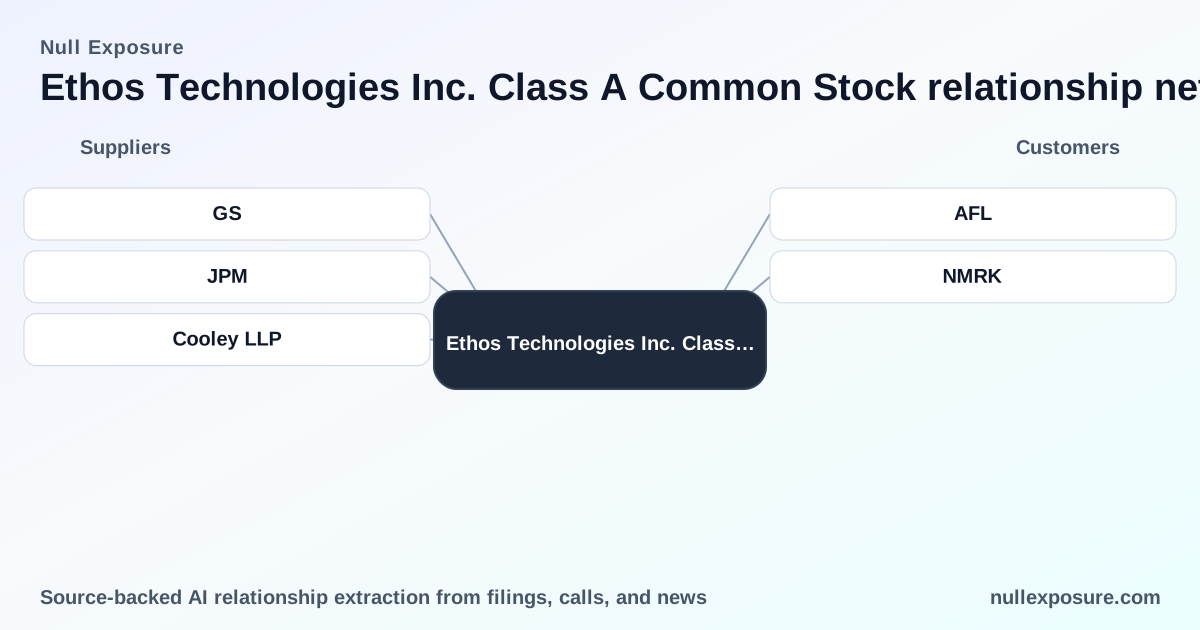
Ethos Technologies (LIFE) — Supplier relationships and what they mean for investors
Ethos Technologies is a digitally native life-insurance carrier that monetizes by underwriting and servicing life policies sold through digital distribution and partnerships, collecting recurring premium revenue and investment income on reserves. The company reported $387.6 million in revenue (TTM) with a positive profit margin (18.4%) and an EBITDA profile that supports a market capitalization near $750 million; capital markets and legal partners are therefore strategic vendors that shape access to public capital and broader distribution. Explore more on the platform if you want a consolidated view of counterparty exposure and deal counterparties: https://nullexposure.com/
Why the IPO syndicate matters to holders and operators
Ethos’s supplier-scape for the IPO is not a routine vendor list — it is the gate that determines execution quality, pricing, and the reputational footprint of the company’s market debut. Lead underwriters and legal counsel govern deal timing, book-building, and the narrative delivered to institutional investors, which directly impacts the company’s cost of capital and secondary-market liquidity. For an insurer that relies on scale and continued access to capital, these relationships are operationally critical around transactional windows and strategically important for signaling.
The underwriting and counsel roster — quick takeaways
- Goldman Sachs and J.P. Morgan acted as the lead managers for Ethos’s offering, an indicator of top-tier institutional engagement and standard market execution for a high-profile listing. According to Capital.com coverage of the IPO, “the deal will be managed by a consortium of underwriters led by Goldman Sachs and JPMorgan” (reported March 10, 2026).
- Goldman Sachs & Co. LLC is named explicitly in later reporting tied to the IPO priced at $19 per share, reinforcing Goldman’s primary role in syndicate leadership as reported on March 10, 2026 by fbroker.kz.
- Cooley LLP served as legal counsel for Ethos, while Simpson Thacher & Bartlett represented the underwriters, a typical structure that places sophisticated law firms on either side of the underwriting agreement and prospectus process (Capital.com, March 10, 2026).
If you need an aggregated view of counterparties for due diligence and exposure monitoring, see the company page: https://nullexposure.com/
Relationship-by-relationship breakdown
Goldman Sachs (capital.com, FY2025). The bookrun was led by Goldman as reported by Capital.com on March 10, 2026, underscoring Goldman’s role in pricing and institutionally distributing the deal to buy-side accounts.
Goldman Sachs & Co. LLC (fbroker.kz, FY2026). A report from fbroker.kz on March 10, 2026 reiterated Goldman Sachs & Co. LLC as a lead underwriter and referenced the IPO price of $19 per share.
JPMorgan (capital.com, FY2025). Capital.com’s coverage of the offering on March 10, 2026 identified J.P. Morgan as the co-lead alongside Goldman, signaling a two-firm syndicate leadership structure for allocation and book-building.
J.P. Morgan (fbroker.kz, FY2026). Fbroker.kz’s March 10, 2026 article also listed J.P. Morgan among the lead underwriters, consistent with other market reports on the offering.
Cooley LLP (capital.com, FY2025). Capital.com notes that Cooley LLP provided legal counsel to Ethos on the IPO while Simpson Thacher & Bartlett represented the underwriters (March 10, 2026), which is consistent with standard counsel allocation in public offerings.
Operating-model signals and company-level constraints
The supplier-oriented data returns no specific contractual constraints in the supplier scope; that absence is meaningful in itself as a company-level signal. From the commercial and financial metrics we have, several operating-model characteristics stand out:
- Contracting posture: Ethos’s reliance on premier investment banks as underwriters and on a recognized law firm for issuer counsel reflects a classic issuer contracting posture when accessing public capital — engaging blue-chip firms to offload execution and regulatory risk. This indicates a preference for established counterparties over boutique providers for capital-markets execution.
- Concentration: Underwriting concentration around two global banks is standard for IPOs, but it concentrates execution risk during transactional windows; single-syndicate leadership means these banks shape pricing, allocations, and aftermarket stabilization activities.
- Criticality: These relationships are mission-critical during the IPO and any follow-on equity or debt issuance because underwriters and counsel enable access to institutional demand and regulatory compliance. Outside issuance windows, counterparties shift to more routine roles, but the reputational linkage persists.
- Maturity and sophistication: The selection of Goldman, J.P. Morgan, and Cooley signals that Ethos meets institutional governance and disclosure standards expected by primary-market players. The company’s public financials — positive EPS of $1.14, a trailing P/E of 10.47, and EV/EBITDA ~7.35 — support a narrative of operational maturity sufficient to attract top-tier firms.
Investment implications and risk checklist
For investors and corporate operators, translate the supplier relationships into actionable items:
- Positive: Top-tier underwriters reduce execution risk and increase the probability of broad institutional distribution; recognized counsel lowers the legal execution risk on disclosure and offering structure. These factors support liquidity and acceptable pricing on primary issuance.
- Risks: Concentrated underwriting leadership increases single-event exposure; reputational or operational missteps in the execution phase would have outsized market consequences. Also monitor any ongoing dependence on capital markets if growth requires recurrent public issuance.
- Valuation context: Ethos’s valuation and operating margins are healthy relative to many growth insurers — P/E 10.47, EV/EBITDA 7.35, and Revenue TTM $387.6M — which suggests capacity to fund operations but still leaves capital-raising optionality on the table as expansion accelerates.
For more detailed counterparty mappings and to download a collateralized counterparties report, visit https://nullexposure.com/
Final note for investors evaluating supplier exposure
Ethos’s choice of Goldman Sachs, J.P. Morgan, and Cooley LLP for their offering is a deliberate, conventional strategy that de-risks public-market entry and signals institutional acceptance. Investors should treat these relationships as high-signal around capital access and governance, but remember that their practical impact is greatest at issuance and around any future capital raises. Monitor follow-on issuance plans, lock-up expirations, and any counsel disputes or underwriter-related litigation, as those are the paths by which counterparty relationships convert into measurable investor outcomes.
If you want an operationalized supplier exposure view and ongoing monitoring of these counterparties, start here: https://nullexposure.com/