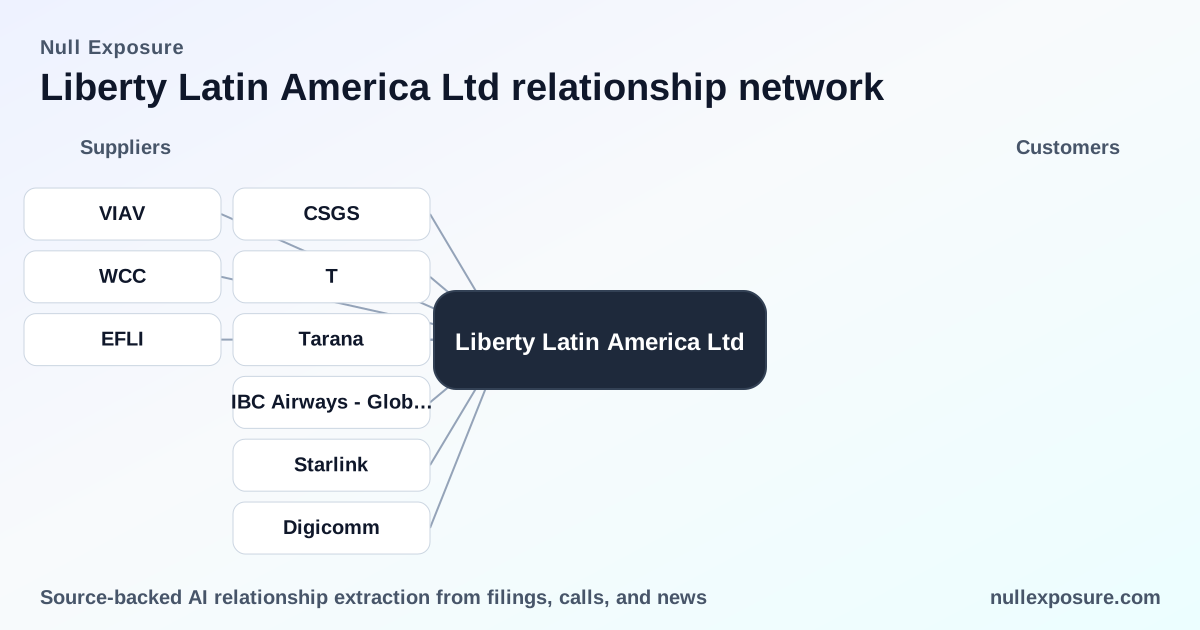
Liberty Latin America (LILA): supplier map and what it means for investors
Liberty Latin America operates fixed, mobile and subsea telecom services across Caribbean and Latin American markets and monetizes through subscription and wholesale connectivity, programming and value-added services; the company’s economics are driven by network asset utilization, programming and spectrum/license positions, and recurring customer billing. For investors, LILA’s supplier relationships reveal a dual strategy: heavy vendor reliance for core network hardware and software, and selective third-party partnerships for wholesale, disaster recovery and humanitarian logistics. Explore supplier exposure and risk more broadly at https://nullexposure.com/.
Quick take: why supplier relationships matter for LILA investors
LILA is a capital-intensive telecom operator with ~$4.44 billion in trailing revenue and about $1.13 billion in EBITDA, yet negative reported EPS, indicating a business where operating scale and capital allocation dominate valuation. The supplier profile shows significant third‑party dependence for equipment, software and services and signals a mix of long‑term concessions and vendor financing that affect cash flow timing and operational resilience. Key investment themes: cost of goods (programming and content), vendor concentration in critical network layers, and contractual tenure of rights and licenses.
Supplier relationships summarized (every partner in the results)
Below I list every supplier relationship surfaced in the available coverage and provide a concise investor-oriented read on each.
CSG — wholesale operations and platform modernization
Liberty Latin America selected CSG to streamline its wholesale business and unify operations across 21 countries and multiple lines of business, positioning CSG as a central platform for commercial and billing flows. According to Yahoo Finance, this engagement was announced in March 2026 and targets wholesale simplification across the group (Yahoo Finance, March 10, 2026).
AT&T — past asset acquisition in Puerto Rico and U.S. Virgin Islands
LILA completed a material acquisition of AT&T’s wireless and wireline assets in Puerto Rico and the U.S. Virgin Islands in a transaction valued at $1.95 billion, a deal that expanded LILA’s scale and fixed/mobile footprint in those territories. NextTV reported this completion as part of LILA’s FY2020 strategic expansion (NextTV coverage of the closing, FY2020).
Tarana — partner in disaster/humanitarian response
Tarana was acknowledged among equipment and service contributors when LILA and its foundation delivered humanitarian aid to Jamaica after Hurricane Melissa, indicating Tarana’s role in radio/wireless support during crisis recovery. The contribution list was published in a press release reported via Markets/FinancialContent in late 2025 (BizWire/Markets FinancialContent, Oct 31, 2025).
IBC Airways – GlobalX — logistics support for relief operations
IBC Airways - GlobalX is credited as a logistics partner in LILA’s humanitarian deployment to Jamaica, highlighting the company’s use of third‑party air logistics for emergency response and supply chain mobility. This is drawn from the same October 2025 press release describing relief efforts (BizWire/Markets FinancialContent, Oct 31, 2025).
Starlink — satellite connectivity for resilience and coverage
Starlink appears among named contributors to post‑hurricane relief, indicating LILA’s willingness to deploy or accept satellite connectivity for resilience, temporary coverage or backhaul augmentation in disaster contexts (BizWire/Markets FinancialContent, Oct 31, 2025).
Digicomm — local technical/operational support in relief
Digicomm was included in LILA’s list of contributors to disaster relief in Jamaica, suggesting Digicomm provides local provisioning, installation or logistics capabilities when terrestrial networks are disrupted (BizWire/Markets FinancialContent, Oct 31, 2025).
Viavi — test & measurement and network assurance
Viavi is cited among partners thanked for contributions during the humanitarian response; given Viavi’s product set, this indicates LILA leverages Viavi for test/measurement and assurance support in network restoration scenarios (BizWire/Markets FinancialContent, Oct 31, 2025).
Wesco‑Anixter — hardware supply and material logistics
Wesco‑Anixter is listed as a supplier contributor to relief efforts, reflecting its role as a large distribution partner for cables, passive network materials and logistics in both routine deployments and emergency rebuilds (BizWire/Markets FinancialContent, Oct 31, 2025).
EFL — regional service and installation partner
EFL (noted in LILA’s acknowledgements) is part of the ecosystem used for rapid-response and field operations, consistent with LILA’s reliance on regional installers and services providers to maintain and restore network availability (BizWire/Markets FinancialContent, Oct 31, 2025).
What the contract and spend signals tell investors
The available constraint signals describe LILA’s operating posture and supplier economics at the company level:
- Contracting posture: LILA operates with a mix of long‑term concessions and shorter vendor financing arrangements. Evidence includes a 15‑year renewable concession (renewal in process) and vendor financing for equipment and VAT that is often due within one year or aligned to licensing terms. This indicates both long-duration rights exposure and working‑capital financing of capex.
- Contract types: The company uses licensing arrangements alongside short‑term vendor financing; licensing obligations can extend over the license term while other debts are short term. This duality creates timing risk: capitalized network investments are financed off‑balance via vendor terms while licenses carry longer performance commitments.
- Role and segment exposure: LILA relies on third‑party service providers for hardware (CPE, handsets, network infrastructure), software and services—a classic telecom outsourcing model that concentrates risk in suppliers that provide mission‑critical network stack components.
- Spend scale: Programming and direct service costs are meaningful—reported programming and other direct costs are roughly $989.4 million—placing some supplier categories comfortably in the $100M+ spend band and highlighting cost levers that directly affect gross margin.
These are company-level signals: they describe LILA’s overall supplier profile rather than attributing a constraint to any single named partner.
Operational risk, concentration and investor implications
- Criticality: Hardware and software suppliers deliver network availability; outages or delivery delays from major vendors would have immediate customer and revenue impact. Vendor failure is business‑critical.
- Concentration: Several large, single‑purpose vendors and distribution partners imply concentration risk in procurement and logistics; the AT&T asset purchase demonstrates that M&A decisions also reshape supplier needs and counterparty exposure.
- Maturity and leverage: The mix of long concessions and vendor financing signals a mature operator balancing long‑dated rights with near‑term capital programs. Investors should watch concession renewals and vendor financing rollovers as discrete liquidity and regulatory events.
What investors should do next
- Review LILA’s concession renewal schedules and vendor financing terms in the next SEC filings; these are potential inflection points for cash flow and capex timing.
- Track the CSG wholesale implementation timeline—success or delay will affect wholesale revenue and cost rationalization across 21 countries.
- Monitor programming and direct costs as margin drivers; nearly $1 billion in direct costs is a lever for margin sensitivity.
For a broader supplier exposure map and deeper relationship signals, visit https://nullexposure.com/. If you want a tailored supplier risk briefing for LILA or comparator telcos, start an engagement at https://nullexposure.com/ and we’ll prepare a focused supplier risk memorandum.
Final takeaway: LILA operates as a capital‑intensive, vendor‑dependent telco with clear spend concentrations and a blended contract posture that combines long‑term concessions with short‑term vendor financing; investors must weight execution of vendor integrations (for example, CSG) and concession/licensing timelines equally with traditional revenue and cost metrics.