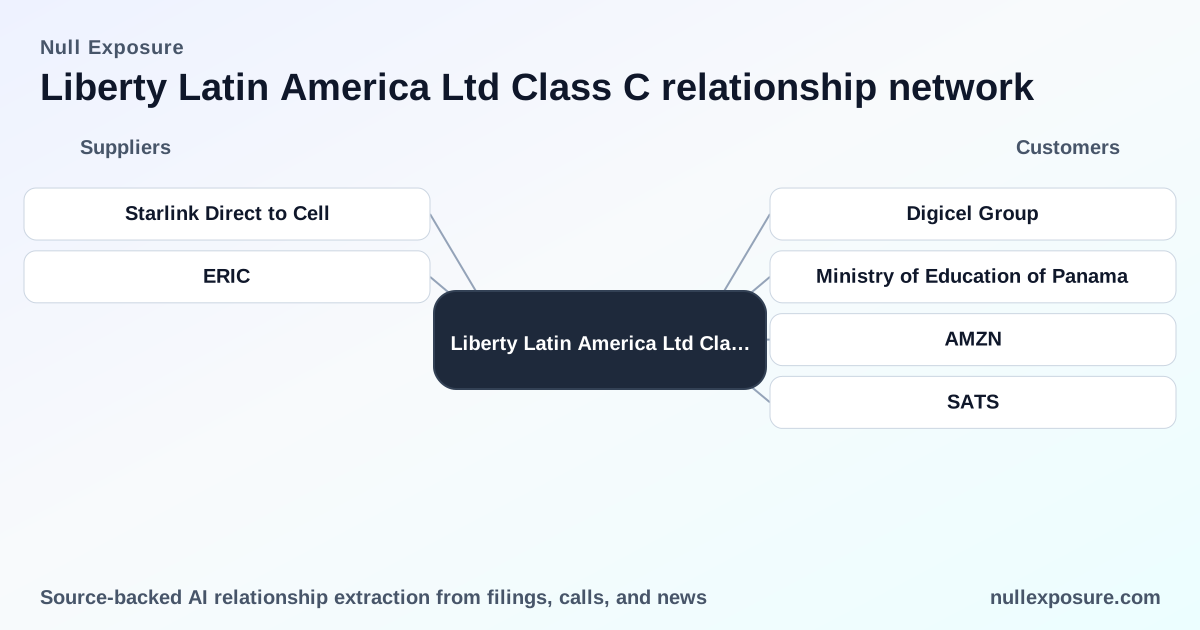
Liberty Latin America (LILAK): Supplier relationships that shape connectivity in the Caribbean and Central America
Liberty Latin America generates revenue by selling fixed, mobile and wholesale telecom services across Latin America and the Caribbean, monetizing through subscription fees, device and service contracts, and long-term programming and infrastructure commitments. As a network operator, LILAK leverages vendor partnerships for spectrum, core network equipment and emergency connectivity, converting capital investments and multi-year supplier agreements into recurring cash flows and service resilience for its markets.
For a quick look at supplier exposure and implications for counterparties and investors, visit the Nillexposure homepage: https://nullexposure.com/
How partnership decisions drive revenue and risk
Liberty Latin America’s supplier relationships reveal a classic telecom operating model: capital-intensive rollout, long-term vendor commitments, and high dependency on third-party equipment and software. The company’s FY2025 and 2025Q4 disclosures and public reports emphasize multi-year programming fees, guaranteed minimum commitments and device supply obligations that support both subscriber growth and margin volatility.
- Long-term contracting posture supports revenue visibility but locks in fixed costs.
- Reliance on third-party manufacturers and network suppliers concentrates operational risk.
- Targeted spectrum and base station investments indicate an offensive strategy to expand 5G coverage and capacity.
For deeper supplier mapping and exposure analysis, see https://nullexposure.com/
Supplier relationships that matter today
Starlink Direct to Cell — emergency and resilience partner (FY2025)
Liberty Latin America executed an operational relationship with Starlink Direct to Cell to deliver emergency connectivity in Jamaica after Hurricane Melissa, showing LILAK’s use of satellite-based services to restore critical communications rapidly. According to a March 2026 press report republished on FinancialContent and an industry write-up on AIJourn, the engagement is positioned as a contingency and emergency-service augmentation rather than a broad commercial substitution for terrestrial networks (news reports, March 2026).
Ericsson — 5G radio and core deployment partner (2025Q4)
Management disclosed on the Q4 2025 earnings call that following its 2025 spectrum acquisition, LILAK will deploy 5G Standalone networks in partnership with Ericsson, signaling vendor selection for radio and core equipment and a multi-year rollout plan to lift mobile service quality and ARPU in targeted markets (Company Q4 2025 earnings call).
What the supplier mix reveals about Liberty Latin America’s operating model
Liberty Latin America structures supplier relationships to support scale and continuity: multi-year supplier contracts, guaranteed minimums, and vendor-supplied customer equipment underpin the business. The company’s public disclosures and the captured constraints show several actionable operating characteristics:
- Contracting posture — long-term commitments. Evidence in financial notes indicates obligations tied to acquisitions and multi-year programming and device contracts, confirming a strategic reliance on long-duration supplier commitments rather than short-term spot purchasing.
- Buyer position in the value chain. Liberty acts as a significant buyer for programming, devices and network buildouts, implying negotiating leverage on price but exposure to fixed minimums that compress margins if subscriber growth underperforms.
- Regulatory and license maturity. Company filings name Liberty Servicios and Columbus Networks as license holders for wireline HFC operations with licenses expiring in 2028, indicating regulated tenure and the need to manage renewal timelines as part of long-term network economics.
- Supplier role diversity. The company both licenses networks and depends on third-party manufacturers for CPE, infrastructure and handsets, creating a hybrid model of in-house operations supported by external hardware and software supply.
- Capital deployment signal. A spend-band classification flags the company in the $1m–$10m purchase band for some commitments, while a textual excerpt cites approximately $16.3 million for specific spectrum rights and a commitment to deploy 1,552 base stations — a company-level signal that LILAK executes mid- to large-size capital deployments to secure coverage and capacity.
These constraints together outline a business that is capital-intensive, contractually committed, and operationally dependent on a small set of network and equipment suppliers.
Risk and concentration considerations for investors and operators
- Counterparty concentration risk: Partnerships with major vendors like Ericsson for 5G and emergent suppliers like Starlink for emergency services create both resiliency and concentration — if a single vendor underperforms, network rollout timing and service SLAs are at risk.
- Cost lock-in risk: Multi-year guaranteed commitments for programming and device supply reduce procurement flexibility and raise downside risk if subscriber growth decelerates.
- Regulatory timing risk: License expirations (e.g., Liberty Servicios and Columbus Networks in 2028) require proactive regulatory engagement; lapses or unfavorable renewals could materially impact service rights in specific countries.
- Operational criticality: Satellite-based emergency services extend resilience but also signal that terrestrial networks require augmentation in disaster scenarios — a structural cost that will be borne via supplier contracts and CAPEX.
Key takeaway: Liberty Latin America’s supplier relationships are integral to both its growth thesis and its operational risk profile — they enable rapid coverage expansion and emergency resilience, but they also lock capital and expose the company to vendor concentration.
Quick, relationship-by-relationship recaps (plain English)
- Starlink Direct to Cell — Liberty Latin America partnered with Starlink Direct to Cell to restore critical connectivity in Jamaica after Hurricane Melissa; this engagement was reported across industry outlets in March 2026 (AIJourn, FinancialContent/BizWire, FY2025 reporting context).
- Ericsson — Management stated on the Q4 2025 earnings call that LILAK will deploy 5G Standalone networks in partnership with Ericsson following spectrum acquisitions in 2025 (LILAK 2025 Q4 earnings call).
Actions for investors and sourcing teams
- Investors should track vendor concentration metrics and monitor vendor-delivery milestones for Ericsson 5G rollouts and Starlink emergency integrations to assess execution risk and capital absorption.
- Procurement and operator teams should negotiate flexibility in minimum commitments and include performance-based milestones for rollout and emergency service activation.
For a comprehensive supplier risk profile and continual monitoring, visit Nillexposure: https://nullexposure.com/
Final assessment and next steps
Liberty Latin America operates as a capex-driven regional operator that converts long-term supplier commitments into service coverage and recurring revenue. The supplier relationships documented — notably with Ericsson on 5G and Starlink for emergency connectivity — are consistent with a strategy to expand modern mobile services while shoring up network resilience. Both investors and counterparty managers should weigh the positive revenue implications of improved coverage against the fixed-cost and vendor-concentration risks embedded in LILAK’s contracts.
Explore a full supplier exposure dashboard and stay updated on counterparty developments at https://nullexposure.com/