Lincoln Educational Services (LINC): supplier relationships and what they mean for investors
Lincoln Educational Services operates career-oriented postsecondary campuses and digital learning programs and monetizes primarily through tuition and fees, supported by a mixed campus/online delivery model and long-term property leases that create a fixed-cost footprint. Revenue of roughly $518 million TTM with an 11.8% operating margin and a valuation reflecting a premium multiple (EV/EBITDA ~28x) frames supplier relationships as operationally critical rather than discretionary. For a concise supplier-risk view and to map counterparty concentration, see NullExposure for deeper supplier intelligence: https://nullexposure.com/.
One-line take: what the record set contains
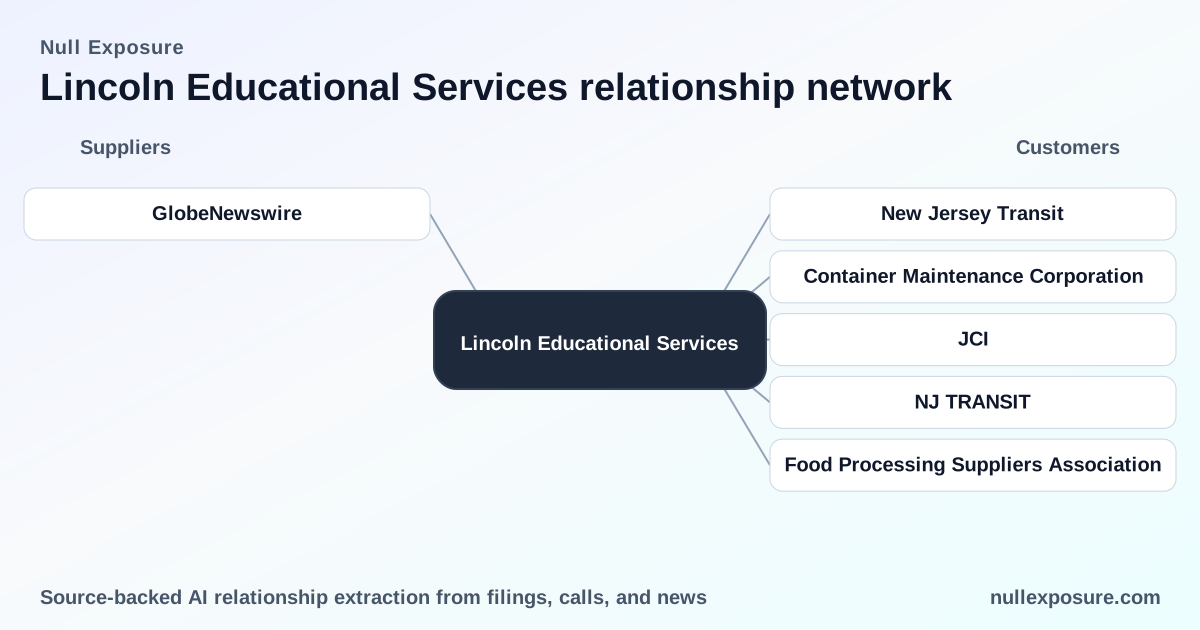
The supplier-scope records for LINC returned a single public relationship entry — a press-release distribution about an earnings call — and a set of company-level constraint signals that reveal material vendor and lease exposures. Below I parse the relationship entry and then translate the constraint signals into operational risk and negotiating posture.
What the relationship entry says (all recorded items)
GlobeNewswire — press release distributed / indexed by QuiverQuant (March 2026). The company announced its fourth-quarter fiscal conference call schedule for Q4 2025 results. The QuiverQuant posting flags the item as an automated summary of a GlobeNewswire release. Source: GlobeNewswire press release as posted via QuiverQuant, first indexed March 10, 2026.
How to read a sparse relationship list
A single public-facing distribution like an earnings-call notice is not a supplier contract record; it is a communications event. The substantive supplier signals come from the constraint excerpts — long-term leases, a short-term facility, and third‑party software licensing — which collectively shape how Lincoln sources core services and capital.
Long-term real estate commitments drive supplier strategy
- The company disclosed multiple long-dated leases with initial terms ranging from approximately 15 to 21.5 years across new campus locations, including large Houston campuses signed in late 2023 and a lease entered in December 2024. These commitments are explicit in the company filings and indicate a strategic preference for long-term, stable campus locations that lock in occupancy costs and create durable landlord relationships.
- Financial implication: long-term leases increase fixed costs and reduce near-term flexibility, but they also establish predictable occupancy expenses that support asset planning and capitalization of campus investments.
Short-term facility and near-term financing cadence
- Separately, Lincoln maintains a 36-month facility maturing February 16, 2027, which is a shorter-tenor debt instrument that requires active liquidity and refinancing management in the near term. This short-term maturity is material for investors watching covenant risk and cash-flow timing.
Third-party software as an operational dependency
- Lincoln licenses software and hosting/maintenance services for its online platform and student information system from external providers, which makes certain software suppliers operationally critical to enrollment, online delivery, and compliance reporting. Vendor continuity and SLA performance therefore matter materially to operations.
(These constraints are drawn from company disclosure excerpts in the record and should be treated as company-level supplier posture signals rather than items tied to a single external entry.)
Why these supplier signals matter to investors and operators
- Contracting posture — long-term and lumpy: Multi-decade leases shift Lincoln’s supplier relationship mix toward long-duration, low-frequency negotiations with landlords. That reduces recurring procurement friction but concentrates counterparty importance in a smaller set of landlords and property managers.
- Concentration and criticality: Software vendors for the online platform and student information system are single points of failure for student enrollment administration and remote delivery; they are operationally critical and create vendor-concentration risk if not diversified or backed by strong SLAs.
- Maturity profile: The coexistence of long-term real estate leases and a short-term facility maturing in 2027 produces a two-speed maturity profile: predictable occupancy costs for the long run versus near-term refinancing and liquidity monitoring for debt.
- Negotiation leverage and flexibility: Long-term leases reduce short-run negotiating leverage but can enable campus-level operational stability; the short-term debt facility increases management’s incentive to maintain lender relationships and preserve covenant headroom.
- Valuation sensitivity: With revenue near $518M and an operating margin above 11%, Lincoln carries fixed-cost leverage that magnifies both upside and downside to enrollment trends; investors should treat supplier disruptions (property or software) as direct drivers of margin volatility. Market multiples (Trailing PE ~59, EV/EBITDA ~28) imply high growth/operational execution expectations, which increases the cost of any supplier failures.
Practical risk checklist for due diligence
- Confirm the identity and geographic concentration of landlord counterparties for the multi-decade leases and review rent escalation, sublease rights, and early termination clauses.
- Validate continuity plans, redundancy, and SLA commitments with the student information system and online learning hosts; these suppliers are critical to revenue continuity.
- Model refinancing scenarios around the Feb 2027 facility maturity and stress-test covenant levers against lower enrollment or delayed cash flows.
- Track capex and occupancy capitalization policy; long-term leases can mask underlying capital intensity that affects free cash flow.
For investor-grade supplier maps and counterparty exposure analytics, visit NullExposure: https://nullexposure.com/.
Final read and next steps
Lincoln’s publicly visible supplier profile combines durable, long-term real estate commitments with operational reliance on third-party software and a near-term financing instrument that requires active treasury management. That combination favors investors comfortable with fixed-cost operating leverage and confident in management’s ability to execute enrollment growth and refinance near-term obligations. For operators, the priority is rigorous vendor management and lease portfolio optimization to preserve margin and flexibility.
If you want a structured supplier risk brief or counterparty concentration report for Lincoln, see NullExposure for tailored intelligence and mapping: https://nullexposure.com/.
Bold takeaway: Lincoln’s supplier posture is strategic and concentrated — long-term leases reduce location risk but amplify landlord and software-supplier importance, while the short-term facility introduces near-term refinancing risk that investors should monitor closely.