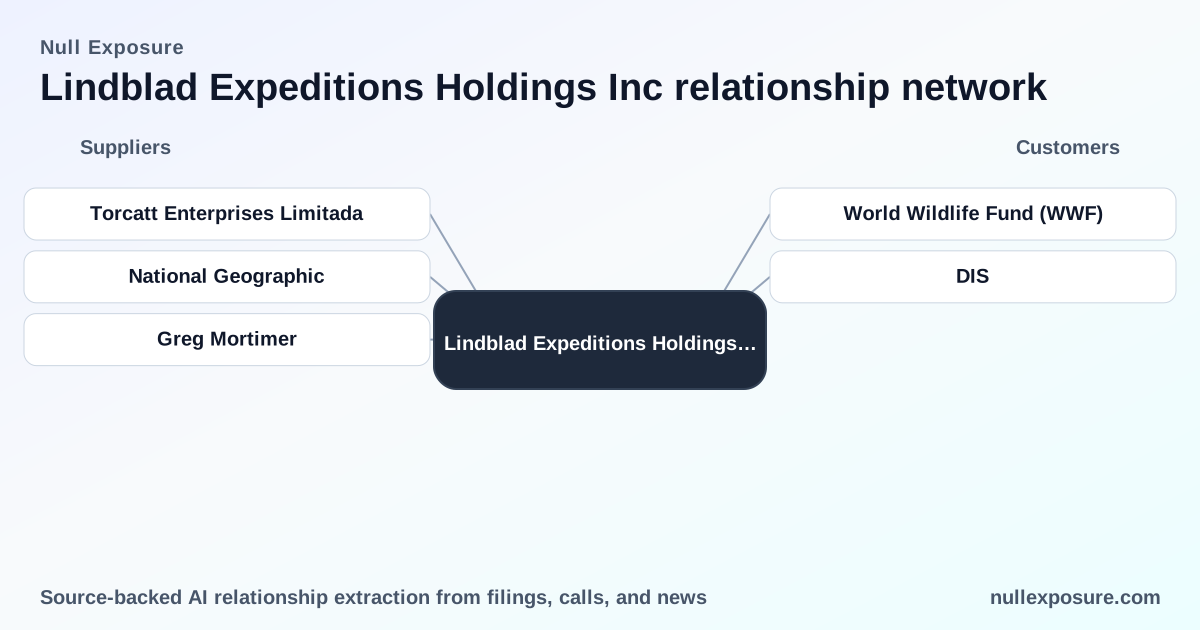
Lindblad Expeditions (LIND): Supplier relationships that shape revenue and risk
Lindblad Expeditions is an operator of adventure travel and expedition cruises that monetizes primarily through voyage ticket sales, branded co-licensing (notably with National Geographic), vessel charters and ancillary in-trip services. The company runs a mixed model of owned and chartered tonnage to scale routes, collects royalties and co-brand fees under long-standing partnerships, and offsets capital intensity via capital-light charter agreements and third‑party service contracts.
For a rapid vendor and partner risk read, see the supplier snapshots below or visit the firm profile on NullExposure: https://nullexposure.com/.
Market context: what investors should know right away
Lindblad is a mid-cap leisure operator with ~$1.1 billion market capitalization and $771 million TTM revenue (latest quarter FY2025). The business delivered positive EBITDA of $115 million, but reported a small negative EPS and thin net margins reflective of a heavy fixed-cost operating base and fleet investments. Valuation multiples show a forward P/E around 19.2 and EV/EBITDA about 18x, underlining that the market prices in growth and brand premium rather than deep current profitability. Institutional ownership is material (about 62%), and insider ownership is significant as well (about 25%), which concentrates governance and alignment.
How Lindblad contracts and runs the product — practical characteristics
- Contracting posture: The company operates a hybrid model—owning ships and also entering charter agreements and service contracts to expand capacity without full capex. That creates flexibility in route deployment and fleet modernization while transferring some operational burden to counterparties.
- Service sourcing and maturity: Public disclosures show Lindblad engages third‑party service providers for both specialized functions (cybersecurity assessors, managed detection) and core operating activities (chartered vessels, chartered air), indicating a mature supplier governance framework and reliance on external expertise.
- Concentration and criticality: The co‑branding and royalty relationship with National Geographic is commercially critical for customer acquisition and pricing power on premium itineraries; that relationship drives brand differentiation and pricing leverage.
- Risk posture: Subscription contracts for managed security and an emphasis on third‑party assessments indicate operational outsourcing for non-core functions and an active approach to third‑party risk management, but also introduce vendor concentration and counterparty service risk.
For deeper supplier risk signals and monitoring, visit the vendor intelligence hub: https://nullexposure.com/.
Relationship inventory: the supplier and partner list you must consider
Below are the relationships identified in public disclosures and earnings commentary. Each is described in plain English with source context.
Torcatt Enterprises Limitada — Galápagos vessel operator / holding company
Lindblad disclosed an agreement to acquire Torcatt Enterprises Limitada, a holding company that operates two vessels in the Galápagos Islands, showing strategic fleet and destination expansion into high-margin expedition markets. This comes from the company’s FY2024 10‑K filing. (Source: FY2024 10‑K, Lindblad Expeditions)
National Geographic — co‑branding, licensing and royalty partner
Lindblad runs co‑branded National Geographic-Lindblad voyages, collecting royalties and benefiting from the partner’s marketing and editorial cachet; the company reported that it reached a final step-up to the run‑rate royalty under the National Geographic agreement effective January 1st, reinforcing near-term revenue upside tied to the contract mechanics. The partnership is referenced across recent FY2026 earnings commentary and market coverage. (Sources: FY2026 earnings call transcript coverage, InsiderMonkey; Q4/CY2025 coverage, Finviz; reporting on corporate actions and branding, Intellectia)
Greg Mortimer — charter partner for capacity expansion
Lindblad expanded its charter portfolio with a new three‑year agreement for the vessel Greg Mortimer to increase and modernize Alaska capacity under a capital‑light charter, illustrating the company’s approach to scaling routes without immediate fleet capex. The disclosure was made during FY2026 earnings commentary. (Source: FY2026 earnings call transcript coverage, InsiderMonkey)
What these relationships mean for revenue durability and operational risk
- Brand dependence is real and material. The National Geographic co‑brand provides customer acquisition and premium pricing power; the recent royalty step‑up increases revenue sensitivity to the partnership economics and highlights the commercial importance of that contract.
- Capital intensity is managed through charters. Charter agreements such as the Greg Mortimer deal demonstrate a deliberate capital‑light growth lever, which improves fleet flexibility and shortens payback cycles, but transfers counterparty and operational performance risk to less vertically integrated arrangements.
- M&A and vessel acquisitions expand footprint but concentrate destination risk. The Torcatt acquisition increases exposure to the Galápagos — a high‑value but environmentally and regulatory‑sensitive geography — which raises operational and reputational stakes tied to local compliance and seasonal demand.
- Operational resilience is outsourced for specialist services. Company disclosures about subscriptions to managed security services and the use of third‑party assessors show a structured approach to non‑core, high‑skill functions, enhancing security posture while introducing vendor performance and continuity risk.
Recommended investor actions
- Prioritize diligence on the National Geographic contractual terms (royalty step‑ups, renewal windows, exclusivity and termination rights) because those terms directly affect pricing power and demand elasticity.
- Review charter counterparty credit and operational records for vessels like the Greg Mortimer to assess service continuity and performance risk under the capital‑light strategy.
- Evaluate destination concentration risks introduced by the Torcatt transaction and the company’s regulatory mitigation measures for Galápagos operations.
For real‑time supplier alerts and deeper contractual signals, check the Lindblad supplier dossier at NullExposure: https://nullexposure.com/.
Bottom line
Lindblad’s commercial value rests on a distinctive brand partnership, flexible fleet economics via charters, and targeted destination expansion. Those levers support revenue growth and justify a premium multiple, but they come with concentration and counterparty risks that require focused due diligence on contract terms and vendor performance. For investors and operators analyzing supplier dependence and contract risk, Lindblad is a case study in balancing brand-driven pricing power against the operational complexity of a mixed ownership‑and‑charter model.
Continue your supplier risk review and scenario modeling at NullExposure: https://nullexposure.com/.