Lineage, Inc. — Supplier Relationships, Capital Markets Activity, and Operational Constraints
Lineage (NASDAQ: LINE) operates as a biotechnology company focused on regenerative medicine and advanced cell therapies, monetizing primarily through clinical-stage product development, licensing, collaboration agreements, and capital markets activity to fund development and commercialization. Revenue growth is driven by advancing assets through clinical stages and strategic partnerships, while financing through debt and equity remains an active lever for scaling operations. For an investor evaluating supplier and service-provider relationships, the combination of active capital markets transactions and a reliance on third‑party logistics and short‑term commodity contracts creates a distinct operational profile you must price into valuation and risk assessments.
Explore deeper supplier intelligence at https://nullexposure.com/.
Why a legal adviser listing matters more than it looks like
A law firm disclosure is a signal about financing strategy and balance-sheet choices. Lineage’s engagement of a global capital markets firm to represent it in a senior‑notes offering indicates active use of debt markets to fund operations or refinance maturities, which changes free‑cash‑flow dynamics and elevates the importance of interest coverage and liquidity metrics for investors.
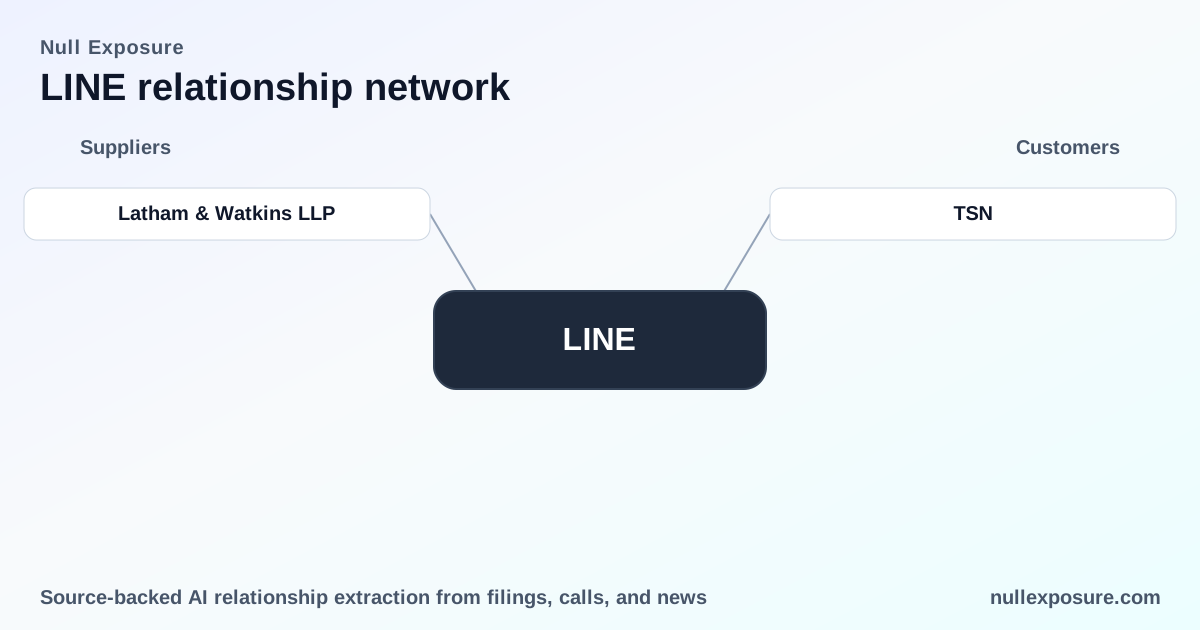
Latham & Watkins LLP — capital markets counsel (November 2025)
Latham & Watkins announced that its Capital Markets team represented Lineage in a senior‑notes offering; the firm named partners and counsel leading the engagement and framed the matter as part of Lineage’s FY2025 capital markets activity. According to Latham & Watkins’ November 2025 announcement on lw.com, the firm served as Lineage’s counsel for the transaction. (Source: Latham & Watkins news release, Nov 2025.)
Latham & Watkins LLP — media coverage of the same transaction (March 2026)
Industry press also covered the representation: LegalDesire reported on March 10, 2026, that Latham & Watkins represented Lineage in a senior‑notes offering, reiterating the capital markets team involvement and public counsel names. This second mention reinforces that the debt issuance was a visible, market‑facing event for Lineage in FY2025. (Source: LegalDesire, March 10, 2026.)
What the supplier and contractual constraints reveal about Lineage’s operating model
The company disclosures and constraint excerpts point to clear operating tendencies that affect supply‑chain exposure, working capital, and execution risk:
-
Short‑term contracting posture for commodities and services. Lineage uses forward contracts to fix power costs for discrete periods, with durations “generally one to three years.” This is an explicit policy to manage exposure to volatile electricity prices while retaining flexibility. The short duration limits long‑dated price protection and requires active risk management around renewals and market cycles.
-
Operational reliance on third‑party logistics and service providers. The company disclosed that it does not maintain exclusive or long‑term contracts with trucking or rail providers and that it relies on third‑party truckload carriers and rail services to move inventory. This creates operational criticality around transportation capacity and carrier availability, a common pinch point for biologics manufacturers with cold‑chain and specialized handling needs.
-
Partial vertical exposure through minority supplier investments. Lineage reports owning investment stakes in suppliers accounted for under the equity method and incurred costs of approximately $9 million in 2024 and 2023 (and $5 million in 2022) with those related parties. That pattern signals selective strategic investments into the supply base that align incentives but also create related‑party cost exposure that investors should monitor for concentration or governance implications.
-
Control and maturity signals: use of external specialists and audit findings. The company has engaged third‑party specialists to supplement internal capabilities and disclosed that its independent auditor identified a material weakness in internal control for the year ended December 31, 2023. These items reflect a company in growth or transition, operationally maturing with explicit dependence on external expertise and ongoing remediation of control gaps.
Collectively, these constraints describe a firm that balances flexibility and risk: short‑term contracts preserve agility but increase market exposure; third‑party logistics deliver scale but elevate execution risk; minority supplier investments align supply incentives but create related‑party considerations.
Investor implications — what to watch and how to act
For investors and operators evaluating Lineage supplier relationships and strategic posture, prioritize the following:
-
Monitor debt issuance and covenant language. The retention of Latham & Watkins as capital markets counsel for a senior‑notes offering is a direct indicator that debt financing is material to Lineage’s capital structure; track subsequent filings for covenant packages and use of proceeds. (Source: Latham & Watkins news release, Nov 2025; LegalDesire coverage, Mar 2026.)
-
Quantify commodity and logistics exposure. Because power contracts run one to three years and transportation agreements are non‑exclusive, model electricity cost volatility and logistics disruptions into near‑term margins and working capital stress tests (based on company disclosures regarding forward power arrangements and third‑party carrier reliance).
-
Review related‑party supplier economics and governance. The company’s equity stakes in suppliers and the $9 million annual procurement with those entities are material to supplier governance and fairness assessments; investors should request disclosure on contract terms, pricing mechanics, and board oversight where available.
-
Track remediation of control weaknesses. The identified material weakness in the audit underscores the need to confirm the company’s remediation plan and timeline, since controls affect financial reporting integrity and the reliability of supplier‑cost disclosures.
If you want a structured supply‑risk briefing that ties these signals to balance‑sheet scenarios, see our research hub at https://nullexposure.com/.
Tactical next steps for portfolio managers
- Demand updated covenant and offering materials following any public debt issuance to determine interest coverage and downgrade thresholds.
- Stress‑test margins under a scenario of prolonged power price increases and a constrained trucking market.
- Seek granular disclosure on related‑party supplier agreements and the economics of those equity investments.
- Validate the status of the audit remediation plan and confirm whether external specialists remain in place for core operations.
For a one‑page risk memo you can use internally, visit https://nullexposure.com/ to request tailored analysis.
Conclusion — balancing financing and operational execution
Lineage is at a crossroads where capital markets activity and operational dependencies intersect. The firm’s use of senior notes, documented through Latham & Watkins’ engagement, signals a funding strategy that changes leverage and investor return dynamics. At the same time, short‑term commodity hedges, non‑exclusive logistics contracts, and selective supplier investments create a mixed profile: agile but exposed. Active monitoring of financing terms, supplier economics, and control remediation will be decisive for investment outcomes over the next 12–24 months.
For detailed supplier mapping and scenario modeling tied to Lineage’s filings and market signals, go to https://nullexposure.com/.