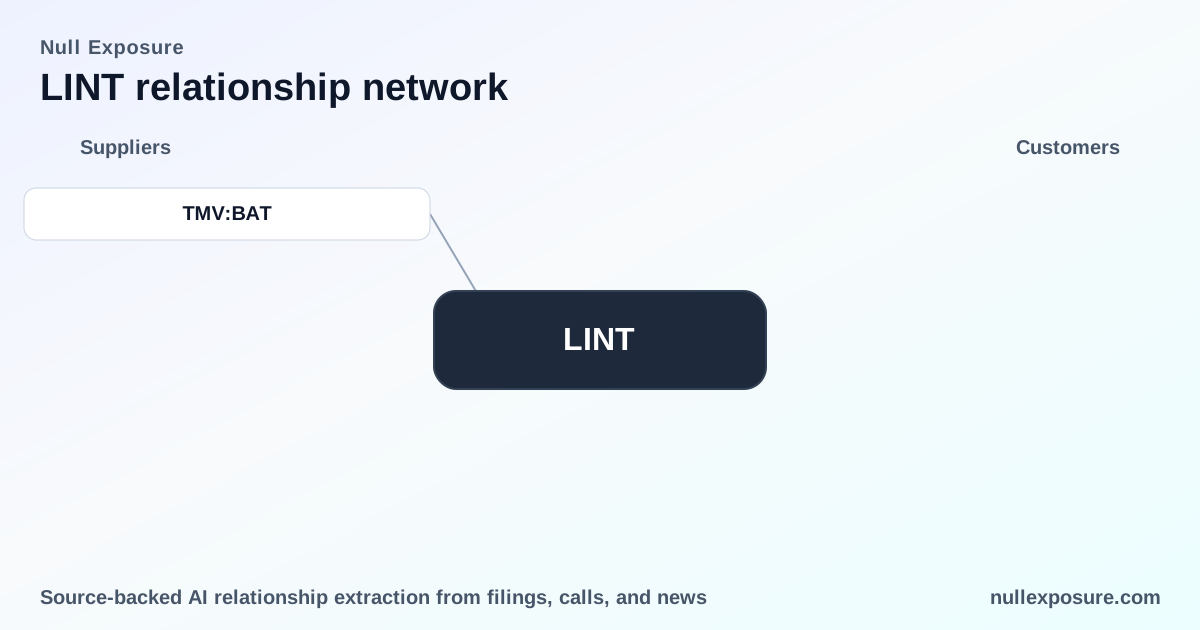
LINT supplier brief: where the market signal lands and what investors should know
Thesis: LINT operates in the capital-markets supplier layer that surfaces through exchange-traded product activity; its economic model is driven by product issuance and trading flows, generating recurring management and trading-fee revenue tied to assets under management and secondary-market liquidity. For investors and operators evaluating supplier relationships, LINT’s public footprint is concentrated in ETF-related market signals, which translate into fee-for-service economics, sensitivity to trading volume, and direct exposure to short-term market volatility. For deeper supplier intelligence, see https://nullexposure.com/.
What the headline signal tells you about LINT
The single clear public signal tied to LINT in our pull is a high-frequency market news item about a leveraged ETF that used the LINT identifier in market copy. That trade-level reporting is exactly the kind of upstream indicator investors watch to infer liquidity-driven revenue swings and short-term product performance impact. News-driven spikes in volume correlate with fee capture and distribution opportunity for issuers and their supplier network — custody, market-making, and distribution partners all benefit from—and are tested by—these episodes. For a deeper supplier map and ongoing monitoring, visit https://nullexposure.com/.
The relationship set: what public records show (every relationship covered)
Direxion — A Futunn item reported a 21.50% move and $3.362 million trading volume in a leveraged Intel ETF quoted with the LINT.US identifier, situating LINT in the context of ETF product flow and short-duration price moves. According to a Futunn news post on March 10, 2026, the headline noted: “$2x Leveraged INTC ETF - Direxion (LINT.US) Increased by 21.50%, with a trading volume of $3.362 million.” https://news.futunn.com/en/post/67199850/us-stock-etf-tracker-intel-leads-the-tech-sector-rally
- This is the only explicit relationship surfaced in the public results set; it ties LINT to an ETF product event handled by Direxion as the issuer and market participant referenced in the report.
How to read that relationship as an investor or operator
The Direxion-linked broadcast is not a balance-sheet filing, but it is a high-value signal for commercial counterparties. Short-term volume spikes are a direct leading indicator of fee capture and operational stress points: custody reconciliation, settlement capacity, authorized participant (AP) bandwidth, and market-maker inventory funding. When a product tagged with LINT registers a 20%+ intraday move and multi-million-dollar turnover, the supplier-side economics shift—trade execution and bid/offer spreads widen, and ancillary services (prime brokerage, margin financing, clearing) accelerate revenue recognition for providers integrated into the ETF’s lifecycle. The Futunn report dated March 10, 2026 provides the concrete event that justifies this inference: https://news.futunn.com/en/post/67199850/us-stock-etf-tracker-intel-leads-the-tech-sector-rally
Company-level operating signals and constraints
Absent explicit constraint excerpts, present company-level signals are the most reliable way to interpret LINT’s operating posture:
- Contracting posture: LINT’s public presence through ETF product activity implies transactional, market-driven contracting with distribution and execution partners rather than long-term captive agreements. The supplier role is oriented around scalable, usage-based pricing tied to trading volumes and custody assets.
- Concentration risk: The visible set of public relationships is narrow. That concentration implies that a small number of product episodes or a single high-visibility issuer event can materially move near-term revenue and operational load.
- Criticality to counterparties: For APs, brokers, and market-makers, LINT-associated products can be critically important during volatility windows, forcing rapid capital and infrastructure deployment; for passive service vendors (custody, back-office SaaS), these episodes are operational rather than existential.
- Maturity and disclosure: Public market news coverage indicates a functioning commercial product and established market paths, but the absence of broader filings or additional relationships in the public pull points to limited public disclosure around vendor contracts and long-term revenue composition.
These company-level signals inform how counterparties should price risk, allocate capital, and structure contractual protections.
Risk profile and what it means for supplier negotiations
- Revenue volatility: Trading-volume-driven revenue is inherently cyclic. Counterparties should expect revenue spikes during high-volatility events and troughs in calmer markets. Contract terms and fee schedules should reflect this seasonality.
- Operational concentration: With limited public relationships on record, a single stressed product can create outsized operational demands. Negotiate SLAs, capacity commitments, and surge pricing provisions to protect margins when volume spikes.
- Counterparty selection: The Direxion signal shows that institutional-grade issuers use the channel; prioritize counterparties with proven clearing, settlement, and prime financing capabilities. Operational resilience is as valuable as headline fees.
Investment implications and portfolio actions
For investors evaluating LINT as a supplier exposure, the practical consequences are clear: value derives from transaction volume and product stickiness, while downside is driven by rapid liquidity evaporation and concentration. Structurally, that argues for active monitoring of product-level flows, counterparty capital adequacy, and settlement metrics rather than relying solely on periodic filings.
Mid-report action: if you need continuous tracking of such supplier signals, register for the Nullexposure platform to map relationships and automate alerts: https://nullexposure.com/.
Tactical next steps for operators and sourcing teams
- Revisit contract language to add explicit surge-capacity pricing and priority execution windows tied to market-event definitions.
- Validate counterparties’ clearing and settlement throughput under simulated stress tests aligned to a 20%+ intraday move scenario like the Direxion event reported March 10, 2026.
- Require real-time reporting hooks during product launches and volatility episodes to measure spread capture and margin leakage.
Closing takeaway and call to action
The single public relationship tying LINT to a Direxion-referenced leveraged ETF trade is a concentrated but highly informative signal: this supplier’s commercial value is realized in the heat of market activity, and governance must be structured around episodic surges and settlement-critical performance. For infrastructure buyers and investors who want continuous, enterprise-grade visibility into supplier relations and event-driven exposures, explore the full platform at https://nullexposure.com/.