LightInTheBox (LITB): supplier relationships and the operational implications for investors
LightInTheBox is a Shanghai-headquartered cross-border e-commerce retailer that buys direct from manufacturers and ships internationally, monetizing through product margins and scale in order fulfillment. The company’s economics are driven by low gross margins on high-volume international shipments and a reliance on third‑party logistics to deliver to end customers; shipping and logistics arrangements are therefore material to revenue recognition and unit economics. For a quick view of our platform and monitoring capabilities, visit https://nullexposure.com/.
Where LightInTheBox stands financially and operationally
LightInTheBox trades on the NYSE under ticker LITB with modest market capitalization and thin institutional ownership. Key public metrics indicate Revenue TTM of $219.1M, Gross Profit TTM $140.4M, and a reported Profit Margin of ~2.5%, with a trailing P/E around 10.4. Shares outstanding and insider ownership figures imply concentrated control: insiders reportedly hold 54.5% of the equity while institutions own roughly 5.8%. These figures frame the supplier discussion: a company with constrained public ownership, modest scale, and high sensitivity to logistics cost and revenue recognition.
Supplier relationship inventory: the records we hold
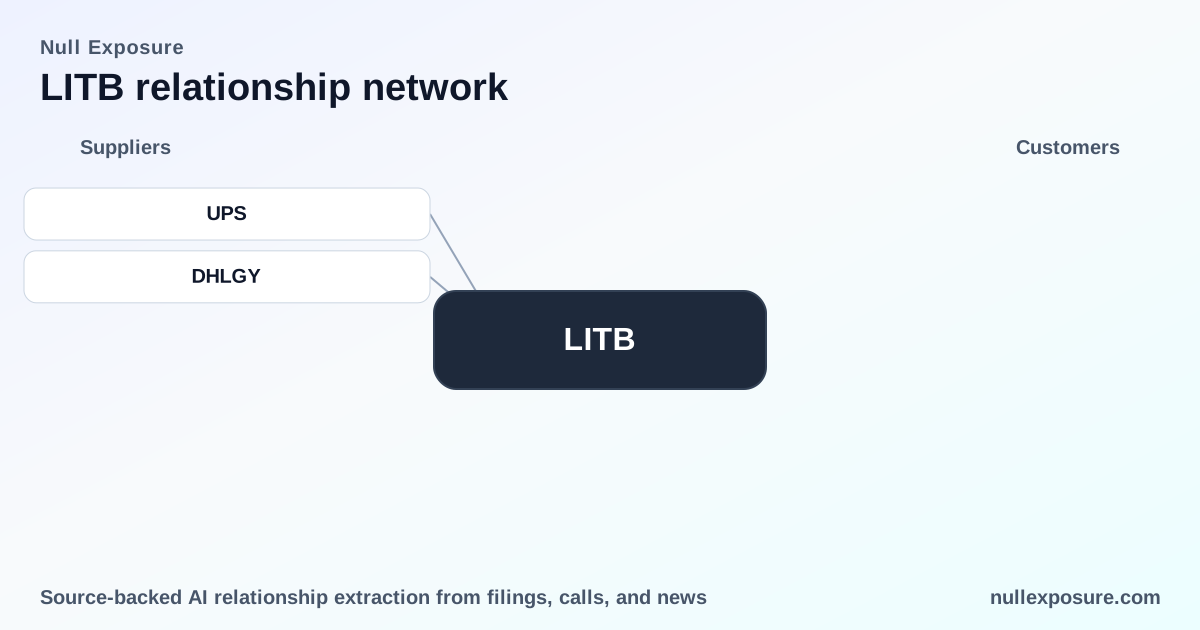
Below are the supplier/partner relationships that our records surfaced for LITB. Each item is summarized in plain English with a direct source cited.
UPS
A 2013 TechnologyNode report alleged that LightInTheBox had lent its UPS logistics accounts to third-party logistics firms, and that inflated shipping fees booked through those accounts were recognized as LITB revenue. The article frames these arrangements as an avenue through which shipping charges were routed into the company’s top line. Source: TechnologyNode, June 2013 — https://technode.com/2013/06/06/lightinthebox-sets-ipo-price-at-9-5/.
DHL
The same 2013 TechnologyNode article also named DHL in identical allegations: LITB allegedly allowed third parties to use its DHL accounts, and the related shipping fees were accounted for as company revenue, contributing to purportedly inflated sales figures. Source: TechnologyNode, June 2013 — https://technode.com/2013/06/06/lightinthebox-sets-ipo-price-at-9-5/.
Why these supplier notes matter to investors
Logistics partners are not incidental for LightInTheBox; they are core to how the company transacts and reports revenue. The 2013 allegations around UPS and DHL are directly relevant to revenue recognition and channel control. Whether or not those specific practices persisted, the allegation highlights two persistent investor concerns:
- Revenue provenance: If shipping accounts are used as conduits for third-party volume, reported sales and gross profit can overstate organic demand.
- Counterparty control and auditing: Lending of carrier accounts implies operational arrangements that are complex to audit and that increase counterparty and compliance risk.
- Reputational and regulatory exposure: Historical allegations linked to well-known carriers create a legacy risk profile that will influence investor due diligence and future audit scrutiny.
For a deeper operational risk scan, follow our coverage at https://nullexposure.com/.
Constraints and company-level operational signals
Our supplier-relationship constraints feed into four practical signals about how LightInTheBox operates. There are no explicit supplier constraints recorded in the data we reviewed; that absence is itself informative at the company level.
- Contracting posture: Centralized logistics control is implied by historical behavior—if LITB operated carrier accounts for multiple flows, contracting likely ran through corporate accounts rather than decentralized merchant accounts.
- Concentration: Public data shows high insider ownership and small institutional floats, which correlates with concentrated decision-making and potential for non‑standard contracting arrangements that are not market-tested.
- Criticality: Logistics are critical to the business model—delivery costs and routing directly affect margins and customer experience. Any disruption or change in carrier agreements would have a meaningful operating impact.
- Maturity and documentation: The lack of recorded constraints suggests either limited public disclosure of supplier restrictions or insufficiently standardized supplier governance in historical filings; both increase the need for targeted vendor due diligence.
These are company-level signals—no specific constraint excerpt named UPS or DHL in our constraints feed.
Practical diligence steps for investors and operators
Given the role logistics play for LITB, institutional buyers and analysts should:
- Request detailed carrier agreements and billing histories to confirm how shipping revenue is recorded and whether carrier accounts are used by unaffiliated third parties.
- Validate internal controls around revenue recognition for shipping and drop-shipped orders, including reconciliation between carrier invoices and recorded revenue.
- Assess counterparty concentration (how much volume runs through any single carrier account) and any indemnities or contingent liabilities tied to carrier use.
If you want a systematic supplier and exposure overview for your investment memo, see our services at https://nullexposure.com/.
Final assessment and investor takeaway
LightInTheBox’s platform model makes logistics a central economic lever; historical reporting concerns linked to UPS and DHL demonstrate the kinds of operational arrangements that can distort top-line metrics if not tightly governed. Public financials show a company operating at modest scale with concentrated insider control—conditions under which non-standard contracting or account-sharing are especially material. Investors must prioritize verification of shipping revenue practices and carrier agreements in any diligence.
For institutional-grade supplier analysis and ongoing monitoring of LITB and similar e-commerce operators, begin with a vendor exposure review at https://nullexposure.com/.
Bold takeaway: logistics governance is a core financial control for LightInTheBox — verify carrier account use and revenue treatment before relying on headline revenue trends.