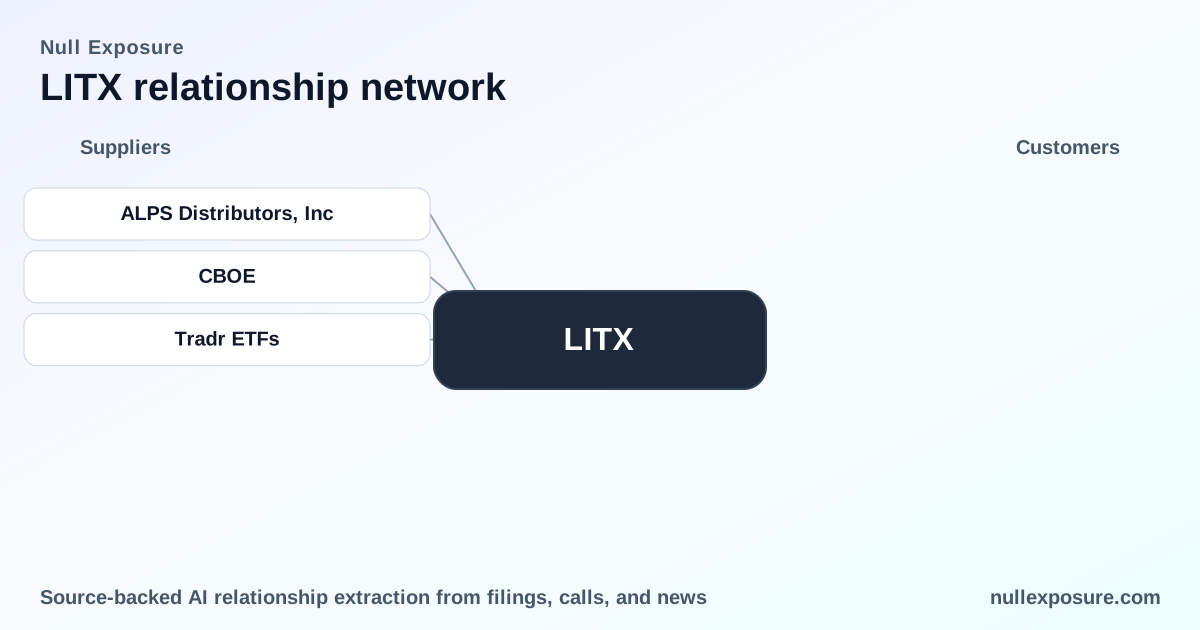
LITX supplier footprint: distribution, listing and issuer relationships that matter to investors
Thesis: LITX is an exchange-listed leveraged ETF product whose economics are derived from assets under management, trading liquidity and distributor/market access arrangements. The issuer captures management and operational economics through fund creation/redemption and AUM-linked flows, while counterparties — distributors and exchanges — create the distribution and liquidity channels that convert product design into investible flows.
If you track supplier risk for traded products, focus on the three commercial relationships that establish market access and distribution — the issuer (product sponsor), the exchange (listing venue) and the distributor — because these three parties determine go-to-market, listing continuity and end-investor access. For an integrated view of exposures and counterparties, visit https://nullexposure.com/ to see how these link into larger supplier maps.
How LITX operates and where the economics come from
LITX is a branded leveraged ETF (the Tradr 2X Long LITE Daily ETF) that monetizes through the typical ETF economics: management/operational fees, bid-ask spreads on secondary market trading and scale-dependent creation/redemption activity. The product requires a licensed issuer to file and manage the fund, an exchange to list and provide continuous market access, and a distributor to reach advisory platforms and retail channels. Those three functions are the core supplier ecosystem that turns fund strategy into AUM and trading revenue.
The publicly reported early traction for the product is material to assessing commercial viability: initial AUM accumulation and listing choice are primary drivers of early fee revenue and liquidity formation. For more on mapping these supplier relationships and how they affect revenue capture, see https://nullexposure.com/.
What the public records show — the three named relationships
Below I cover every relationship found in the reviewed filings and news for FY2026. Each entry is a plain-English summary with the cited source.
Tradr ETFs (product sponsor)
Tradr ETFs is the issuer of the Tradr 2X Long LITE Daily ETF (Cboe: LITX) and is the entity responsible for product design, filings and fund management; the fund collected roughly $200 million in AUM within its first month, indicating strong early investor demand and rapid fee-generation potential. Source: Stocktwits news article reporting FY2026 flows (reported March 10, 2026).
Cboe (listing exchange)
The fund is listed on Cboe, which provides the primary trading venue and public market liquidity for LITX; the choice of Cboe signals a standard exchange listing strategy that supports continuous secondary-market execution and price discovery for the product. Source: PR Newswire release announcing the launches (March 10, 2026).
ALPS Distributors, Inc. (distributor)
ALPS Distributors, Inc. is named as the product distributor for the Tradr ETFs offering, handling fund distribution and placement in intermediary channels; ALPS’ role affects channel access to broker-dealers and platform integrations. Source: Both PR Newswire (March 10, 2026) and a Stocktwits news article referencing the same distribution disclosure.
What the relationships imply for operating posture and supplier risk
The public records show a standard three-party market structure: sponsor, exchange and distributor. From a commercial and operational perspective, that implies:
- Contracting posture: The relationships follow conventional industry roles — the sponsor contracts listing and distribution services to convert prospectus-level product into tradable and sellable inventory. This suggests a modular contracting posture (separate sponsor, exchange and distributor agreements) rather than a vertically integrated model.
- Concentration: With a single listed venue and a named distributor, concentration risk is non-trivial at product inception: any disruption with the distributor or de-listing at the exchange could materially affect liquidity and flows for a nascent fund.
- Criticality: Each counterparty is operationally critical: listing continuity (exchange), placement channels (distributor) and fund governance/management (issuer) are all necessary to maintain NAV integrity and investor access.
- Maturity: The product is early-stage in AUM and market history (first‑month accumulation reported), which implies limited historical resilience to shocks and higher sensitivity to distribution channel performance and secondary-market liquidity.
Note: the public constraint reporting available for FY2026 did not include supplier-level constraints; the absence of such disclosures is a company-level signal indicating limited public constraint detail, not an omission tied to a particular counterparty.
For investors and operators who want to convert these qualitative signals into monitoring triggers — such as exchange delisting metrics, distributor termination clauses and monthly net flows — our platform builds that linkage into supplier risk dashboards. Learn more at https://nullexposure.com/.
Investment implications and an operational checklist
The combination of early AUM growth and a standard three-party supply structure creates a practical framework for monitoring LITX:
- Monitor monthly AUM and creation/redemption volumes to gauge whether fee economics scale beyond marketing-driven initial accumulation.
- Track secondary-market liquidity metrics on Cboe (spreads, quoted size, intraday volatility) because they dictate retail execution quality and the attractiveness of the fund on platforms.
- Verify distribution agreements and platform placements with ALPS to understand which advisory and retail channels are supporting flows; distribution concentration is an elevated risk when product history is short.
Bold investment takeaways: early AUM growth is encouraging for fee capture, but distribution and listing concentration create outsized operational risk for a nascent leveraged ETF.
Final read and recommended actions
LITX has executed a conventional go-to-market structure — Tradr ETFs as sponsor, Cboe as listing venue, and ALPS Distributors as the distribution partner — and early flows indicate rapid initial uptake. That combination generates a clear revenue path for the issuer while concentrating execution risk in the named counterparties.
If you evaluate supplier relationships for traded products, prioritize: (1) flow and liquidity durability, (2) contractual levers that protect listing continuity, and (3) distribution breadth. For a deeper mapping of commercial counterparties and to integrate these supplier signals into investment workflows, go to https://nullexposure.com/.
Actionable next step: subscribe to ongoing supplier monitoring and receive alerts tied to exchange listings, distributor notices and issuer filings at https://nullexposure.com/.