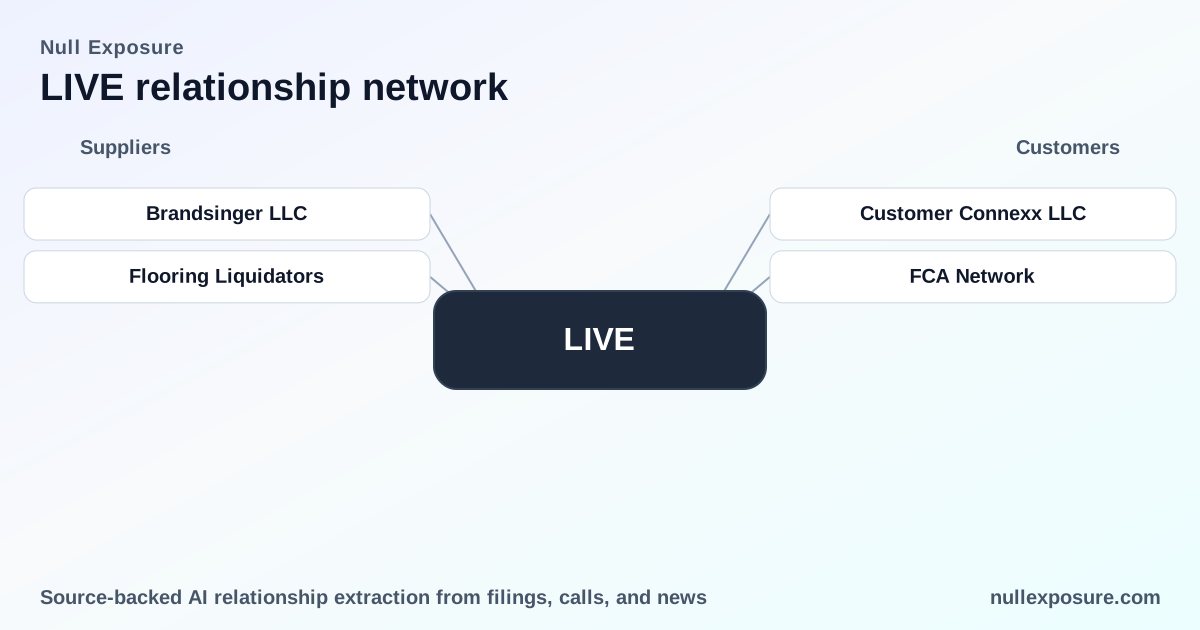
Live Ventures (LIVE) — Supplier relationships and what they tell investors
Live Ventures operates as an acquirer and operator of niche industrial and consumer businesses, monetizing through operational turnarounds, seller-financed purchase structures, and the cash-flow generation of acquired subsidiaries. The company generates value by selectively buying companies with seller financing, restructuring obligations, and extracting operating leverage across small business platforms, while its supplier and financing relationships reveal both fixed commitments and material counterparty exposures. For a fast read on supplier concentration and contractual posture, visit https://nullexposure.com/.
Quick take: why supplier relationships matter for LIVE
Live’s supplier and counterparty footprint is not a conventional vendor list; it contains seller-financed notes, long-term leases, and professional services retainers that directly affect free cash flow and balance-sheet flexibility. These relationships function as both liabilities and strategic levers: negotiating sellers’ notes can create one-time gains, while long-term lease commitments lock in fixed costs that influence margin resiliency. Investors should weight these relationships as operational exposures that are integral to Live’s value-creation model, not peripheral procurement items.
Relationship-by-relationship: the two items in scope
Brandsinger LLC — strategic communications partner
Live Ventures retained Brandsinger LLC, a New York City–based branding and communications consultancy, as a strategic partner to support a new communications campaign. According to a company press release on GlobeNewswire (Sept 3, 2025), Brandsinger is being used to facilitate Live’s corporate messaging and outreach for that program. This is a professional services engagement aimed at investor and market communications rather than a material operating supplier relationship.
Flooring Liquidators — counterparty to seller-financed obligations
Live disclosed a negotiation that reduced Flooring Liquidators seller notes by $19 million, and when combined with cancellation of accrued interest and related items produced a reported $22.8 million gain for Live Ventures in the quarter. An earnings-call transcript summarized this as a realized financial benefit from restructuring seller-financed debt (InsiderMonkey, Q2 2025 earnings call transcript). Flooring Liquidators represents a material financing counterparty where note adjustments directly impacted reported earnings.
What the company-level constraints reveal about operating posture
The available constraint signals provide consistent, company-level indications about Live’s contracting and spend profile:
- Long-term lease commitments: The company reports building leases that run 20 years with two five-year renewal options. This indicates a highly committed, long-term fixed-cost posture that increases leverage to occupancy economics and reduces short-term flexibility on property costs.
- Multi-band spend and financing exposure: Evidence shows obligations across a spectrum: amounts reported at sub-$100k, ~$0.8–1.0M, multiple loans in the $1M–$10M range, and two separate notes in the $10M–$100M band (e.g., outstanding balances of $11.6M and seller note carrying values near $15.0M). These figures are reported in the company notes to FY2025 financials. This pattern signals diverse financing relationships—from small residual seller loans to material multi-million dollar notes—implying both concentration risk and potential for episodic earnings volatility when notes are restructured.
- Maturity and restructuring activity: The presence of seller-financed loans across multiple vintage acquisition transactions (e.g., Precision Marshall, Central Steel, Kinetic) and the reported principal reductions and cancellations indicate an active approach to negotiating legacy seller obligations, which is a core part of the company’s cash-flow engineering.
- Spend concentration is uneven: The combination of several mid-sized loans and at least one larger seller note in the two-digit million range suggests financial exposure concentrated in a handful of counterparty notes, increasing the materiality of any single renegotiation or default.
These constraint signals are company-level and describe Live’s operating model: it relies on long-duration commitments and layered seller-financing. That structure creates both optionality via negotiated gains and vulnerability via locked-in fixed costs and concentrated note exposure.
Visit https://nullexposure.com/ for a deeper index of supplier and counterparty signals if you are benchmarking Live against peers.
Investment implications — risks and levers
- Earnings volatility tied to note renegotiation: Live’s reported gain from the Flooring Liquidators note reduction demonstrates how adjustments to seller-financed liabilities can produce material one-time earnings items. For investors, these are real profit drivers but not recurring core cash flows.
- Fixed-cost risk from long leases: Twenty-year building leases with renewal options embed fixed occupancy costs that reduce flexibility during industry downcycles and increase the importance of operational execution at acquired businesses.
- Concentration of finance exposures: The existence of multi-million-dollar seller notes means counterparty actions (restructuring, default, or litigation) can materially affect book value and free cash flow. Monitor the schedule and counterparties of those notes each quarter.
- Active management as a competitive advantage: The firm’s willingness to renegotiate and cancel accrued interest shows management capability to extract value from purchase structures—a positive if management continues to execute without disrupting operating cash flows.
How to use this supplier intelligence in diligence
- Prioritize due diligence on the size, maturity, and covenant terms of seller-financed notes and long-term leases; these determine balance-sheet flexibility.
- Watch quarterly disclosures for note reductions, interest cancellations, or legal disputes tied to sellers—these are often the largest drivers of reported non-operating gains.
- Model scenarios where one or two large seller notes are restructured unfavorably; test impacts on covenant compliance and liquidity.
Closing view and next steps
Live Ventures’ supplier footprint is dominated by financing-counterparty relationships and a small number of strategic service retainers, rather than by broad transactional vendor networks. That structure creates a distinctive risk-return profile: high optionality via negotiated adjustments coupled with concentrated counterparty risk and long-term fixed commitments. For investors focused on event-driven returns and operational turnarounds, Live’s model is attractive; for those prioritizing predictability, the structural exposures warrant a valuation discount.
For a curated view of these supplier signals across comparable small-cap operators, explore the index at https://nullexposure.com/. If you are evaluating counterparty risk or preparing a model of Live’s cash flows, the supplier and constraint signals summarized above should be integrated into scenario analysis—visit https://nullexposure.com/ for tools and comparative data.